First published: December 5


The Australian Newspaper today ( HERE, Paywall ) ran a story regarding the Three Capes Track, exposing to a national audience, the reality that the new tourism attraction is a destructive, expensive, politically driven development that does not appeal to many walkers looking for a wild experience.
TCT Director Peter McGlone said today “the construction of the Three Capes Track has caused enormous environmental destruction and it can never be honestly promoted as an eco-tourism experience. It has seriously degraded the wilderness qualities of the Tasman National Park and must never be promoted as a wilderness experience.
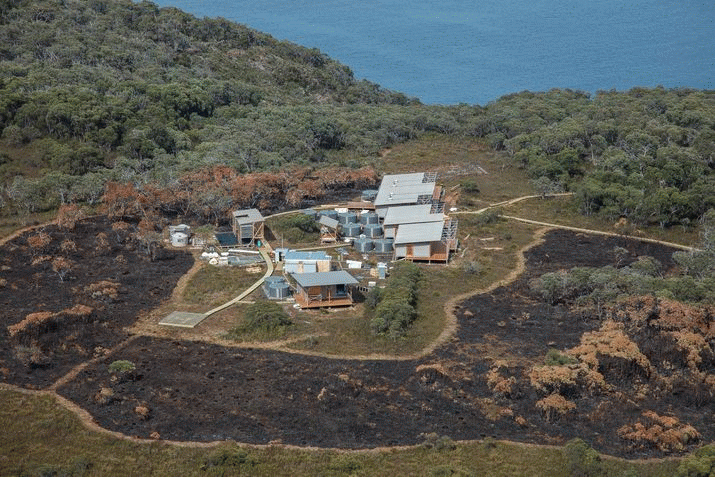
“The three hut complexes and 20km of new track constructed to access Cape Pillar have destroyed large areas of native vegetation, including threatened plant species, and have diminished the wilderness quality of the previously untracked western side of Cape Pillar.
“The attached photos by Hobart photographer Rob Blakers, show the true scale and environmental impact of these recently constructed tax-payer funded hut complexes.
“Not only are there massive visual impacts, a large area of native vegetation has been cleared for construction of the massive accommodation huts, the access tracks and duck boards, a large fuel reduced area, water tanks and helicopter landing site.
“The huts are more accurately described as a small village and are an ugly blight on the landscape of a once wild part of the Tasman National Park.
“Tasmanians should be worry that three capes style developments will be approved for the Tasmanian Wilderness World Heritage Area. Now they are built I wonder how many Tasmanians think the three capes huts are sensitive and appropriate?
“The Three Capes Track has been and continues to be a large drain on tax-payers. Already $25 million dollars has been spent on the eastern half of the Three Capes Track and, because income from walkers will not cover the operational costs, tax-payers will be subsidising the operation of this luxury tourist attraction.”
Tasmanian Conservation Trust Inc
Ph: 03 62 343552
2nd fl, 191-193 Liverpool St, Hobart 7000
Email : [email protected]
Fax: 03 62 312491
Web: www.tct.org.au
EARLIER, Ted Mead on Tasmanian Times …
• Plug and Play … the Neo-Wilderness Experience
• If You Go Out in the Woods Today You’re in for a Big Surprise …
• Ted Mead in Comments: I think the government’s estimates so far is that it has cost over $40 million. The Keep the Capes Wild Group estimated that it would cost $62 Million to complete. Our figures may turn out to be conservative. If the government undertakes the construction expenses for more commercially exclusive huts the cost would most likely exceed $100 million …
• Doug Nichols in Comments: As if the sense of being in nature hasn’t been diminished enough by the relentless miles of duckboarding, the posh huts and the connectivity, there will apparently be art works dotted along the track. Why stop there? What about flower beds, little ponds with fountains, newspaper stands, and nice cafes at the popular lookout points?
• Luke Martin: Conservationists now applying anti-forestry tactics to tourism Tourism Industry Council Tasmania CEO, Luke Martin, today accused conservation groups of selectively releasing images of the Three Capes Track project to mislead UNESCO representatives in the State last week about tourism in wilderness areas …
• Luigi in Comments: Luke Martin: “Conservationists now applying anti-forestry tactics to tourism.” I think Luke means: “TICT now applying Forestry Tasmania practices to wilderness”.
• Ted Mead in Comments: … Without that knowledge then your opinion is worthless beyond what your seemingly pro development ideology may suggest! Development area percentages have little to do with wilderness quality – it’s about the integrity of a region assessed on an area’s remoteness and naturalness values. Prior to the 3 Capes development – the Lunchtime Creek region had a wilderness index value of around 13/20. Being a rare example of wilderness on the East Coast – That NWI value there has now almost been halved.
• Chris Harries in Comments: … The next generation of leaders then says: “What if we just make a nip and a tuck here, it will hardly matter?” And so it goes. There will never come a time in history when everyone is happy and says: “Enough is enough, let’s stop right here”. In 50 years time the Luke Martin’s and Will Hodgmans of the world will be arguing the same. And a little bit more natural quality is again… and then again… lost forever. The ultimate end point is a total subjugation of all of nature.
• Leo Schofield in Comments: Who designed this shocker? It looks like an aerial view of Auschwitz … When I did the Cradle Mountain Huts walk some years ago I was bowled over by the environmental sensitivity of the developers. Helicopters were not allowed to land near the huts but had to hover overhead and lower supplies in huge nets, then remove rubbish in the same way. Now I see this new development has a helipad? Can a landing strip for light aircraft be far behind? A MacDonald’s outlet? An eco-friendly laundrette?
• Peter McGlone in Comments: In response to Luke Martin’s comments regarding Three Capes Track: – He must be joking by encouraging “Tasmanians to visit the site and see the development for themselves”. Is he going to pay the $500 fee? – Mr Martin claims that “less than 0.2 per cent” of the Tasman National Park will be affected by the clearing for the Three Capes Track. The impact is not limited to this 0.2%, especially in areas of wilderness. This is like the proverbial nail hole in the Mona Lisa. Also, there is not meant to be any clearing of native vegetation in National Parks. How much clearing is acceptable? Another 0.2% or another 2.0%. …
• Robin Charles Halton in Comments: The days of the Tassie bush hut experience have gone. I agree with all of the comments, the whole wildness experience has gone, dreadful next will be the upgrade to Sapphire standard. Had it been me I would have done the burning different, earlier in the season when the open and closed fuel moisture would have sufficed allowing the fuel reduction to peter out naturally by late pm. The area would have greened up by now but over a broader area. Double tracking is not necessary for that reason and is also overly obtrusive. Its a laugh the visitors will be now able to interact with the charcoal blowing in their faces on a windy day.
• Doug Nichols in Comments: I’ve just come back from a few days on Maria Island. While we were there we spent some time trying to find the huts (or perhaps they should be called standing camps?) run by the Maria Island Walk people. We knew from their website roughly where to look, and we were passing right by one of the sites on Wednesday on a walk to Haunted Bay, so we had a look. We failed to find it on the way there, but with a more determined search on the way back we found it. I saw nothing to object to in that development. The huts were discreet to the point of being invisible unless you tried hard to find them; they aren’t built in an area previously wild and completely undeveloped; the groups use beaches and existing tracks to get about the island (no relentless duckboarding across wilderness); no bush was burnt around the site; there are no helipads or artworks. In short, the footprint for the whole enterprise is, in my opinion, acceptably small. The contrast with the Three Capes is huge. To me the Three Capes project seems to be exploiting and changing the landscape, rather than merely facilitating people’s enjoyment of it. (In a nutshell, that is also my objection to the Mt Wellington Cable Car.)
• Chris Harries in Comments: I’ve come across these Maria camps too, Doug, and didn’t object. But recently there’s been publicity surrounding the purported need to ‘develop’ Maria Island more and I presume the state government is thinking along the same lines of how to make the most money from the island – having taken a basic political position that natural resources have no other purpose than to feed the economy. People who go to Maria like its quietness and safety for children and low profile amenities so there’s always a bit of trepidation as to what sort of development will eventually ensue there.