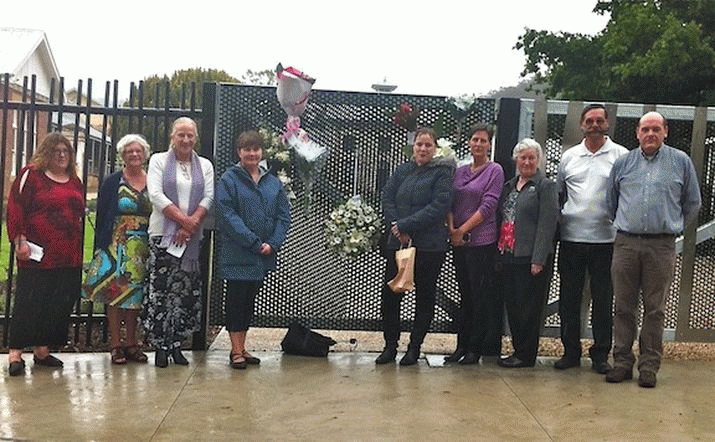
*Pic: Yesterday a small group of people gathered outside the gates to Willow Court (RDH) where they heard first hand accounts of the experiences of children who were patients. There was also a roll call of the names of children who died whilst patients.
When thinking of asylums and other similar institutions, there is a tendency to think only of adults.
For some reason the children become invisible.
They become the voices we never hear and the suffering we never see, and perhaps it is because of that suffering that they become invisible victims, because society would rather not know what happens to children behind locked doors.
No child should be in an asylum, yet during its 173-year history, the Royal Derwent (Psychiatric) Hospital (RDH) held hundreds of children.
A 75-year government moratorium on patient files makes it difficult to determine exactly how many children were in the Royal Derwent in the fifty years before its closure, but the number was substantial.
Many of the children had intellectual and physical disabilities, while others had mental health issues.
There were also the troublesome, aggressive children and adolescents whom society preferred locked away, out of sight and out of mind. And then there were the young girls diagnosed with ‘Moral Mania’ because they were caught having underage sex outside of marriage and who would spend years detained against their will as punishment for shaming their families.
December 2015 marks the 15th anniversary of the closure of the Royal Derwent so it was an appropriate time to remember the children and acknowledge the suffering they endured.
Yesterday a small group of people gathered outside the gates to Willow Court (RDH) where they heard first hand accounts of the experiences of children who were patients. There was also a roll call of the names of children who died whilst patients.
Ms Cassy O’Connor, MP, was guest speaker.
The Derwent Valley Mayor, Martyn Evans, and two councillors also attended, along with residents of New Norfolk and Hobart.
Wreaths and bouquets of white flowers, representing purity, were laid, each one carrying a card with the names of deceased children patients, some of whom were as young as three and six years of age.