First published October 9 …
On the back of four years of dry and the shadow of El Niño looming large, recent rains across parts of inland Queensland must come as great relief. While plenty of follow up will be needed to restore surface water stores and recharge aquifers, we should be thankful for such mercies.
As I sat down on Thursday morning (November 5) to start this piece, it began raining proverbial “cats and dogs” in Melbourne, bringing relief to parts of Victoria, including my garden (the 2-3 cm of rain that fell across Melbourne was twice as much as fell in all of October).
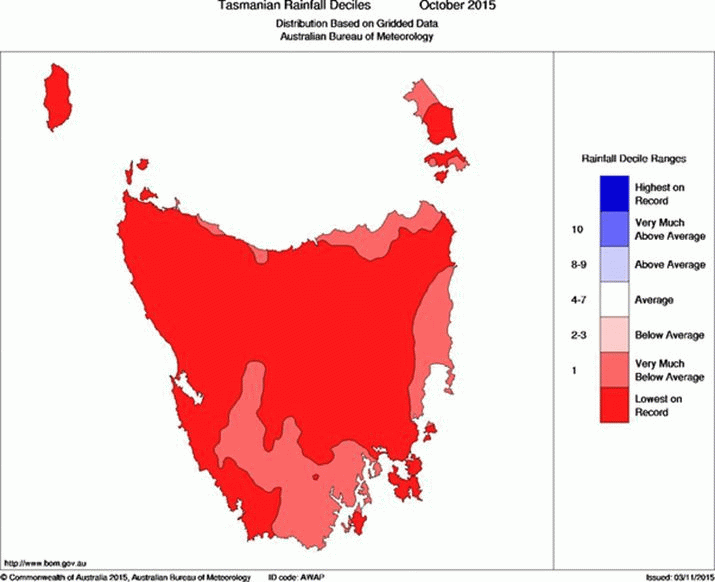
However, the news is not so positive in Tasmania, which seems to have largely missed out on rain again, after several near record dry months.
And that is compromising the health of Tasmanian hydro storages. By the end of October, Tasmanian hydro capacity was already below 30% capacity, and falling calamitously, despite a dramatic reduction in Tasmanian hydro power output.
I presume that in an attempt to shore up storage capacity, Tasmanian hydro output has been substantially reduced in recent weeks. And that has implications for energy flows and generation across the National Electricity Market. Because reduced hydro output is compensated by Latrobe Valley brown coal generators, and further along the chain by black coal generators in NSW, CO2 emissions from our electricity sector have rocketed.
In my last post, just a few days back (“Winds of – not so much – change”), I commented on the way wind was impacting the Victorian energy market at the margins. While wind generation was lowering the emission intensity of Victorian power supply, it was overwhelmed by countervailing forces unleashed by the uncertainty of carbon policy.
And that has everything to do with the way the hydro resources have been used, quite legitimately, over the years of carbon pricing when capacity of hydro dams was drawn down.
The problem now stems from the fact that our largest hydro reserves in Tasmania have yet to recover following repeal of the carbon tax in mid 2014. With developing El Niño conditions, no one can be certain when that recovery will occur.
More concerning …
Read more here, where there are further graphs and hyperlinks …
• Chris Harries: A short potted history of Tasmania … and its water storages …
It’s probably useful here to add a short potted history …
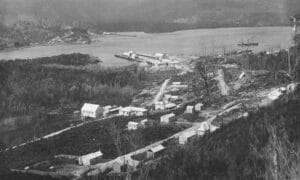
Tasmania progressively dammed its rivers throughout the last century and generally matched growing power demand by doing this until the 1960s. We burned no coal in power stations, though the burning of firewood was the main space heating source.
This success-story turned sour in the 1960s when a 5 year drought left the state with critical shortage of supply over demand. In 1968 severe power rationing was introduced.
An emergency Bill was passed by the state legislature to enable the Hydro Electric Commission to purchase three Rolls Royce gas turbine engines and hook them up to the grid. A New Zealand frigate was also bought and this ship was docked at Bell Bay and the ship’s generators were run flat out, also feeding into the grid. Street lights in Hobart and Launceston were turned off and Daylight Saving was introduced for the first time in Australia – as a calculated power-saving measure.
None of this was enough. The state’s metallurgical smelters were ordered to cut back power consumption and this resulted in the Comalco aluminium smelter having to turn off one of its furnace potlines.
The upshot of all this was that the state government decided it could not rely on the hydro-electric system without back-up to provide the state’s power needs. Consequently a decision was made to install an oil-fired power station in the Tamar Valley. Unfortunately this decision was made just prior to the Arab Oil Embargo and, once built, operating the power station became immediately unaffordable and so it was essentially never used.
For the next 20 years a combination of further dam construction and normal weather conditions enabled the state to be self-sufficient in hydro electricity. However, with most of the state’s river systems already dammed, and with growing power demand (most homes have converted from wood heating to electricity) the state’s power system was again very vulnerable to any unanticipated drought.
To forestall another calamity, as had happened in the 1960s, a decision was made to install an undersea cable from the mainland. This was largely done on a pretext of exporting renewable energy at a price advantage. Again the weather intervened immediately following Basslink’s construction and so for the first few years of its existence the primary function of the link has been to shore up Tasmania’s energy security.
Now … though there was also an opportunity for Hydro Tasmania to opportunistically trade into the high-priced peaking market, even this advantage soon withered away. As manufacturing activity in Australia declined so too did national power demand. To make matters worse, gas-fired power came onto the scene on mainland Tasmania and this has further reduced Hydro Tasmania’s profitable trading opportunities. The business case for building a mooted second Basslink cable has thus been sunk for the medium future at least.
The last bit of the story is as we know now. Having some superb wind power sites in Australia, some wind capacity has been added to the Tasmanian system, providing some limited drought proofing, but a protracted El Nino means that significant amounts of thermal power will need to be imported to shore up water storages.
One lesson to be learned is not to put all you eggs in the one basket. A diversified power system delivers best security. This applies to all forms of power generation. Australia relies far too much on coal.
• Claire Gilmour in Comments: … The upshot of all that is … in my learned opinion, and as the TFS recently ultimately inadvertently reiterated … Look after yourself and trust your own instincts … Because the government and their agencies aren’t prepared! Communication is the key … Act and force authorities to act promptly … it’s not a ‘she’ll-be-right mate scenario. To FT I say … you’re a huge risk! To TFS I say … put the fires out sooner rather than later. To the government, members of parliament and political parties I say … your policies, inaction and selfishness, can kill lives and communities … and in more ways than one!
• When will ‘they’ wake up … or won’t they? Graphs of October 2015 rainfall and maximum temperatures … and download expert articles on those dying trees …


• Download …
Fenner_School,_Monaro,_Catherine_Ross,_Viminalis_00049158.2015_.pdf
The_Conversation_15_October_2015,_Dying_trees,_viminalis.docx
• Surging Seas … Mapping Climate Change: There goes Kingston Beach, Opossum Bay becomes an island and Wrest Point in danger … The question is: Do UTAS administrators ever talk to their climate scientists? UTAS is moving to an area which will probably be under water even with the two-degree rise that’s probably unavoidable by now. • See more of these fascinating graphic predictions – for anywhere in the world – HERE
ALSO …
• EMRS poll of voting intentions: Libs remain cock-a-hoop … read for yourself HERE