
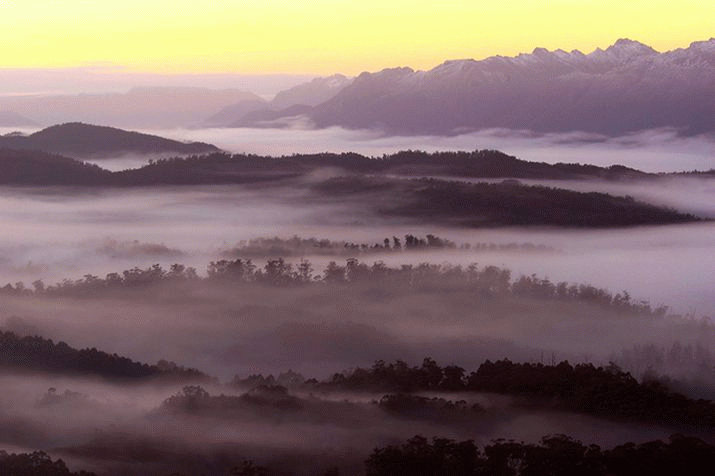
Dawn across the expansive Tasmania’s Wilderness World Heritage Area. Pic: Ted Mead
The whole concept of rewilding the earth makes sense, yet in a reserved view one deeply ponders on its possibility. In a new, to be released publication, Half Earth – Our Planet’s Fight for Life renowned biologist, naturalist and author EO Wilson builds on his futuristic proposal to set aside 50 percent of the earth for the preservation of biodiversity.
In this highly anticipated publication EO Wilson proposes to establish huge biodiversity parks to protect, restore and interconnect natural habitats throughout the continents. Wilson advocates that these parks should have people integrated into them; people as environmental educators and managers. Although this is not entirely a new idea as many other conservation movements and societies in the USA have mooted such models, Wilson’s idealism seems drawn from existing conservation projects like the Area de Conservación Guanacaste (ACG) in Costa Rica.
Behind Wilson’s ideology is the knowledge that we are within the sixth great extinction event in earth’s history. Today more species are being lost than at any time since the Homo sapiens roamed the planet. This is a direct result of modern human depredations relating to habitat destruction, overpopulation, resource depletion, and climate change.
Meanwhile back in Tasmania we are in an ideal position in the world to fulfill such a goal. With around 35% of the Island’s land mass set in reasonably secure reserves it would be quite feasible to almost achieve a 50% target with the greater expansion of the Western Tasmanian Wilderness World Heritage Area to an extent of over 2.5 million Hectares.
What a global statement that would be, and as legendary explorer and photographer Olegas Truchanas stated almost half a century ago … “Tasmania can be a shining beacon in a dull, uniform and largely artificial world”

…
Wilson’s half-earth ideology is primarily focused on an environmental rather than anthropocentric, which appears to be a dichotomy from his 1993 publication. The Biophilia Hypothesis.
In his more recent view he states – “What kind of a species are we that we treat the rest of life so cheaply? There are those who think that’s the destiny of Earth: we arrived, we’re humanizing the Earth, and it will be the destiny of Earth for us to wipe humans out and most of the rest of biodiversity. But I think the great majority of thoughtful people consider that a morally wrong position to take, and a very dangerous one”.
If we look at Tasmania’s history since European settlement it would clearly attest that in just over 200 years we have become a highly anthropocentric culture driven by resource extraction ideology, and one that appears in general to be disassociated from a harmonious connection with nature. This marvels to the fact that somehow (through federal government interventions) we have managed to preserve a significant portion of our island’s primeval areas into secure reserves despite the representation of conservative politics on both sides of the fence.
Of course underpinning Wilson’s view for the restoration of the earth’s biodiversity is the need for the human race to develop an ethical value that considers all forms of life and ecosystems, rather than placing the privileged values of Homo sapiens above everything else.
Without a global initiative to towards obtaining goals such as Wilson advocates, modern projections regarding the loss of biodiversity and animal species on the planet over the next half century look severely grim through climate change alone. Up to 50% of all mammals species are predicted to become extinct by 2060, which is dire considering it has been estimated that it would require the preservation of somewhere between 30% to 70% of the original natural habitats on earth to sustain our planet’s biodiversity.
There is no place more ideal than Tasmania to reach Wilson’s half-earth goal. I’m predicting the year 2025 for the next inevitable amendment of the Tasmanian Wilderness World Heritage Area, which will include the Tarkine, the West Coast Ranges and South of Macquarie Harbour.
It will be a world-class reserve of monumental significance …
• Nicole Anderson in Comments: I wholeheartedly agree Ted, that Tasmania stands in very good stead to be rewilded. I live in the hope this will be one day a reality. I am however concerned with the persistent push to increase the population – of humans and our commercially profitable livestock – given that it is demonstrated quite well that the population of these we already have has contributed to so much of the environmental degradation. Population control is paramount across the board to limit climate change and pollution. With Tasmania also being so suited to agriculture (which I thoroughly endorse diverse, small scale and carefully planned ventures) I see a looming problem with intensification of industrial agriculture competing with native vegetation and water quality unfolding, not to mention the biosecurity risk which comes with crop monocultures and massive cattle farms. I feel promoting and preserving biodiversity is reaching a critical point, yet the word is barely known up here in the northwest.