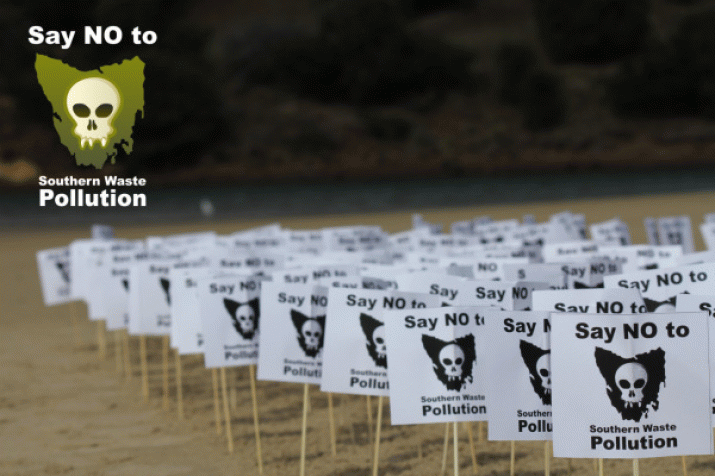
Southern Waste Solutions (SWS), have discontinued their legal action against Southern Beaches Conservation Society (SBCS) and Angela Marsh but SWS has not given any reason why it dropped the case. “In our opinion this was nothing more than a SLAPP suit, that was completely unwinnable, to shut us up,” says Angela Marsh.
The case was discontinued on condition that SWS does not bring another case like this against SBCS or Angela Marsh. SWS will need to pay SBCS’s and Angela Marsh’s costs. These costs will be determined by the Supreme Court early next month. The case could cost SWS up to $100,000, relative to lawyers costs.
The voice of SBCS was effectively stifled for 18 months for sending a letter of concern to major companies in Tasmania, requesting they undertake due diligence regarding the risks of a municipal Authority tip at Copping taking responsibility for level 3 (controlled) waste generated by their companies. This hazardous waste may contain lead, cadmium, mercury and over 150 other toxic materials.
While being relieved by the discontinuance of the case against them, SBCS maintains that if the case had proceeded to trial their concerns that the landfill site itself, as well as the proposed Controlled Waste cell, does not meet the 2004 Sustainability Guide, would have been validated. SBCS will now press its campaign even harder to stop this proposed C cell.
SWS has an application to fund the C cell before the Department of State Growth. This would be a “last resort” application as SWS was unsuccessful in their application to the Regional Development Australia Fund, has not been able to secure private investor funding and has no large corporate customers to warrant the $11million price tag for the C cell. SWS has not released its business case for the tip. The development is shrouded in secrecy.
Should the funding application succeed, this would effectively mean that the Tasmanian Government is being asked to spend $11mil to construct a hazardous waste cell in a landfill facility owned by local municipalities, to house hazardous waste from large corporate enterprises. Disposal of waste to the C cell may also extend to International Antarctic Treaty Nations, in opposition to the general tenets of the Basel Convention that seeks for generating nations to repatriate their own hazardous waste from the Antarctic. In reality this waste would then become the responsibility of municipal ratepayers.
Tasmania does not need a C cell. Tasmania needs the State Government to take responsibility for waste management, adopting the National and International Waste Management Hierarchy. A government strapped for cash should not contemplate spending $11mil on a hazardous waste dump.
The proposed investment in a landfill development is at the expense of investment in alternative waste management technologies for reprocessing hazardous waste and reusing part or all of the materials therein. This is in the context of Tasmania having the worst record in relation to diverting waste from landfill in the nation (excluding the NT).
• ABC: Legal action dropped against hazardous waste dump campaigners