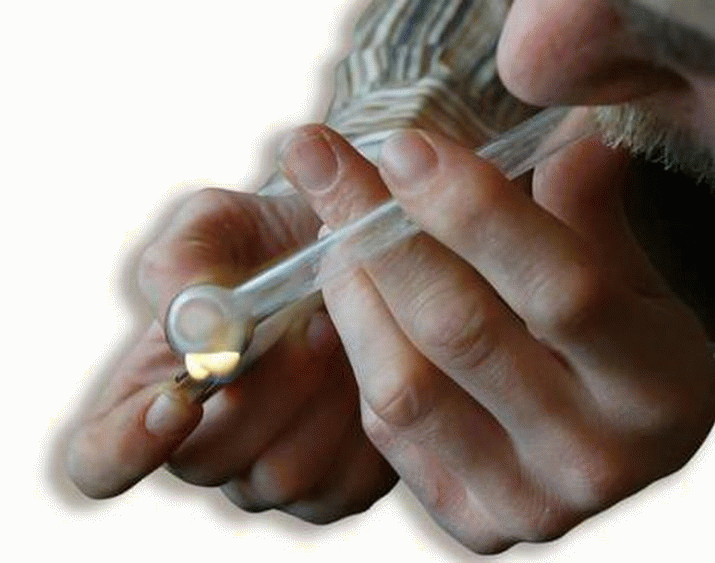
Ice is a hot topic right now. Amphetamines have been around a long time, Ephedra sinica has been used for 5000 years in traditional chinese medicine.[1]
Synthesized methamphetamines were doled out to troops in World War Two to give them the edge in battle, and have been prescribed for a range of conditions such as depression, obesity and attention deficit hyperactivity disorder.[2]
But why is it that problems associated with their use are experiencing such a rapid rise? Is it that ice is a particularly dangerous and addictive drug which is spreading like a plague?
The problem
The particular problems with the short and long term effects and the addictive power of ice are due not only to the use of rapid absorption delivery methods such as smoking, snorting, or injecting, but also due to its greater purity over other forms such as speed; leading to increased strength of effect and increased chance of overdose. [3]
Basically this is the only thing that has changed in the last few years. According to the Australian Drug Foundation, the rate of amphetamine use hasn’t vastly increased, still being steady at around 2% of the population over 14 using them at least once a year, but the relative purity has increased, as ice now makes up 50% of amphetamine use, hence the increase in ill effects and hospital admissions.
Australian Drug Foundation: Statistics
The drugs which place the greatest burden on society are still alcohol and tobacco, and even the abuse of antidepressants and painkillers still trump amphetamines in the distribution of bads. But nevertheless we still have a problem with drug abuse in general, be it legal, illegal, or the constantly shifting legal ground of new synthetics of variable safety.
Even caffeine, the socially acceptable stimulant, has skyrocketed, with the side-effects of energy drink bingeing earning it a place in hospitalization statistics.
By all counts the overall drug abuse problem is significantly higher than it was in the so-called drug-fuelled 60s and 70s.[4]
Although the levels of use of some drugs, especially nicotine, have shown some decrease in previous years, the misuse of pharmaceuticals has increased, and overall drug use remains at a consistently high level compared with the past.[5] This plateau does however offer some hope that either strategies are working, or that drug use has reached a saturation point.
Possible solutions
There has been plenty of talk of the problems of drug use and recently of ice in particular, and plenty of proposed solutions, the most prominent of which were well covered in a recent ABC article.
But what often gets glossed over in the debate are the likely causes. This is the realm of preventative medicine which is often overlooked. It is a difficult area as often there are co-factors, and the direction of cause and effect can be difficult to establish. Does the drug use cause the problems?, or do the problems lead to the drug use? Sometimes, however, especially on a case by case basis, the questions can be easily answered. As Senator Lambie has offered herself and her family up as a public example already. I will attempt to bring some clarity to this case study based on the limited information available.
Australian Story: Getting the hang of it
Tasmanian Times: Lambie’s heartfelt plea for mandatory detox
Genetics and environment
The age-old nature-versus-nurture debate, which can rarely be adequately studied except in the rare case of identical twins separated at birth. There are identified genes indicating a predisposition towards the addiction affecting 10% of the population, but they may still require an environmental trigger to be switched on.[6] Other environmental factors include drug abuse by parents, the often-cited low income and lack of employment opportunities, as well as the general quality of the home environment.
In the case of the Lambies, it is possible they share a genetic vulnerability, but it is also obvious that circumstances beyond her control were a contributing factor to Jacqui’s addiction, and by her own admission, her addiction was a contributing factor to her son’s. It is clear that the her injury and the government’s eventually overturned decision to strip Jacqui of her military pension became a catalyst, and that leaving a seven-year-old to care for a drug and alcohol addicted parent was unreasonable.
A recent one-hour strike action by child protective services in New South Wales is not an isolated case, as unions in other states have also highlighted the failure of governments to ensure that children have the right to live in a safe environment.[7]
Trauma. This may be violent, sexual, emotional, or accidental. Studies have shown both that a high percentage of people receiving treatment for substance abuse have experienced trauma, and that people who experience trauma are much more likely to develop substance abuse issues. [8]
In Jacqui’s case it was physical injury, and the aftermath previously described. In her son’s case it was having to live with a parent who was constantly on the brink of death.
Ironically one of the most promising treatments for Post Traumatic Stress Disorder (PTSD) is actually amphetamine based. Administering MDMA (3,4-methylenedioxy-methamphetamine, or ecstasy), during therapy sessions was three times more effective than therapy alone. [9] Attempts to hold similar trials in Australia have faced difficulties. Another promising PTSD treatment; camp-like outdoor peer support programs for returned military personnel, has received little research focus or funding from the Australian Defence Force.[10]
Mental illness
This can be through a combination of genetics, environment and trauma. While reading statistics of the high associations between drug use and mental illness it is sometimes difficult to attribute cause and effect, as the relationship between drugs and mental illness can be two way. A telling example, however, is the fact that nicotine use among people with mental illness has been shown to be at least two to three times the rate of the general population, and far from causing symptoms, it has been found to improve them.[11]
State mental health services, both inpatient and outpatient, are barely adequate. Something I can personally attest to.
Health funding in general has barely met demand in Australia in recent years, and lapses in treatment of both physical and mental conditions at the less acute phase lead to greater costs in treating acute conditions.
Medicare funding for psychologists has been reduced, and the guidance counsellors once a fixture of most schools have now been replaced with chaplains who lack the training and qualifications to deal with more serious problems.
There have been the addition of headspace centres for teens and adolescents, but these have come in part at the expense of services in some remote areas not serviced by headspace or services for other age groups.
State, federal and private funding for mental illness is around $330 a year per person, or the equivalent of one and a half psychology sessions. This amount includes funding for inpatient and outpatient services as well and medications.[12]
Considering one in five Australians experience mental illness every year,[13] even a $1650 figure for each of these individuals isn’t going to pay for much treatment, as evidenced by the Australian Bureau of Statistics data which show that one-third of people with mental illness don’t have their treatment needs met by the current system.[13]
Personal choice and peer pressure
It is difficult to argue that personal choice is the sole determining factor where other causes are involved. While some may use drugs socially or recreationally, unless this progresses to addiction is is difficult to characterise this as abuse. Moderate alcohol use is not referred to as abuse, hence for other drugs legality should be treated as a side issue, especially as it varies by jurisdiction.
There are some who would say that to bring up any of these factors is an excuse or an attempt to apportion blame to society rather than the individual. It needn’t be a case of either or, as the responsibility could be shared, but this argument brings to mind another potential cause of drug abuse which has recently been so well summed up by Will Hutton in The Guardian:
The Guardian: Perhaps it is not just Nic Kyrgios, the bad boy of tennis, who is losing control
Yes, the old Culture wars. The difficulty of looking at the causes of social problems is it requires us to have a long good hard think about the sort of society we want to create, and how we should create it. Few would argue that growing up in a combative household is ideal for a child, yet these are the sort of cultures which are prevalent and even rewarded in government, business, and sport. And the more life becomes a game of war, the greater the temptation to take the performance enhancing drugs once doled out to warriors of the past.
[1] http://www.rcpe.ac.uk/journal/issue/journal_41_1/lee.pdf
[2] http://www.pbs.org/wgbh/pages/frontline/shows/drugs/buyers/socialhistory.html
[3] https://ndarc.med.unsw.edu.au/sites/default/files/ndarc/resources/ICE%20FACT%20SHEET%202.pdf
[4] http://ndarc.med.unsw.edu.au/sites/default/files/ndarc/resources/TR.228.pdf
[5] http://www.aihw.gov.au/WorkArea/DownloadAsset.aspx?id=60129549848
[6] http://www.ncbi.nlm.nih.gov/pmc/articles/PMC2715956/
[7] http://www.smh.com.au/national/child-protection-workers-go-on-onehour-strike-20150318-1m2p3p.html
[8] http://www.nctsnet.org/nctsn_assets/pdfs/SAToolkit_1.pdf
[9] http://www.ncbi.nlm.nih.gov/pmc/articles/PMC3122379/
[10]http://jmvh.org/article/peer-outdoor-support-therapy-post-for-australian-contemporary-veterans-a-review-of-the-literature/
[11] http://www.nationaldrugstrategy.gov.au/internet/drugstrategy/publishing.nsf/Content/FE16C454A782A8AFCA2575BE002044D0/$File/mono71.pdf
[12] https://mhsa.aihw.gov.au/resources/expenditure/
[13] http://www.abs.gov.au/AUSSTATS/[email protected]/Lookup/1301.0Chapter11082009%E2%80%9310
Ben Cannon is a lapsed writer and musician originally from northwest Tasmania. He is presently living in Melbourne … with an adopted cat and the possum who may or may not reside somewhere in the roof and who has a penchant for apricot leaves. Ben is studying a Bachelor of Health Science with a focus on Naturopathy. He has previously been diagnosed with schizophrenia, and has experienced a broad spectrum of treatment options along the often winding path to finding a tailor-made mix of psychotherapy, philosophy, medication, diet, and lifestyle, that may well go beyond mere management of the often misunderstood condition.