

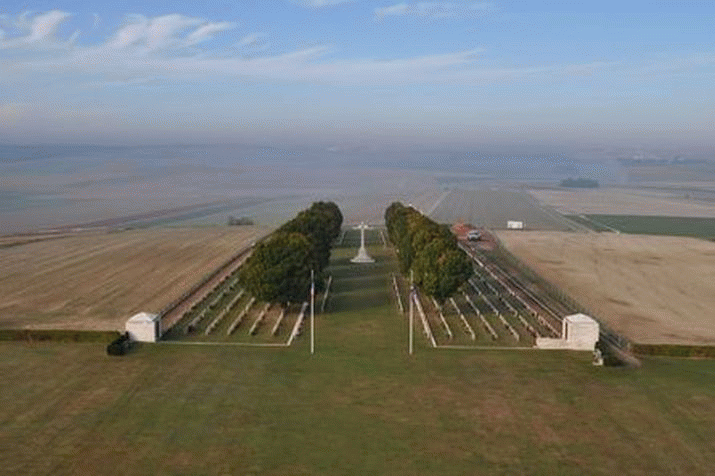
*Pic: View from the top of the Australian memorial at Villers Bretonneux, the Somme …

Charles Wooley … 60 Minutes
I was running late. My alarm had failed to go off and I left the hotel in a hurry without the kick-start of coffee. As my cab passed Sydney’s Martin Place en route to the airport I spotted the Lindt Café and decided I really needed a takeaway.
It was about 8.30 in the morning and the café was much as I remembered it from the briefest visit before the grim events of the past summer. Its beige and chocolate décor seemed unchanged and although less than a quarter full, there was still the usual mix of office workers and early shoppers at the shiny black tables.
The place seemed relaxed. Too relaxed. The service was slow and the coffee, when it arrived, was tasteless and too hot to drink. Though to be fair, the young man at the espresso machine was still getting on-the-job training. It may be that experienced baristas are not exactly lining up yet, to work at the Lindt.
The ‘Sunrise Show’ was still in full swing in the Channel 7 building across the road and it was too early for happy tourists to be in the café. They would fill the place later in the day, because wherever grim events have taken place, be it Auschwitz or Port Arthur, a dark tourism persists for a long time.
But do the sightseers ever get the taste of the real human horror they are looking for? I doubt it. A book or a movie will always be more informative than the act of merely being there after the event.
I have been to the Burma Railway and heard about the horrors of that place first hand from the men who had slaved on it for the Japanese. Without their company I would probably have learned more about what it had actually been like back then, from Richard Flanagan’s recent novel. When I travelled up that “Narrow Road to the Deep North” more than a decade ago, the scenery was breathtaking.
Bizarrely, Hellfire Pass, where it is said that one Prisoner of War died for every sleeper laid, was a place of astounding beauty. So much so, it was full of Japanese honeymooners laughing and waving into their cameras. They had been taught nothing about World War Two and even less about the atrocities their countrymen had inflicted on tens of thousands of Allied and Asian prisoners.
So how could they understand anything now? What could they learn where Hell had become just another tourism wedding destination, and where Nature had so well disguised the inconvenient horrors of the recent past?
I’ve been to death camps and killing fields, almost always after the event, and have mostly come away with little or no idea of how humanity can plumb such awful depths. I remain convinced that for most of us, the unthinkable can often only be explained through the re-imagining of a writer or a filmmaker. Only art can truly reveal the worst in us.
Nature echoes the affairs of men … ?
In literature there’s an odd notion that Nature echoes the affairs of men: that skies can ‘brood’ and that rocks can be ‘cruelly unfeeling’. In particular it’s often asserted that in places where dark deeds have been done, a ghostly trace remains. The landscape never recovers. The sun never again shines so brightly, nor do flowers so vividly bloom and no birds sing. In literary studies this phenomenon is called ‘pathetic fallacy’ and I only remember that, thanks to the extraordinary persistence of my High School English teacher, Mr Spaulding.
In an old yarn, such romance is fine, but in modern reality we must all know that the storm the night before Caesar’s assassination, or a bright light in the sky before the disastrous Battle of Hastings, in 1066, are mere coincidences. Well, the latter was actually Halley’s comet. But any inklings of a real and present evil lingering in the death camps or the killing fields are only the products of our suggestible imaginations. And worse, they let humanity off the hook.
A million and a half people visit Auschwitz every year and pass through that infamous gate bearing history’s most cruelly ironic inscription “Arbeit Macht Frei” or “Work Makes You Free”. Four million people were killed in the gas ovens, but, does Nature, more than half a century later, still echo the horrors of what happened in that place? Well not on the day I was there. It was sunny and in the woods beyond, the world was in flower and the birds were singing.
Still the death camps should be visited, not as some spooky tour, but as an attempt to fathom how one of the most civilized nations on earth, the birthplace of Bach and Strauss and Schiller and Goethe, could somehow descend into a nightmare of depravity. That is the question, which should be for all of us, far more frightening than any ghostly intimation.
Each year two hundred and fifty thousand people visit our own monument to ‘man’s inhumanity to man’, Port Arthur. Mixed in with a genuine interest in the past, the sightseers are also titillated by the horrors of the place.
The solitary confinement cells where men were sent mad, and the floggings, where a hundred and fifty lashes were considered an instructive punishment. Like all Tasmanian school kids I was raised on that terrible history and so, I was absolutely amazed at how I felt, when I first went there on, once again, a perfect day.
Immediately, the serene beauty of that lovely ruin struck me and from that first day on, Port Arthur has remained in my mind, even despite more recent horrors, as being one of the most tranquil places I have ever experienced on our disturbed planet.
Visiting the fields of Flanders and the Somme last year, where at least four million young men, forty-six thousand of them Australians, died in a pointless war, I was again amazed at the beauty of the place.
The rolling green fields and the shining verdant woods bore no testament to the carnage and horror that had gone before. Walking down a sunny, winding French country road, with a lark singing on high, I came to the lonely conclusion that wise old Mother Nature is absolutely indifferent to the human condition.
She’s right of course. Our appalling behavior, as a species, over the past century, is simply beneath contempt.
First published in Mercury’s Tasweekend
• Ted Mead in Comments: Nature will prevail. Human beings are merely a flicker in the evolution of this planet. History shows we cannot live in harmony within ourselves or with mother-nature as we recklessly destroy the very life-thread that supports us. Time will attest, as we are the only species on earth that is capable of eradicating itself. Hardly a claim of a superior being. Nature in its purest evolving form will inevitably reclaim its dominance on earth after we cease to exist. Essentially the Homo erectus has been spiritually retrograding even since we stood upright and crawled out of the caves. Many would believe that it would have been better if we had never come down from the trees in the first place.










