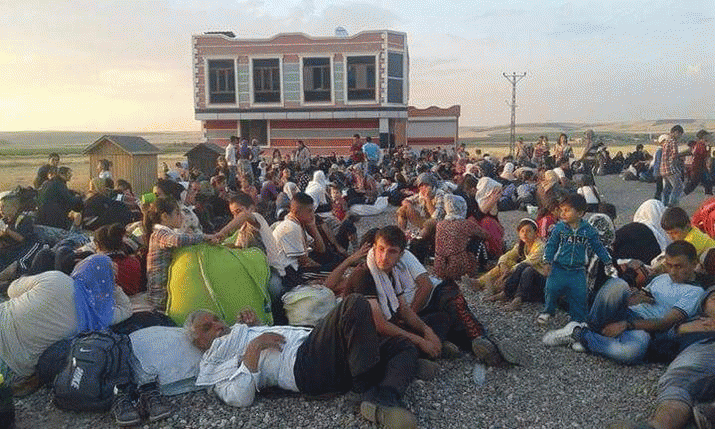
Yezidi refugees at the Bulgarian border. They were not permitted to cross into Bulgaria. Image provided by Hadi Aldakhi..Yezidi refugee

Nusaybin. Yezidi refugee camp. Under this tent live 4 families. Theyve been here for over a year. Image provided by Yezidi refugee..Hadi Aldakhi.


Images of the Yezidi camp at Nusaybin, Turkey. 5000 Yezidi are accommodated here. Unable to leave and impossible to stay for long. Children while away the days playing. Images provided by Hadi Aldakhi. Yezidi refugee.


*Pics: Hadi’s children and friends hiding under blankets at the border …
“We’ve lost everything we ever owned. All we worked for has been taken. Our dreams…our lives..Now..apart from what we have in our hands..there is nothing..” “Best case we start again. Worst case – I think – is too frightening to think.”
Those little words were being slowly tapped out on a mobile phone far across the world by Hadi Aldakhi, a young Yezidi father. Currently held captive in the Nusaybin refugee camp, south eastern Turkey, Nusaybin attracted global attention when authorities recently erected a 2 meter high, barbed wire wall along the Turkish Syrian border.
Hadi and his young family, together with about 5000 other Yezidi refugees are held in Nusaybin. Controlled by the Turkish Army, this form of detention currently provides both protection and incarceration. Here in the 45 degree summer heat and living in tents, with as many as four families under the same canopy people slowly normalise to lives placed on hold.
Living in these cramped conditions takes the form of suspended animation. Choices for self determination are limited and have a brutal kind of clarity. Live today under the conditions imposed by the Turkish government or return to Iraq and be hunted down and slaughtered like animals by Daesh.
Oppression is not new to the Yezidi. Over the last 400 years there have been no fewer than 74 campaigns of genocide against them. Their ancient Christian faith embraces a redeemed Angel whom in Muslim faith is banished to Hell.
This difference, combined with the poison from fundamentalist Muslims including Al Qaida and Daesh places the Yezidi culture at the pinnacle of the world’s most endangered.
Mt Sinjar
This was most evident when ISIL attacked the largely Yezidi city of Mosul in 2014, causing thousands to escape to Mt Sinjar.
“No country wants us,” Hadi tapped. “I dont know if you can understand..” We live in hope…but in the silence of the night…I wonder..for what ?”
He continued… “Life in the camp is shelter from Daesh..There is a school and we have some medical service. We are allowed out of camp during week days up to 10 times a month from 9am until 6pm. We are provided with 85 Turkish lire (about 25 Euro) a month for food..it isn’t much but we can just survive.
“The only country we can move to is Iraq, and that means we move to our death. There are 16,000 Yezidi in Turkish camps.. we all need to get to Europe where we can start again. Is it too much to ask that we live a good life ?”
The gateway to Europe for the Yezidi is Bulgaria. Once secured by 20th Century Communist walls to keep its people in, Bulgaria began installing a new wall in 2014. Now, with estimates that it is close to 100 kilometers long it is designed to keep refugees out. Over 200,000 refugees made their way into Europe in 2014, and beyond the humanitarian level – the economic and other challenges to governments are substantial.
There is the further complication that Daesh are sending terrorists through disguised as refugees. Governments have to be convinced to accept the Yezidi refugees under UNHCR section 11. The wheels of government, no matter what country and especially concerning refugees, turn at their own pace and time. To the Yezidi – the situation is well past desperate.
Another failure to find freedom …
“We are running out of spirit..” Hadi tapped out, achingly slow because of the network and its distance from my phone … we running out of answers …
“Many of us. This week. We pooled our money and we got buses to take us to the Bulgarian border. There were more than 30 buses and each took more than 50 people. It is a 36 hour trip and we got there on the buses. But when we got there. No one let us through..so we sat in protest on the road. We were in shock..we thought we would get through. So we sat. Everything we bring with us was placed on the road.
“The Turkish army came..we pleaded to let us through … women and children begging for our freedom to Bulgaria … our hearts breaking. Why do they not want to help us?
“Some of us..we could not speak..the crying was so strong.
“We got put back on the buses by the army and brought back. Some tried to get off in Istanbul but were forced back on.
“Now we are back in camp and have to live with another failure to find freedom.
“Hadi tapped on into the early hours of an Australian morning.
“I was a writer for the Iraqi army for 8 years … then … I bought a small shop and started selling mobile phones. We had a home. We started a family and I have two children.. I will send you a photo. …
In my shop … I had 60,000 and a new car. We had a life. Now. All is gone. All is gone. We live in hope … but I don’t know what that is. Yesterday. My wife ask me “do you think the world sees us?”