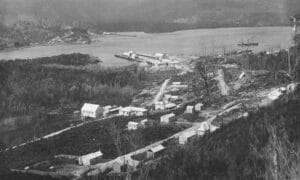

Surges Point from R. Crankle. Below PWB raffle drawing on July 12

Huon Valley Guessing Games
All’s quiet on the Waterloo Bay battlefront. The Surges Point shoreline remains untouched. Little sign of industrial activity other than the to-ing and fro-ing from Port Huon of Huon Aquaculture’s 75-metre Ronja Huon well-boat. Upriver at Huonville, barely a squeak out of Huon Valley Council (HVC), where one might imagine management is still smarting over its failure to persuade the Tasmanian Planning Commission (TPC) that council — “acting as a planning authority” — nor the commission has jurisdiction to hear marine engineer Dennis Bewsher’s applications to develop a bulk-loading and barge facility at Surges Point.
At least for the moment, the TPC has no more deliberating to do.
And the Protect Waterloo Bay (PWB) group is taking a breather after months of building its case against the Bewsher vision and campaigning to raise the $15,000 it estimated it would need to counter the joint Bewsher/HVC push to have the project approved.
It all adds up to a strange and threatening silence, especially since the Hodgman government let it be known a few weeks back that it was interested in private ventures offering a woodchip export facility in the state’s south.
There was one bit of public Surges Point-related activity. On Sunday July 12, outside Cygnet’s Southern Swan bookshop, a band of PWB volunteers gathered to draw a raffle that raised just over $2000. Not surprisingly, there was a bit of chit-chat about “What next?”, though no one had anything concrete to contribute. I did hear that one concerned ratepayer has been asking questions of council, and that, elsewhere, Bewsher-vision objectors are considering likely post-TPC scenarios.
Driving home afterwards, I got to musing on the possibilities, my first thought turning to what must have been the huge amount of cash Bewsher (and/or friends) ploughed into pulling together all the documentation required to compile his applications to HVC for a planning-scheme change (to acquire a lease on a strip of Crown land at Surges Point), and for approval to construct a substantial jetty and gain road access to the river from the nearby Huon Highway.
Did Bewsher spend $50,000, $100,000, $150,000, more? However much, it was enough for him to say he’d spent all his money compiling his case, and that, if his plan were approved, the money to finance the estimated $10-million project would not be coming from his bank account. One could have interpreted this as a suggestion that he’d sent himself to the brink of going broke (unlikely) to win permission to undertake an industrial venture for which he had no business plan.
Previous HVC mayor Robert Armstrong (now, tragically, a state MLC) has acknowledged that Bewsher had long been in touch with council (possibly as far back as 2013) about his vision. And, presumably, at some point along the way, council management had given Bewsher the impression that it would be OK for him to submit his applications. These, whether council approved them or not, would then be subject to final consideration by the TPC.
So, where to from here?
It was at Armstrong’s final council meeting — October 2014 — that the Bewsher applications first came on the agenda. As is normal, they then had to go out to public scrutiny. Of the subsequent 200 or so representations received by council, 188 were against approval.
Events since that time are well documented in TT, by the TPC and elsewhere. See:
http://iplan.tas.gov.au
http://oldtt.pixelkey.biz/index.php?/article/more-pie-in-the-sky-in-the-huon/
http://oldtt.pixelkey.biz/index.php?/article/huon-valley-guessing-games-the-waterloo-bay-fiasco/
http://oldtt.pixelkey.biz/index.php?/article/waterloo-bay-the-great-deceit/
http://oldtt.pixelkey.biz/index.php?/article/tpc-ko-for-waterloo-bay-barge-plan/.)
So, where to from here?
Dennis Bewsher. Considering how much money and effort he has put into chasing his vision, it is highly unlikely he’ll let the matter drop. But, just say he decided it was all too hard to carry on. Surely he’d want some recompense for having been sent on what he might construe a fool’s errand? Who sent him? By my reckoning, considering the timing of his lodgment of applications, it would be the council presided over by Robert Armstrong, who, presumably, would have been briefed by management as to whether council could accept applications of the nature of Bewsher’s.
So, unless Bewsher is in possession of information from higher up that the public is unaware of (say, from political interests that might be ready to contemplate a southern re-vamp of the state’s northern pulp mill farce), Huon Valley Council could well find itself a target for legal action by Bewsher for compensation for having wasted lots of his money preparing applications council didn’t have the authority to hear.
Protect Waterloo Bay group. This formed just before the January 28 HVC meeting at which the Bewsher applications came to council for a vote. In a series of PWB meetings that followed — and especially after the special March 12 meeting of HVC, when the Cr Mike Wilson-led Heart of the Huon group (but without the support of Cr Lydia Eastley) overturned council’s January rejection of Bewsher’s applications — the group worked on strategy and a means by which to finance it. It estimated its costs at about $15,000, a target that was just about achieved, thanks mainly to public donations. Now, because council bit off something it failed to realise it couldn’t chew, the PWB group knows it need not have raised or spent thousands of dollars on legal and planner services. Consequently, it might now consider asking council for its money back.
Deputy Mayor Ian Paul v. Cr Liz Smith. This was a strange, Waterloo Bay-related episode. For a couple of meetings, Paul demanded Smith apologise to council staff for being critical of its work on the Bewsher applications. Smith’s offence, it seems, was to suggest — in a note she distributed to councillors and later in her Waterloo Bay representation to the TPC — that staff reporting to council (perhaps even going back as far as last October) had been unbalanced (or something like that).
Smith seemed perplexed as to exactly what is was that Paul was wanting her to apologise for, and to whom. At one ordinary council meeting, Mayor Peter Coad said he had conveyed to Smith the substance of Paul’s complaint some days earlier. Smith responded that the letter had only just reached her and that she would be dealing with it.
Whatever it was that Paul was in a tizz about, it seems to have resolved itself. Paul hasn’t mentioned the issue again (as at the June 20 HVC meeting). Could this be because he was one of the five Heart of the Huon councillors who backed the council staff report that fell in a heap at the hands of the TPC in June. (Crs Smith, Coad, Rosalie Woodruff and Lydia Eastley, on the other hand, had stood up for the wishes of the huge majority of representors who had indicated that Bewsher’s vision would not be good for the valley — environmentally, socially or economically.)
It now looks as if Paul stirred a storm in a teacup. But one should never discount the possibility that his attack was part of a wider Heart of the Huon team strategy play. This group, a successor to HVC’s less-than-illustrious past ruling groups, seems determined to keep the valley council mired in the go-nowhere ways of yesterday.
This, of course, means taxpayers’ costs …
HVC’s costs. This, of course, means taxpayers’ costs. Who knows! Where do you start counting? Presumably from even before Bewsher was told HVC (acting as a planning authority) was the place he should lodge his applications. Since then — what with council’s processing of the applications (which would have amounted to hundreds of hours of labour); and consultations with outside lawyers to foil council’s initial dismissal of the Bewsher applications in January, and again after the TPC said it couldn’t see that it had jurisdiction to deal with what HVC had sent to it — council costs must have been substantial.
Knowing how lawyers charge, it’s mind-boggling how much taxpayers/ratepayers have been slugged to support a venture that, clearly, was something valley residents did not want. (Remember the 188-against, 15-for representor count? It amazes me how often elected representatives and bureaucrats forget that they’re servants of the people, not their rulers.)
Finally, that illegal, unapproved jetty at Franklin. The link with Bewsher’s Waterloo Bay vision and the still-unresolved issue of the ‘Petty Sessions Jetty’ at Franklin, could be this: if council didn’t have the jurisdiction to approve a jetty at Surges Point, it might also not have it to approve the jetty illegally constructed at Franklin. This, of course, in no way (i) excuses the behaviour of whoever it was who, without a permit, built the Petty Sessions Jetty on what is Crown land leased to HVC, and (ii) in no way excuses HVC for having allowed that jetty to be built in the first place.
I say all of this with no disrespect to the always pleasant and helpful HVC staff. I am simply drawing attention to two more HVC management cock-ups — the Waterloo Bay fiasco and the ‘Petty Sessions Jetty’ morass. How many more glitches must valley voters have to hear about before they wake up to the fact that their council is desperately in need of a damned good shake-up? — Bob Hawkins
Bob Hawkins, a volunteer with the PWB group, campaigns for council transparency and proper governance.
• Ben Lohberger in Comments: … It’s quite gobsmacking that the peak planning body in Tasmania could remove a current jurisdictional arrangement, and then fail to arrange (or order) any alternative, effectively leaving the entire planning process in limbo for on-water structures in the Huon. The TPC’s decision to waste everyone’s time and effort by continuing the ultimately unnecessary hearings process, instead of first sorting out jurisdiction, also deserves scrutiny. The Protect Waterloo Bay group in particular has every right to be annoyed. Their fundraising campaign (to pay for legal advice for the TPC hearings) started in late February, two weeks after the TPC announced that it would not prioritise the jurisdiction issue.
• Treeger in Comments: Those determined to liquidate nature in Tasmania may have been given an early heads up by the negotiators in Canberra, rendering the TPC’s decision unimportant, because an alternative solution had been found to the southern forest wood excess IE- Burn it all.
• Trish Kyne in Comments: … As part of the PWB group, I would like to know the exact costings related to this fiasco, and what services the residents of the Valley have missed out on to pay these bills. As part of the PWB fundraisers, I know we have paid our bills. I also know that this was not all about environmental issues though that was a large consideration. We had 5 councillors voting for an application in the face of unprecedented community backlash, on an application that had no business plan, no contracts, no cargo and no markets. Why?