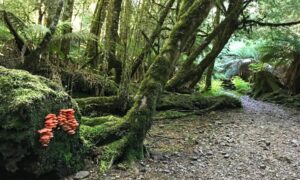


“There is more wilderness in Battery Point Hobart than there is in the Tarkine” – Tony Rundle – Tasmanian Liberal Premier 1996–1998
A philistine view that reflects contempt for the Tarkine and contempt for wilderness.
Yet it is true that the wilderness values of the Tarkine cannot match those of the wildest reaches of Tasmania’s current World Heritage Area.
To clarify this let me first define, Wilderness.
The following definition reflects the widely held perception of wilderness in Australia.
‘Wilderness is essentially a large tract of original earth where one stands with their senses entirely steeped in nature and free from the distractions of modern technology’. (Bob Brown 1982)
While this definition is eloquent, a more scientific definition is needed if wilderness is to be measured in a meaningful and objective way.
Recognising this, the Australian Heritage Commission developed a National Wilderness Inventory (NWI) in the early 1990s, and used this to assess wilderness values across the entire land-mass of Australia.
In the NWI system the wilderness value of an area is evaluated as the sum of four variables: Remoteness from Settlement, Remoteness of Access, Apparent Naturalness and Biophysical Naturalness.
The first three of these variables is defined in terms of remoteness from features such as towns, roads, dams and cleared land, while the last is a measure of local conditions. Each of these variables can take a maximum value of 5, giving a maximum possible wilderness value of 20.
A region that is five kilometres or more away from a road, which excludes any post-colonial infrastructure or disturbances is likely to have a high wilderness value (typically >14).
An area close to a road yet in pristine condition could have a medium wilderness value. Proximity to roads yields low ‘Remoteness from Access’ and ‘Apparent Naturalness’, but if ‘Biophysical Naturalness’ and ‘Remoteness from Settlement’ are high, fringe areas typically have a wilderness value of 8-10 under the NWI assessment.
If you view the NWI map above it is clear where the core wilderness zones in Tasmania are, and most of these are reasonably inaccessible.
The greatest blow to wilderness in the Tarkine was the development of the Savage River Mine
Insofar as the Tarkine goes, the high-wilderness zones are relatively small compared to the Western Tasmania WHA, these being centered in the proximity of the Norfolk Range, The Meredith Range, Mt Bertha and the upper Savage River region.
Prior to the 1970’s the Tarkine wilderness zones were relatively extensive, even though there had been a history of low-scale mining in the region post-colonization.
The greatest blow to wilderness in the Tarkine was the development of the Savage River Mine.
This great gaping wound of a mine is unfortunately located in the core of the Tarkine, which has seen the natural landscape scarred and ecologically disturbed for possibly millions of years.
The development of this mine also resulted in the extensive construction of sealed roads and power transmission lines across the landscape, and a pipeline-bearing thoroughfare that bisected Australia’s largest single tract of pristine rainforest.
Concurrently Forestry, driven by the insatiable woodchip and pulpwood industries, were pushing roads deep into the Tarkine from the north.
The final and unjustifiable blow to the Tarkine’s wilderness was the construction of the Western Explorer Road (‘the Road to Nowhere’) in the early 1990’s. This contentious road significantly shrank the remaining high-wilderness zone and has increased the risk of fire, weeds and the introduction of pathogens.
The Tarkine essentially remains a highly natural region even though its primal wilderness values have been greatly reduced in recent decades.
Expansion of the Tarkine isolated wilderness zones could be possible, to some degree, through the closure and rehabilitation of some tracks, but given the outstanding mineral leases and exploration licenses in the area such an objective seems a long way from reality.
Wilderness is currently expanding in the present TWWHA as a result of the natural reclamation of roads and dilapidation of bridges within old forestry areas. It could also be subject to drastic reductions if the current government proceeds with intrusive tourism developments, mineral exploration and resource extraction.
The Tarkine region has the potential to undergo a similar process of wilderness restoration after it has been reserved into a secure tenure. The challenge now is procuring that protected status it rightly deserves.
With the Wilderness Society’s submission of the optimal TWWHA to be presented at the IUCN meeting in Bonn this month, the preservation of the Tarkine is well on the way …
• Bob Hawkins, in Comments: As imperfect as its “wilderness” condition is, the Southwest is one of the few — and diminishing number of — relatively environmentally pristine jewels remaining on our planet. Why can’t we all be content simply to rest in the knowledge that “it is there”, to be left untouched for ever.
SATURDAY, June 20 … is the GAG in … ?
• ABC: Minister tells advisers to keep opinions on Forestry Tasmania out of the media