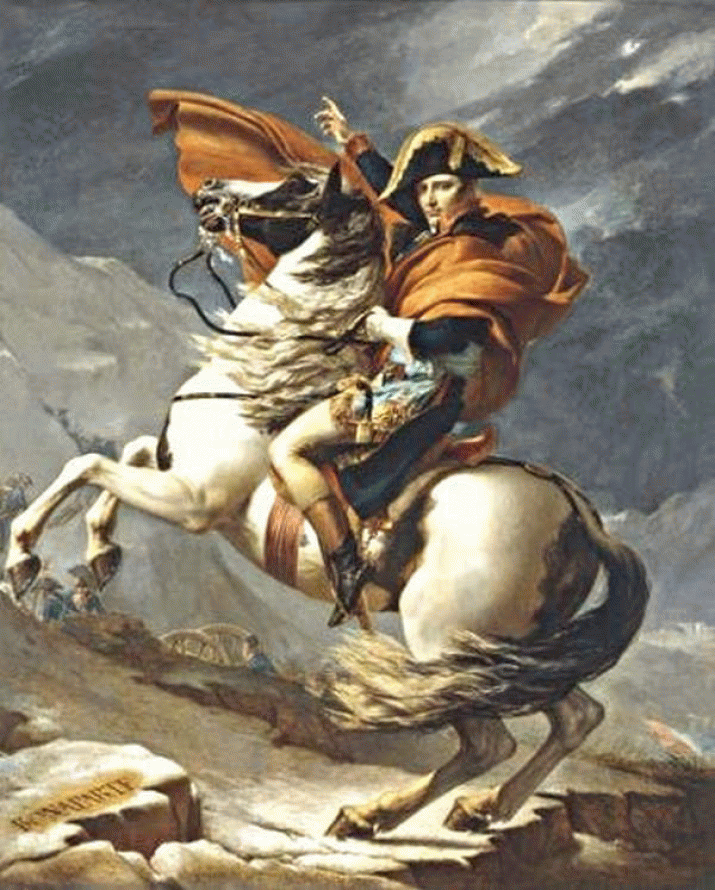
Evan Whitton gently corrects him …
Andrew Roberts’ Napoleon The Great (Penguin 2015) is 936 pages set in 8.98 on 12.15 Sablon. The book, a snip at $27.75 from Booktopia, can thus be read with ease with the aid of a microscope.
Tasmanian Times’ readers with keen memories will recall that I noted on 24 June 2013 ( Evan Whitton’s TT archive of brilliant articles is here ) how Napoleon was able to reform the inquisitorial system only because of a fluke of timing at the Battle of Chicken Marengo on 14 June 1800.
I thought the bit on the battle was quite fun, largely because most of it came from A. G. Macdonell’s Napoleon and his Marshals, which sadly is not in Mr Roberts’ bibliography.
As one historian to another, I thought it only decent to help Mr Roberts with his account of the Code Napoleon. Thus:
Dear Mr Roberts,
I read History at the University of Queensland, and became interested in the origins of Napoleon’s system and ours when I happened to observe how each dealt with the same criminal, police chief Sir (as he then was) Terry Lewis.
In the next reprint of Napoleon the Great you may care to adjust one or two things in Chapter 7: Lawgiver.
You state at p. 276 that the Napoleonic Code is “Essentially a compromise between Roman and common law …” I am afraid that is not accurate. Roman law was what we would call an inquisitorial (investigative) system: it sought the truth, however shakily. The common law does not.
You say Napoleon’s Code was the first “since the Emperor Justinian”. That is true, but it omits an important step. Here is a sequence involving both systems.
In the Dark Ages after the West Roman Empire collapsed in 476 AD, England and West Europe adopted an accusatorial (prove it) system, trial by ordeal, and verdict by an unknown god.
Roman law continued in the East Roman (Byzantine) Empire. Justinian’s Code was compiled by 535. A digest of Justinian’s Code was discovered in Italy about 1070 and was studied at Bologna University, founded in 1088. The future Pope Innocent III studied jurisprudence at Bologna. As a Cardinal from 1190, he devised inquisitorial techniques to investigate alleged clerical misbehaviour.
Professor Richard Jackson, of Cambridge, wrote in The Machinery of Justice in England (seventh edition 1977): “[The] technique was to send a trusted person along to inquire into the allegations. This founded the inquisitorial concept of a trial, whereby the judge is expected to find out for himself what has happened, and he will do this by examining all persons, including the accused or suspected person, who may be able to enlighten him.”
As Pope 1198-2016, Innocent was virtually master of Europe. Ambassadors from most countries, including England, attended his church-state conference, the Fourth Lateran Council, in November 2015. The conference adopted his inquisitorial procedure. European temporal courts then adopted his system, but a handful of English judges formally rejected the truth-based system in 1219. The nominal reason – as it was again in 1992 – was that wogs begin at Calais.
Like the US Administration of George W Bush, European judges wrongly believed for five centuries that torture is a reliable way of finding the truth.
The adversary system is a variant of the accusatorial system. It dates from 1460, when lawyers began to take over control of the process, and judges did not stop them. Yale law professor Fred Rodell rightly said the legal trade is “a high-class racket”.
There would have been no Napoleonic Code if Marmont, Desaix and Kellermann had not won the second Battle of Marengo in 1800. On the other hand, if Admiral Villeneuve had followed Napoleon’s instructions in 1805, England and its former colonies except the US might today use his system. A comparison:
The adversary system:
• Much relevant evidence is concealed from jurors.
• Lawyers are in charge of the process. Untrained and largely passive judges let them use sophistry when they question witnesses.
• Witnesses are obliged to give Yes-No answers.
• Jurors are isolated from judges.
• Hearings can take weeks or months.
• Jurors do not give reasons for their verdicts.Results. Some innocent get convicted and more than 50% (84% in India) of guilty defendants get off.
The French system is not perfect but it delivers at least twice as much justice as the adversary system and at less than half the cost to taxpayers. The heavy lifting is done at the pre-hearing stage: a series of filters tend to protect the innocent and to ensure that the person charged is guilty. The hearing is a “manifestation of the truth”. Thus:
• All relevant evidence is available.
• Trained judges control the process.
• In major cases, judges supervise detectives and compile a dossier of evidence for and against the suspect. Suspects’ lawyers can see the dossier in case they can show the truth lies elsewhere.
• Jurors and judges sit together. Witnesses give evidence as a narrative. Lawyers are not allowed to pollute the truth with sophistry.
• Most hearings take a day or so. Jurors and judges give reasons for verdicts.Results. The innocent are rarely charged, and about 95% of guilty defendants are convicted.
Footnote. Mr Roberts is nothing if not prompt and gracious. I sent that to him at 6.02 pm on Thursday 4 June. Three minutes later, he replied: “Many thanks for your very informative email. Best wishes, Andrew Roberts.”
China Fangzheng Press has contracted to translate and republish Whitton’s book on the history and procedure of the two systems: Our Corrupt Legal System: Why Everyone is a Victim (Except Rich Criminals).
• Noela Whitton, New York Times: The World of Pere-Lachaise
• Noela Whitton’s book: How to stay friends with your children