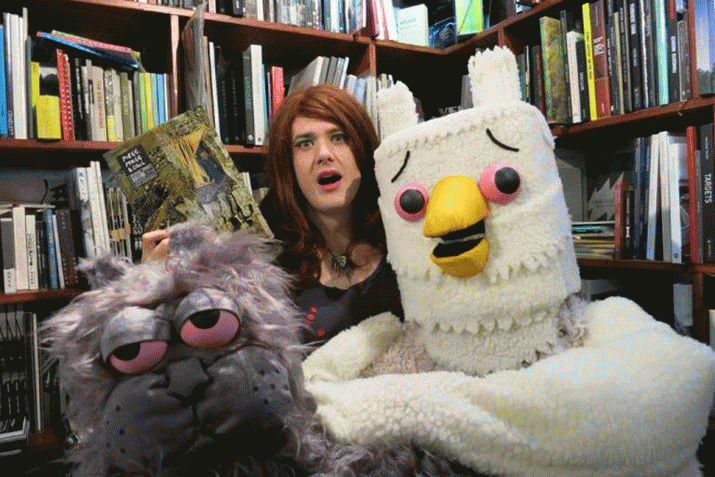

In a nondescript building on the outskirts of Washington DC a man stands nervously on a low stage, illuminated by intermittent camera flashes and dull fluorescent lights. A lustrous russet wig, a billowing cream wedding dress and rows of fake pearl bracelets offset his strong jaw and broad shoulders. He reaches into his stuffed brassiere, pulls out a piece of paper and unfolds it before fixing his gaze on a small pile of graphic novels sitting on a stool.
“I, Simon Hanselmann,” he intones deeply. “Take you, comics, to be my lawfully wedded art form.” The audience, iPhones aloft, laugh gently. He flicks his head, blinks his fake lashes and continues. “It’s been 26 years of unbridled bliss…through obscurity and low-level Internet infamy – a whirlwind romance for the ages,” he pauses to allow another ripple of laughter to pass across the crowd.
“I will be with you – through sickness, profound sadness, delirious highs, crippling insecurity, epic personal fuck-ups, and the inevitable critical backlash, ‘til death do us part. Which may realistically be in about five years.”
Fuelled by further warm laughter and the goodwill of smiling faces, he pushes his synthetic hair back and theatrically announces: “I fucking love you, you cheap bastard. You continually screw me over and undervalue me, but I just can’t stop wanting you.”
“I am a modern woman. Smiley face X O X O hashtag forever.”
He walks across the stage, flinging the paper into the front row.
“Nailed it.”
One month before ‘marrying comics’ – a publicity stunt dreamed up by him and his publisher, acclaimed Tasmanian comic book artist Simon Hanselmann is sitting in his cramped apartment, dressed in jeans and a crumpled t-shirt.
“Sometimes I dress for interviews,” he says ruefully. “Sorry.”
That he has found the time to talk at all is impressive, and throughout our conversation he rarely stops working. His work appears in The New York Times, Pitchfork Review and The Believer; today he’s colouring his weekly strip for youth media website Vice. Simpsons creator Matt Groening, renowned comedians Bob Odenkirk and David Cross, and Ghost World author Daniel Clowes are all confirmed fans. Others follow him on Tumblr where he is, in his own words, a “low-level celebrity and drag personality”. Within a month, his compilation Megahex will debut in the Top 10 of the New York Times Best Seller list.
Tracking how his trajectory of success began requires looking back. Looking back isn’t always easy.
“I just went to the bank this morning, put $400 in my mum’s account to cover her Suboxone for the next month,” he says sighing, referring to her latest drug-withdrawal medication. “I’m hoping she’s not going to go straight out and spend it on drugs. People tell me to cut her off, but I can’t do it. I’m all she’s got,” he smiles wanly. “It’s just this searing empathy I have with her situation.”
Begun in 2010 and showing no sign of ending, Megahex is a semi-autobiographical soap opera about four characters. It too builds on his “searing empathy”. Megg is a depressed, frequently stoned witch, Mogg her boundary-invasive cat, their housemate Owl (a misanthropic anthropomorphised owl) and Werewolf Jones, a pathetic, lecherous hanger-on. The trigger warning adorning the cover – strong coarse language, depression, rimming, drug use, and mental and physical abuse – is not just for promotional reasons.
“I bang on about addiction and drug problems and horrible Hobart scene politics,” he says keenly before we’re interrupted by the buzz of a mobile phone and a glimpse of another overarching influence.
“Here’s a text from my mum,” he informs me, putting down his brush and grabbing his phone. “She’s probably telling me she’s been written off by everybody. ‘Booked into St Johns on the 30th,’” he reads.
A 2012 report from the Australian Bureau of Statistics found half of all Tasmanians are functionally illiterate and innumerate. One-third of the state relies exclusively on welfare payments for their income. In particularly disadvantaged regions of the state, where the unemployment rate is over 50 percent, it’s easier to score pot than find someone who can read a prescription. This is the world in which Megahex was born.
“I think my situation was quite common in Tasmania,” he says, crouching over his low table, dipping his brush carefully in a little jar of ink. “Rampant unemployment and people turning to drugs. My mum did a really good job. I always had slick lunches at school. Nice sandwiches and Roll-Ups and muesli bars. She did provide a really good home.”
Read more at http://junkee.com/meet-the-tasmanian-comic-book-artist-taking-the-united-states-by-storm-from-his-bedroom/57005#Kw2tAQS1hPPBpP03.99