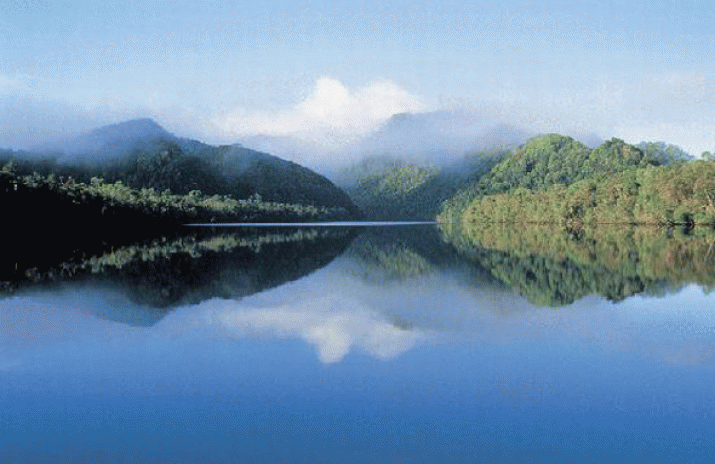
*Pic: of Macquarie Harbour
Greens spokesperson for Fisheries, Senator Peter Whish-Wilson provides the following comments on the salmon deaths in Macquarie Harbour.
“Last week I heard evidence from locals that a storm had caused the upwelling of dead and deoxygenated water below fish pens in Macquarie Harbour leading to millions of dollars of fish deaths.
“Now we have had it confirmed that some 270 tonnes of salmon have been killed.
“The Greens and environmentalists have warned for years that the rapid growth of the salmon industry in Macquarie Harbour was potentially a ticking time bomb due to deteriorating oxygen levels.
“This is not about the stocking rates of any one company; this is about the cumulative load of farmed salmon in the Macquarie Harbour system. Concerns have been raised that there is only so much excess nutrient load a semi-closed system like Macquarie Harbour can tolerate.
“It is a known impact of salmon farming that overstocking can overload the sea floor with waste and lead to deoxygenation of the bottom waters.
“This fish kill event is consistent with ongoing concerns about declining oxygen levels in Macquarie Harbour.
“The Tasmanian Government has a report on dissolved oxygen levels that it is refusing to release to the public.
“The Government thinks that hiding the truth from the public and attacking those with genuine concerns will help the industry.
“I am glad that an upcoming Senate Inquiry will provide an opportunity for all stakeholders to address these issues, and how they should be regulated, in an independent and transparent manner.
• ABC Rural: Petuna says up to 85,000 fish killed in Tasmanian West Coast storm event a ‘one-off’ Tasmanian company Petuna rejects claims that the loss of hundreds of tonnes of salmon in a West Coast storm event calls into question fish farming expansion plans in the region. …
EARLIER …
via Veterinary Pathologist Dr David Obendorf …
21 May 2015 ABC1 TV News [iview]
Fish Kills
Hundreds of tonnes of salmon killed by storm surges on the west coast Peter Whish-Wilson: It really raises significant questions about the state of the environment in Macquarie Harbour.Interviewer introduction: Tonnes of farmed salmon worth millions of dollars have been killed in a storm on Tasmania’s west coast. It’s believed to be the State’s biggest fish kill and has raised question about the industry’s plans to dramatically expand fish farming in Macquarie Harbour.
Michael Atkin from Strahan: Recent wild weather has lashed the west coast village of Strahan.
Liz Hamer, resident: It’s been atrocious. If this had been in ahh … NSW or Queensland, it’d be a Category 2 cyclone; that’s how bad it was.
Michael Atkin: One storm two and a half weeks ago created a dramatic change to thr marinme environments in Macquarie Harbour. The fish farm owned by the salmon company, Petuna was hit hardest.
Phil Vickers, West Coast Mayor: There were 15-odd metre seas and a big low pressure system came in and that forced a whole heap of ahh … salt water into … into the harbour.
Michael Atkin: That caused a rapid change in oxygen levels that killed 270 tonnes of salmon, they’ve been buried at a nearby land-fill site.
Wes Ford, EPA Director: The salmon have basically suffocated because of a low level of oxygen in the water in the bottom of the pens.
Michael Atkin: Critics argue that plan to double the size of the industry by 2030 is unsustainable.
Senator Peter Whish-Wilson: It really raises significant questions about the state of the environment in Macquarie Harbour.
Michael Atkin: This incident comes just months after a leaked email that Petuna and Huon Aquaculture had raised concerns about the health of Macquarie Harbour directly with the State Government. The Greens will push for a Senate Inquiry to examine the incident.
Senator Peter Whish-Wilson: Salmon suffocated and drowned in their own pens from an event that been predictable if you’d listened to people who had raised concerns about nutrient level dumping underneath fish pens.
Wes Ford, EPA Director: This event wasn’t predictable in the circumstance. This event is not related to the fishing … or the fish farm activities; it’s related to the storm event.
[Sign shown: Petuna by Peter and Una Rockliff Aquaculture.]Michael Atkin: Petuna said the incident was only ‘minor’. Michael Atkin ABC News, Strahan.
• DC Reid, in Comments: In BC Canada, we are trying to move the government to get fish farms out of our pristine ocean. I suggest you do the same. There is an election in six months and the federal Conservatives that do not support wild BC salmon are going to be voted out. I have summarized 15,000 pages of science on fish farm issues. By all means, take a look: www.fishfarmnews.blogspot.com Don’t call for more science or more boards. Fish farm companies loves the call for science, etc. as it gives them another decade in the ocean before, well, calling for more science. Etc. Tell you government you want them out and on land, or they can go back to Norway.
• Dr David Obendorf, in Comments: … The pre-existing and well-known dissolved oxygen levels in Marquarie Harbour are acknowledged by Petuna as the basis of this, [i]’the biggest single aquaculture fish kill in Tasmania’s history'[/i]. Both the EPA and DPIPWE had been warned that declines in dissolved oxygen levels could trigger sub-lethal and lethal incidents that could be triggered by weather events or higher water temperatures at these fish farms. The relationship between the fish loads DPIPWE is allowing in the harbour and the commensurate drop in dissolved oxygen levels after the expansion of fish farm leases from 2009 onwards must be investigated as an ecological and an industry [i]sustainability issue[/i].
• Arthur Barsworth, in Comments: “This event is not related to the fishing … or the fish farm activities; it’s related to the storm event.” -according to the Director of our EPA. So, did any other fish species share a similar fate to that of the salmon? No? Then how could it not be related to the stocking practice?