Recently, I read a biography of Lindy Chamberlain-Creighton online. I think it was written in relation to her book, Through My Eyes, The Autobiography of Lindy Chamberlain-Creighton. Most Australians, who were adults in 1980, remember the name and the case of the disappearance of Baby Azaria. Many people born after 1980 also know of Lindy Chamberlain because her case is now legal history. The Copyright of this article is: 2015 Rick Creighton – Lindy’s husband. I am relying on the information that caught my eye as I read the biography. Direct quotations are in italics.
Many rumours were rife in relation to this case and doubtless there are some people today who still believe Lindy Chamberlain is guilty of murder. At the time, it seemed as if Australia barracked for the dingo.
Rumours still circulate in the Tasmanian Community that Susan Neill-Fraser, whose partner, Robert Chappell, disappeared on Australia Day 2009 killed her first husband too. In fact, her former husband is alive and well and sat through the trial to support Sue and their two daughters. Recently, he stated publicly that the picture the court drew of Sue was not the same person he knew and married.
One of the accusations against Lindy was that she dressed Azaria in a black dress. Apparently, the dress was a hand-me-down from an older brother and there were many other photos of Azaria, published at the time, not in a black dress, including her standing on Uluru with her mother. Creighton points out, “Not finding her style appealing to you is not proof of murder!”
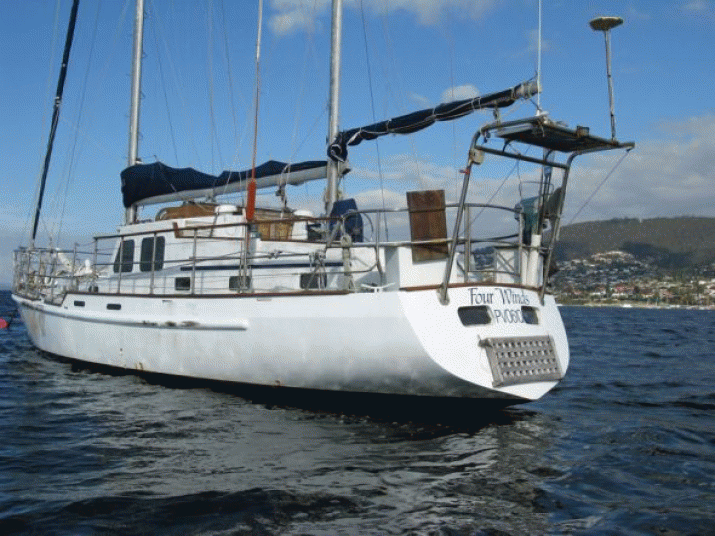
Nor is a red jacket found on a fence in Margaret Street proof of murder. It was not surprising it had Sue’s DNA on it as it is likely it had been on the yacht, Four Winds. Barbara Etter APM, Sue’s legal adviser, writes in her blog of 17 June 2013,
… the DNA of other persons was found on the jacket. In fact a major profile for a female Person 1 was also located … and there was a mixed DNA profile …with both Tim Chappell and Bob Chappell not able to be excluded as possible contributors. The DNA testing would tend to indicate that the jacket was indeed a “shared” Jacket.
Alarmingly, a dark hair found on the red jacket was not examined by the forensic scientists. This could have been highly significant considering both Sue and the homeless girl, with her DNA on the yacht, had dark hair. It is more likely that a homeless person used and discarded the jacket than Sue. Sue did not immediately recognise it, when she glanced at it in the boot of a police car, as the jacket she usually wore was navy blue. Hence, it is not hard to believe that, coupled with shock and distress, she was confused. Others in the trial could be confused, but not Sue.
Lindy Chamberlain was also accused of lying about a jacket , a matinee jacket she claimed Azaria was wearing that fateful night. She named the brand on the label, described the rib pattern on it and suggested that the jacket would explain the lack of dingo DNA on the jump suit. When the matinee jacket was found in 1986, following the death of a British tourist who fell off The Rock, Lindy was released from prison. She had not lied.
I find it strange that a homeless girl who has a police record, gave 2 different addresses in court, was found at a third by a detective, gave her women’s shelter a non-existent address on Mt Nelson for a sleepover that Australia Day night, would not co-operate with the police, refused to be interviewed about anything to do with the case and said she would tell the police nothing, has a strong DNA profile on the yacht, can then deny ever being on the yacht, and yet she is believed by the police, the prosecutor and the jury. Susan Neill-Fraser, who has no prior convictions and, in the judge’s own words, has led ‘a blameless life’ is not believed when she said, “I’ve never harmed anyone knowingly or plotted or planned to harm anyone.”
In the Chamberlain case, the dashboard of the car and a camera bag were purported to be awash with foetal blood, according to the forensic scientist. This was a damning piece of evidence against Lindy.
The stain under the dashboard of their car was later shown to be manufacturer’s sound deadener and, in the camera bag, milkshake and copper dust from Mt Isa copper-mining town where they lived.
In Sue’s case, a photograph of the Quicksilver dinghy was presented to the jury. It showed the solution of luminol, a screening agent for the possible presence of blood, glowing bright blue; that photograph certainly would leave an impression in the viewer’s eye that the Four Winds white dinghy with blue trim was also ‘awash with blood’.
During Susan’s trial, I found the evidence of the forensic scientists difficult to follow and I would not blame the jury if they found the same. Ms Debra McHoul explained that, if looking for blood, there are two classes of tests – a test called a screening test and a confirmatory test.
When shown photograph 21, she commented,
This is a photograph that was taken to show the areas that glowed with the luminol screening test for blood … you can see quite clearly there are some positive areas there with the chemical.
But Ms McHoul also said, for those who were following closely,
Following the microscopic examination of the dinghy which was taken to the labs I didn’t find any obvious red/brown staining in the dinghy that would correspond with my luminol positive result.
In other words, it seems that there was no blood to be found in the dinghy. There were negative confirmatory tests but this was not explained to the jury. The impression that was left was that Bob’s bleeding body had been transferred into the dinghy. The luminol was more likely reacting to the bleach Sue had used to clean the dinghy for Bob’s sister’s visit, remembering Bob had a nose-bleed after leaving Scarborough Marina that hospitalised him on the Gold Coast. There are numerous other substances which can produce false positives to luminol.
Then there is the matter of the latex glove. Was it a simple error that had the Crown claiming that Sue’s DNA was inside a latex glove that she supposedly used to clean up the evidence of her ‘crime’? Or was it an error of grave magnitude? The fact is, the DNA in the glove was that of Mr Chappell’s son. By the time this error was admitted at Sue’s Appeal, it was too late, the jury had gone out hearing damning evidence, found Sue guilty, and she was in prison.
Forensic science damned both women. After Lindy was convicted and in prison, and the stain under the dashboard of their car was shown to be manufacturer’s sound deadener, her lawyer took this new evidence to the High Court, but the High Court could not look at ‘new and fresh’ evidence!
More misinformation, that is often quoted, is that Sue had a trial, two appeals, and a coronial inquiry, implying that the jury’s verdict was correct; they could not ALL be wrong. Sue had a trial and one appeal, an application to the High Court for an appeal that was refused, then a coroner held a Record of Investigation into Death (Without Inquest) in his Chambers that was not open to the public. Much of the evidence that was garnered arguing for an inquest was not even considered. He states, in his – Reasons for Decisions and Findings and General Comments, that:
Others I did not read as they came embargoed with caveats such as (among others) “Personal and in confidence’ or ‘highly confidential’ or ‘legal in confidence’. I considered that I could not complete my statutory and public duties by being hamstrung by such caveats …
Then the coroner said that he could not come up with a finding contrary to a jury’s verdict:
By section 25(3), after the conclusion of criminal proceedings a coroner may resume the adjourned inquest if the coroner is of the opinion that there is sufficient cause to do so. However, by subsection (4), upon a resumed inquest the coroner must not make any finding which is inconsistent with the determination of the matter in the criminal proceedings.
Creighton’s article points out that, “With Azaria, it was a case of disappearance and presumed death.” (Isn’t that the same in Bob Chappell’s case?) That was the decision of the first of four inquests into her death. The coroner went public on television with his decision and his reasons for it to try to overcome the misinformation and rumours fuelled by the media and the general public. I think it could safely be said that Coroner Denis Barritt’s condemnation of the police and their investigation had the opposite effect: they went for Lindy’s jugular!
Living in Papua New Guinea with Seventh Day Adventist missionaries, I did not believe they were a weird cult into ritual killings. My experience was that they were good-living, wholesome people who abstained from drinking alcohol, tea and coffee and from smoking cigarettes. Small coffins in their high school work-shop were not for infant mortality but a teaching aid for anti-smoking campaigns, where the participants were invited to lodge their ‘coffin nails’ in the wooden boxes. Few believed Michael Chamberlain when he said that the little coffins, found under his house in Mt Isa, were for that purpose.
Within a night or two of Bob Chappell disappearing from the yacht that was found sabotaged and sinking the morning after, a senior detective commented on a news session that Susan Neill-Fraser seemed ‘more interested in the property than the person’. My reaction was, “The police don’t like Susan. That’s a judgement. They are going to charge Sue with murder.”
Creighton’s article reminds us that the role of the Crown is to act as a ‘Minister for Justice’. The Chamberlains went through two inquests before their trial and had a lawyer for both: the first was inquisitorial, as it should be, trying to determine the truth and Coroner Denis Barritt determined just that on 20 February 1981: the baby was attacked by a wild dingo. The second inquest was unusually adversarial and fell wide of the mark of justice; Coroner Mr G.P. Galvin CM concluded on 2 February 1982 that Lindy should be committed to trial for murder and her husband, Michael, for being an accessory after the fact.
The article goes on to note,
No longer a ‘minister for justice’, the behaviour of the prosecution was purely tactical – to obtain, and maintain a conviction.
After the second inquest, extraordinarily the government offered Lindy a choice of admitting guilt and going free, or continuing to insist she was innocent and go to gaol.
At trial, the Chamberlains knew they were innocent and the Crown scenario was wrong. (Similarly, Sue was so sure of her innocence that she gave eight hours of interviews to detectives, in two separate sessions, without a lawyer present.) The article notes,
Many of the jurors found the trial difficult to understand. The initial vote of twelve jurors was four guilty, four not guilty, and four undecided.
Someone had looked in the jury room rubbish bins for this information. But worse,
Whilst the judge had summed up for acquittal, some had thought he had told them to find Lindy guilty. They found the Crown forensic scientist, Mrs Joy Kuhl, to be very clear, patient, and friendly as she explained all of the substances she had found in the car, which she said was baby’s blood.
A room was set up in the Supreme Court to simulate the campsite with a tent and accurate amount of light. Coming from a brightly lit room, and not considering that Lindy had been in the dark for several hours, one person who could not see into the tent, called the others to look:
They could not see in such dim light either. They concluded that Lindy must have lied when she told the court she could see inside the tent on that night. If she had lied about that, then she must have lied about everything. They went back upstairs and took a vote – all guilty.
Does that sound familiar? Sue told one lie to the police to protect the privacy of a family member with a mental illness as Bob would wish, but any contentious statement after that was deemed to be part of a pack of lies or school of ‘red herrings’.
I cannot explain it in better or simpler words the complexity of the appeals process, so I quote from Creighton’s article:
The appeals process does not go over the evidence. It looks at the process – whether the correct court procedure was followed, and the lawyers had not made accidental or deliberate errors – and what was presented in court, to determine if the jury was entitled, in their best judgement, to find the defendant guilty or not. In other words, was the case presented legally correctly so the jury was entitled to make the decision they had? Whether all of the evidence was available, whether by Crown tactics or even defence mistakes, was never a question in the appeals. Even though some of the appeal judges felt that the verdict of guilty was wrong, they upheld the right of the jury to make the decision they had. If there was any new evidence refuting the claims of the Crown, they could be heard in the appeals court, but only if it was totally new, like the finding of the matinee jacket. It is a subtle distinction. The matinee jacket had never been produced in court, its only claim to existence was by Lindy.
Finding it was new evidence. Merely discovering, after her conviction, that the ‘arterial underdash spray’ was in fact sound deadener, and other supposed ‘blood’ substances were milkshake, and copper dust, were not new evidence – the substances had already been discussed in court – and it was only considered additional evidence. It therefore could not be presented in the appeals court. It would have to be referred back to the Northern Territory, who could choose whether to reopen the case or not.
By the time the matinee jacket was discovered in 1986, Lindy had reached the end of all legal avenues and the laws had to be changed to allow for a Royal Commission. The first inquest by Denis Barritt that concluded on 20 February 1981 and the last Inquiry by the Hon Mr Justice TR Morling got it right: the cause of death was by a dingo. How much time, money and suffering went on in between? As we know now, the conviction of murder for Lindy and accomplice for Michael were quashed and the Chamberlains were completely exonerated when the Inquiry concluded on 22 May 1987. But it was not until 12 December 2012, thirty-one years after Azaria disappeared, that her death certificate was amended to mention a dingo. On that day, Michael Chamberlain said,
Today, I heard Coroner Morris speak for the dead on behalf of the living… I am here to tell you that you can get justice even when you think that all is lost. But, truth must be on your side… I cannot express strongly enough how important it is to pursue a just cause… If you know you are right, never give up on getting it right.
Even after sitting through the trial of Susan Neill-Fraser and following Lindy Chamberlain’s case through to its conclusion, I do not know how the flaws I saw in Sue’s trial can be corrected following these principles. How can the evidence of Mrs Barbara Zochling be handled now? She clearly said in court that “the lady in the box”, meaning Sue, was not the lady she saw on the beach speaking in a loud voice with Bob Chappell. She waited outside the court and pointed to Bob Chappell’s sister, Caroline Anne Sanchez, as the woman she saw arguing with Bob. She had the wrong woman on the wrong day – out by one day. Yet the Crown used her evidence to accuse Sue of berating Bob for overfilling the outboard motor. Mrs Zochling demonstrated how easy it is to be confused about a day and an event without deliberately lying. This understanding was not allowed to Sue when she confused her days: they were interpreted as LIES. It also showed that Bob’s sister could find her brother frustrating and could have a few ‘loud words’ with him without being a murderer.
Then we have the misleading evidence that Sue had worn a latex glove to clean up the crime scene, “to cover up what you had done” according to the prosecutor. Although Sue had stated, “I have no idea what happened on that boat” and “This is not true”, “This is just not true”, the prosecutor, in his closing address, again referred to the gloves, “Someone who sought with a pair of latex gloves which she had forgotten that she’d left on the stove top to clear up as best she could …” The Crown corrected this and apologised at the time of the appeal. Rosemary Bolger, a journalist for the Examiner newspaper reported on 11 August 2011,
Tasmania’s Director of Public Prosecutions has admitted that he made a mistake suggesting a Hobart woman murdered her husband using a wrench while wearing rubber gloves but he told the Supreme Court in Hobart yesterday the error was not grounds for an appeal …
He then admitted that the DNA found on the gloves belonged to Bob Chappell’s son, but he went on to say it was “a throwaway line”.
But the jury heard that “throwaway line” and it was damning. They found Sue guilty of murder; it was too late by the time they heard, or read in the newspaper, that it was a mistake. In a totally circumstantial trial without a body, without an eye witness, without a wrench, indeed without any weapon, I fail to see how “the gloves were insignificant in the overall context of the trial”. I would argue that it was a powerful and inaccurate claim and completely prejudicial to Sue’s case. But how can that be corrected now? It is not fresh evidence. How can Sue’s so-called lies be shown to be “mistakes”?
Then there was contradictory evidence about Sue’s strength: the evidence of the sailors is quite different from the Crown’s description of what she is capable of doing. A retired yachtsman living in Scarborough, Queensland, sailed on the Four Winds to help deliver it to Hobart. He believed that Sue could not physically wind up the sail through the winch on her own, “she just didn’t have the strength to do it”. In fact, he stated, that he and his co-sailor found it difficult because the winches were large and it required one to winch and one to tail and even they found that difficult. Later in the trial, the prosecutor said (to Sue) that “you couldn’t do the physical things associated with it. You couldn’t winch up the main sail”. But then, in his closing address, he purported:
But what you could be, I suggest, fairly satisfied about is that there wasn’t more than one person involved in the killing of Mr Chappell and the disposal of his body, it’s the work of one person.
So, Sue could single-handedly murder her partner, winch his body up a flight of steps to the deck, get it into a dinghy bobbing around in the water with a fire extinguisher attached, take it out to a deep channel of the river and, without upsetting the dinghy, dump the body overboard! Surely she would have blood everywhere; that is why the photo of the dinghy with the blue glowing luminol looks so plausible.
Then there is clear evidence that “the Quicksilver dinghy in the photographs is not the dinghy I saw at five to four on Australia Day last year” , an assertion that was dismissed on the grounds that, “But how stupid would they be to rely on the description of a single witness, however ‘cocky and confident he was …”. But other witnesses, one of whom wished to remain anonymous, also made statements of seeing another dinghy near the Four Winds that afternoon.
These two women, Lindy Chamberlain and Susan Neill-Fraser, have something else in common other than flawed evidence in their trials: they did not cry. Both were stoic and believed that ultimately the truth would come out. In Lindy’s case it did after 3.5 years in gaol, but what is Sue’s ‘matinee jacket’? How long must she sit in prison, waiting for the truth to bubble to the surface?
My conlusion
Four years after the trial of Susan Neill-Fraser, Attorney-General, Dr Vanessa Goodwin, announced on 9 September 2014 that she would amend the Tasmanian Criminal Code to allow for a further right to appeal where all avenues of appeal have been exhausted, but only if ‘fresh and compelling evidence’ were brought to light. This would enable reviews where verdicts were considered ‘unsafe’ .
While a petition of mercy to the Governor or the Attorney-General is currently an option, Lindy Chamberlain did not go down this path, refusing to plead for mercy for something she did not do. Sue Neill-Fraser has expressed similar feelings, saying, “How can I express remorse to a Parole Board for something I haven’t done?”
Many, including the Attorney-General, feel that these matters should stay in the judicial arena for review, not the political, and the suggested legislation would overcome this problem. Currently, the Labor Party and The Greens appear to support the legislation and the supporters of Susan Neill-Fraser welcome it.
South Australia is the first Australian state to go down the further right to appeal path and their recent case R v Keogh has raised issues that have significant implications for wider appeal rights in Australia.
Dr Robert “Bob” Moles, legal academic and pre-eminent authority on Miscarriages of Justice, in a briefing paper following the recent Henry Keogh case, points out that this case did not rest exclusively on “fresh and compelling” evidence. Referring to the Full Court, he points out that other issues can result in a miscarriage of justice. He writes,
It gave as examples the ‘wrongful admission of evidence’, ‘evidence which is flawed in some respect’, ‘comments by counsel or the judge which are prejudicial’ and ‘statements made which cannot be supported by the evidence’. Ironically, the examples cited have no logical connection to any fresh or compelling evidence issue.
Dr Moles continues:
Where evidence is ‘flawed in some respects’, the flaws may be revealed as much by careful analysis as by the introduction of fresh evidence. So too with ‘comments by counsel or the judge which are prejudicial’ and ‘statements made which cannot be supported by the evidence’. Such errors can be identified without the need to introduce any additional fresh or compelling evidence….
It is inappropriate if legislation forces lawyers in otherwise meritorious appeals to scratch around to find something which could be called fresh and compelling, and if the law tempts courts to identify things as fresh and compelling merely to establish jurisdiction in a case with obvious merit.
For this reason, I implore the Tasmanian Attorney-General, when drafting the new legislation, to make it broad enough that miscarriages of justice do not go unheard without proper independent review. For those of us without legal learning and knowledge, it is very puzzling that, above all, courts appear not to be looking for the truth.
How does Mrs Barbara Zochling slip through the net, the homeless girl who lied to the court, a red jacket without total scrutiny of the available DNA, ‘battleship’ grey dinghies with lee cloths, and an unreliable Crown witness with a police record and a known history of conflict with the then accused?
There are ‘flaws’ aplenty in Sue Neill-Fraser’s case, I have mentioned a few, let’s make sure they are given space to be addressed. Let’s learn from the Lindy Chamberlain case. Let’s not wait 31 years for justice.
In 1924, Lord Chief Justice Hewart said,
It is not merely of some importance, but of fundamental importance that justice should not only be done, but should be manifestly and undoubtedly seen to be done.
When there is a verdict that is ‘unsafe’ and there has been a miscarriage of justice, many feel unsafe themselves that a murderer or other criminal is still at large. There was a feeling of relief when Jill Meagher’s rapist and murderer, Adrian Bayley, was caught and brought to justice. I, for one, think that it was fortuitous that Bayley was caught on a security camera stalking his victim and wonder if her husband, Tom, might otherwise have found himself in the frame for her murder.
Yes, justice must not only be done, but must be seen to be done and that is why the Neill-Fraser Support Group, looking at Sue, and beyond Sue, urge appropriate and timely action by the Attorney-General, as:
Justice for Sue is justice for Tasmania.
• Court of Criminal Appeals decision. Read for yourself, here
All about Lynn Giddings: After leaving school, Lynn trained as a teacher to teach in Papua New Guinea. She taught in Bougainville and the Eastern Highlands Province from 1961 to 1968 when her first child was born. She married a patrol officer who finished his career in 1992 as the Senior Provincial Magistrate of Simbu Province. When he started gaoling some of her ex-students, she thought it was time to start a probation service for the country. After 26 years, she returned to Australia and settled in Pontville from where she continued working with the Justice Department as a Probation and Parole Officer, interrupted by 5 years as a welfare officer in Risdon Prison, the first female to be employed in the male gaol. She retired in 2004. She is a friend of Susan Neill-Fraser’s mother and has considered Sue a friend since visiting her in Risdon Prison when she was refused bail and remanded in custody. She sat through the trial, the appeal, and the High Court application for an appeal, which was refused, via video link at the Federal Court in Hobart.