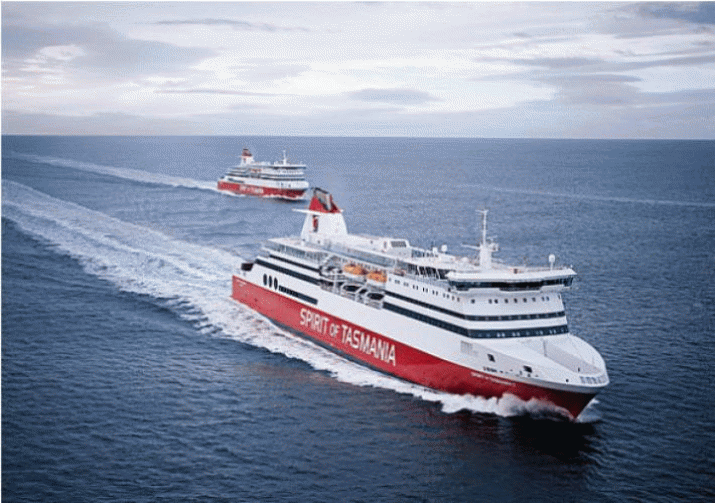
A campaign for Bass Strait interstate transport equality, initiated by the people and supported by business in two states, has failed to deliver transport equity despite resulting in massive federal funding. The Bass Strait Passenger Vehicle Equalisation Scheme, BSPVES, is an ongoing federal uncapped highway equalisation scheme worth billions. It was a major part of a raft of measures to provide a fair sea highway transport link across the Victorian – Tasmanian border for both people and vehicles. The scheme has been progressively been turned over two decades into a funding stream mainly benefitting the Tasmanian leisure industry. Now, under the Abbott Government, there is no money available to equalise the movement of people across this vital and nationally significant corridor. The Federal Government recently said that, “The aim of the BSPVES does not extend to equalising the cost of inbound and outbound travel across Bass Strait.” The consequences of that position severely brings into question issues regarding accountability, effective democratic processes, economic responsibility and governance.
The recent extension of the Tasmanian Freight Equalisation Scheme to equalise international exports crossing Bass Strait to the cost of highway travel is welcomed.
But, amid the jubilation that followed was the little reported Federal Government response to the Productivity Commission’s (PC) PC Tasmanian shipping and freight report.
It covered critical changes to the important Bass Strait Passenger Vehicle Equalisation Scheme, BSPVES.
This ongoing billion-dollar scheme was the centrepiece of the 1996 Coalition’s Tasmanian election package. It met a national call for transport equality for people and vehicles crossing Bass Strait by sea and was to make Bass Strait “part of the national highway”.
With vital marginal seats, core Coalition promises were critical. A bidding war over Bass Strait occurred between Mr Howard and the then Prime Minister Paul Keating. The Howard Coalition won government.
During its enquiry last year the PC faced a dilemma.
Was the BSPVES to be a subsidy to support driving holidays to Tasmania for mainlanders, as the scheme had become or, should it be offering highway transport equality as was suggested to be the scheme’s original purpose?
The PC asked the Commonwealth.
The Federal Government, ignoring the historical context under which the BSPVES was introduced, then responded that “The aim of the BSPVES does not extend to equalising the cost of inbound and outbound travel across Bass Strait.”
A subsidy advantaging few …
This flies in the face of confirmation, from time to time over the last two decades, that the BSPVES’s introduction and adjustments were related to national highway equivalence.
This recent Federal Government response will now embed the purpose of the BSPVES as being a subsidy advantaging few whilst leaving total fares to be governed by ferry operators.
The purpose of the textbook 1996 campaign seeking interstate transport equality across Bass Strait will be almost entirely negated without any substantial justification.
The intent of the BSPVES should be to deliver transport equity for both people and vehicles in both directions. It must be used to build a critical mass of people around businesses by reducing and equalising the sea barrier to entry and exit.
In the government’s response, Commonwealth monitoring of the BSPVES will now be rightly extended past a focus on just leisure travel to Tasmania – to the other half of the travel market, that of visiting friends and relatives and to business travel. This monitoring critically needs to cover travel in both directions. Given the now seemingly one way limited purpose of the BSPVES, it is unlikely to do so.
A properly functioning BSPVES, based on equalisation not subsidy, was said by the Coalition to be necessary to reduce the “single greatest barrier to the growth in population investment and jobs for Tasmania”.
A scheme, supporting leisure travellers with a car to stay 10 days in luxury accommodation across Tasmania, will not remove this barrier.
This issue goes to the very core of what equalisation means and the basic needs of the whole Tasmanian community for interstate transport equality – not just meeting the wants of some.
Bass Strait transport access has a critical impact on most major industries needing people, many far larger than just the leisure sector.
Use of the only inter-capital surface route of national significance between Melbourne and Hobart should not be governed by non highway equalised fares varying daily set by what could be described as a ‘punt” operation.
The recent Federal Government’s response also promises an eventual review of the BSPVES to examine modal competition, presumably competition between air and sea services, and issues surrounding a wider definition of tourism.
This review is unnecessary if considered in the context of meeting the original purposes of introducing the BSPVES.
Another fruitless debate while economies languish …
Air services and highway based surface travel are required to compete over every other national border – why not over a fully equalised Bass Strait?
Is Canberra to start another fruitless debate while economies languish?
In 1996, Tasmania and the rest of the nation won big with the introduction of the BSPVES. This money from Canberra still flows liberally and uncapped based on the movement of a driver and car, each way across the Strait.
Such funding, possibly capable of meeting full transport equality for both people and passenger vehicles from 1996, has not been directed to meet well defined Coalition sea highway objectives.
Because of the unusual focus of largely moving the shell of cars at federal taxpayer expense under the BSPVES, passenger vehicle ratios have dropped and the most costly application of the scheme adopted.
Tasmania is close to the nation’s largest population corridor and its businesses could take full advantage of this geographical location. The scheme is however not delivering direct access to people wishing to cross Bass Strait at necessary all-year, consistently priced, highway based fares.
With 80 % of the gross Tasmanian product coming from activities that need people, Tasmanians have every right and expectation to have Canberra deliver full transport equally – not just for freight, but for people.
This is not a case of where is the money to come from.
It is a case of applying the substantial BSPVES federal funding to meet the original purpose and undertakings of the Coalition’s 1996 Tasmanian package – not skewing an equalisation scheme for other purposes in a way that makes very little economic sense in both a national or Tasmanian context.
The intent of federation was to join the colonies into an integrated national economy through the movement of both people and freight.
The Prime Minister should restore well considered and widely supported purposes to deliver comprehensive two-way maritime highway equalisation, and every federal politician has a responsibility to ensure that he does.
In this instance, without such a restoration, faith in the processes of democracy and effective governance are both brought into question.
• Andrew Wilkie’s email to Peter Brohier …
Email – 25 March 2015
Peter, Andrew met with the PM today.
He thanked the PM for his recent funding announcement but AW said he would continue to
campaign for equalisation for all people, vehicles and freight, north and south across Bass Strait. The
PM said only that services have to be provided within the budget constraints.
That’s about it.
Regards
Chief of Staff
Andrew Wilkie MP
Independent Member for Denison