A little bit mad; only a little bit guilty. This is Evan Whitton’s revised version of a piece on diminished responsibility which appeared in Justinian on February 7, 2005
A judge looks so fetching in his cerise and blue frock and horsy head-warmer that taxpayers who pay his wages probably think he is a monument of clarity, truth and justice.
Alas, the beak is none of those things, but we cannot use the trepanning instrument to examine what, if anything, is actually in his brain.
M’Naghten (1843) reasonably said you are not guilty if you are mad. In the 1960s, lawyers began to persuade judges that if the accused was a little bit mad, he was only a little bit guilty. It was called diminished responsibility.
Judge Burton Katz didn’t buy it. He wrote (Justice Overruled: Unmasking the Criminal Justice SystemI, Warner, 1997): “If a man commits a crime, I believe that he is responsible for his crime … He made the decision to murder. Then he murdered. He decided to rape. Then he raped. Unless we firmly re-establish that principle in our courts, our justice system will cease to have much real meaning.”
Katz was probably a lone voice. Here are four cases in which diminished responsibility did the business:
Twinkies. Dan White was dismissed from the San Francisco public service in 1978. He got a gun; evaded metal detectors by climbing through a City Hall basement window; evaded Mayor George Moscone’s bodyguards; killed Moscone with four shots; reloaded; went to the office of another official, Harvey Milk, and killed him with five shots.
White was charged with first degree (premeditated) murder. It was argued on his behalf that his new addiction to junk food, including Twinkies, a confection with a high sugar content, confirmed that losing his job had depressed him, and that depression had prevented premeditation.
Dr. Martin Blinder, a psychiatrist, said excessive sugar could have aggravated a chemical imbalance in his brain. The jury found White not guilty of premeditated murder, but guilty of manslaughter. He got six years.
Bobbitt. Lorena Bobbitt got a kitchen knife and sliced off half her husband’s penis while he was in a drunken slumber in 1993.
In 1994, a jury found her not guilty of malicious wounding on the ground that her temporary insanity gave her an irresistible impulse to wound.
Menendez. Lyle and Erik Menendez, of Hollywood, murdered their parents to get their money in 1989. They had the same trial, but with separate juries, in 1993. Leslie Abramson, for Erik, claimed years of verbal and physical abuse by their father, Jose, drove them to do what they did.
A psychiatrist used her research on snails to support her claim that Erik’s brain had been “re-wired by fear”. Both sets of jurors were deadlocked; some jurors thought they were guilty of manslaughter only.
At the second trial in 1996, the judge ruled much of the abuse evidence irrelevant but admitted a claim that Erik suffered from Post Traumatic Stress Disorder which prevented him from formulating thoughts necessary for premeditated murder. The jury found both found guilty of murder. They got life without parole.
Singh. Anu Singh, 25, a Canberra final year law student, killed her amiable partner, Joe Cinque, 26, civil engineer, in 1997. As related by Helen Garner in Joe Cinque’s Consolation: A True Story of Death, Grief and the Law (Picador, 2004), the bare facts were:
• In September 1997, Singh got advice on how to inject an overdose of heroin.
• During the night of Saturday, October 25, she put a knockout drug, Rohypnol, in Cinque’s coffee, and injected heroin into his comatose body at about 3 am, but he did not die.
• Singh went out and bought more heroin and injected him again at about 10 am on the Sunday.
• Cinque died about 2 pm on Sunday, October 26, 1997.
Singh was charged with murder. The case was heard by Justice Ken Crispin without a jury. Jack Pappas, for Singh, entered a defence of diminished responsibility.
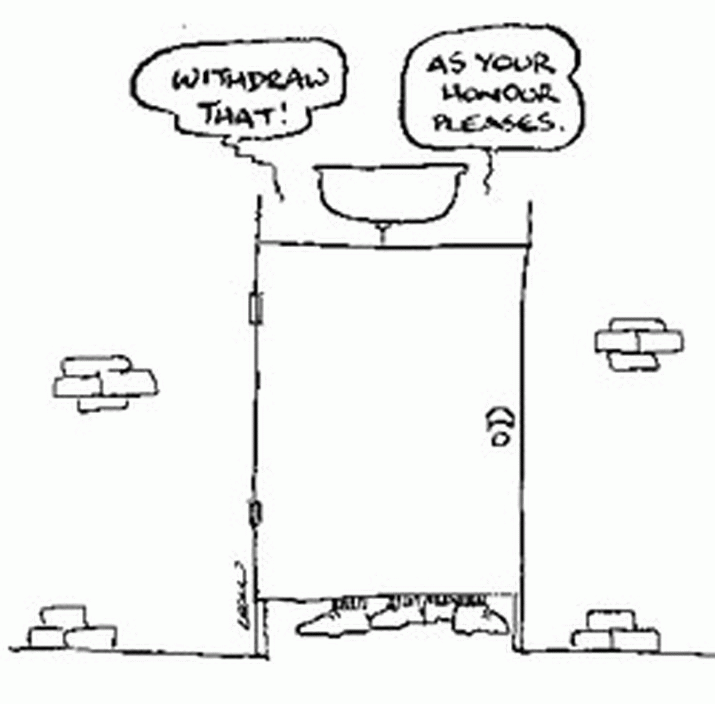
Delivering his verdict, Crispin said: “I find the defendant not guilty of murder, but I find the defendant guilty of murder.”
Advised by Pappas that he meant manslaughter, Crispin said: “I withdraw that.”
The usage improperly but inevitably recalled Patrick Cook’s wicked Yeldham cartoon which relieved the tedium of The Cartel: Lawyers and Their Nine Magic Tricks [E. Whitton, Herwick, 1998].
(Justice David Yeldham frequented lavatories at Sydney railway stations in order to engage in certain practices. When he learned that Justice Jim Wood’s police corruption inquiry had evidence of his activities, Yeldham topped himself.)
Crispin gave Singh 10 years with a minimum of four backdated to October 26, 1997. She passed her final law examinations in prison, and was out in October 2001.
Ms Garner’s steely eye identified two linked and crucial issues:
First, “the ugly divide between morals and the law”.
The law has no moral compass because it is not interested in the truth, according to Justice Russell Fox’s analysis in Justice in the 21st Century (Cavendish, 2000).
Second, does “the moral failure of the law” give judges an “icy chill”?
No. If it did, they would do something about it.