Agatha
I can’t remember exactly when it started… Even in school I was fascinated by the fact people lived on the street. I wanted to know more about them, about their lives. A friend and I had a plan to spend a week living rough, but one night shivering in the multi-story carpark in Salamanca Plane and the romance quickly died.
But the fascination lived on. Fast forward to uni and I’m reading Bukowski novels and drunk-freezing on park benches instead of making the half-hour walk back to my place from the pub.
It sounds naïve, but it wasn’t until I started working and came into contact with actual real-life homeless people did I realise one important truth: there’s no one single homeless story. Not everyone’s a wino poet like Bukowski. Everyone’s got their own story, and they’re all different.
For the past year I’ve been living in a favela of Rio de Janeiro and making films of the favela life with my girlfriend, Brianna. It’s been grand, but as our work got us roaming farther and wider we started to come into contact with the shifting and chaotic ‘group’ of homeless people living on the rich wide sands of Ipanema Beach.
Two things struck us immediately: first, there were a lot of women in the group; and second, their lives and experiences seemed radically different from those of the homeless people I had seen and spoken to back home.
Particularly tragic …
From these observations came two related thoughts. First, for a whole bunch of reasons it seems to me particularly tragic and unnatural to see a woman living without a home. Yet we hear from the UN that over 50% of the 100 million plus homeless people around the world are women. That’s frightening and deeply saddening, and it makes me want to learn more about them and their lives.
Second, although the countries of this world are in many ways unlike each other, homelessness is almost everywhere. If we could get some window into the differences and similarities in the lives of homeless women around the world, might we not learn something about what it is, what factors can cause it, and maybe even get some idea of what we can do to help?
So Brianna and I came up with a plan. We’re going to travel around the world, from Brazil where we are now, back to Australia where we’re both from. Everywhere we go we’re going to speak to homeless women and work with them to document their stories on camera. At the end of our journey, we’re going to compile what we have learned into a documentary.
One question we’ve been getting a lot is whether any homeless people will even speak to us. Well, obviously we don’t know what to expect. Some people no doubt won’t want to talk. Some will resent us for getting footage instead of getting help – and on some level I can understand that.
Some were shy at first, but mostly they were proud
But that’s only one part of the picture. Yes, the women we’ve worked with so far here in Rio were reluctant at times and some were shy at first, but mostly they were proud. Proud to be on camera. Proud to be listened to. Proud to be taken seriously, some maybe for the first time in their lives.
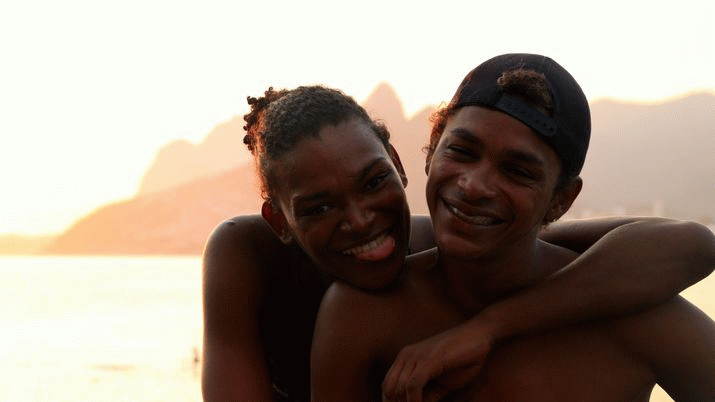
( Photo of Agatha, above )
Agatha is a transsexual woman we interviewed. We were talking to one of her friends when we met her. She charged over, demanding to know what we were doing and why we had a camera. But after we explained our purpose she became supportive, and encouragesd other women she knew to share their tales with us.
By the time we interviewed her, she was determined to tell her story. “I’m going to be honest,” she said. “About myself, at least, I’m going to be honest…”

Hosiane
Josiane is deaf-mute and homeless. We met her on Ipanema through a mutual friend.
Josiane can’t read or write well, so it’s difficult for her to communicate with anyone. But she’s incredibly patient. Through improvised mime, she explained to us that she lost her home in a flood and has lived rough ever since. She is pregnant. She says she has been before, but last time the baby died. She doesn’t like the father because he drinks too much and beats her, but for the time being they’re together.
She was also able to communicate that she was shy. At first she let us take photos but not film. But when we showed her some of the photos, she suddenly found new confidence. It was like she needed to see herself through the lens of a camera to be convinced of her own beauty.
For these girls at least, sharing their stories on camera was a big deal. At the end of the interview with Agatha, one of her friends was ribbing her about how it would go on Swiss TV and they would be a celebrity in Switzerland. We told him we were Australian, but he didn’t care. What was important was that for the first time they would exist outside the boundaries of their own lives.
We know it won’t always be like this, but for some women at least, it was a pleasure. And even if we learn nothing else, that in itself will have made this whole journey worthwhile.

Django Merope Synge and Brianna McNeillage Greene ( Above ) are currently raising funds for Unknown Millions on Kickstarter.
Visit: http://unknownmillions.com/kickstarter for more info.