The “Respect the Mountain” forum ( here, here, and here ) at the Hobart Town Hall earlier this year prompted Don Knowler to return to a diary he compiled after daily rambles on Mt Wellington during the previous year. In what promises to be a momentous year in the modern history of Kunanyi, the weekly diary gives the mountain and its wildlife its own voice. All Don’s Mother Mountain columns – and much more by this superb writer – can be found under the Category, Don Knowler, here
MOUNT Wellington throws up surprises, in all directions, in all weathers. One misty morning I set out on a quest for mountain birds in a direction I had not travelled before, heading south-west along the Pipeline Track high above the hamlet of Neika. I was not to be disappointed.
I had in the past walked the lower part of the trail a little beyond Fern Tree from where it hits the city in South Hobart. Looking at the map, this section held promise but I was not prepared for the sheer splendour of what lie ahead. Or the birds.
The mountain was wreathed in mist after a night of drizzle. This would not deter me. I was out for birds not the spectacular views this side of the mountain offers over the Iron Pot lighthouse at the entrance to the Derwent estuary, or over Bruny Island.
The clinging mist added its own magical, eerie and ghostly effect, the ghosts of a million winters past, of the call of the currawong carried back in time.
Black currawongs trumpeted my own arrival on the mountain and a two-hour hike was marched to their refrain. I had ambitions of possibly reaching the Wellington Falls, about three hours distant, but both the birds and the general spectacle of the walk delayed me. There were lessons in industrial archeology, too, because the trail, as its name suggests, follows the original pipeline that carried water from the summit, round the back of the mountain and then down in a wide half circle to Fern Tree and beyond.
The first pipeline – a second runs under the dirt road that forms the track – was enclosed in dolerite rocks and over more than a hundred years this has become adorned in moss and lichen, so it now resembles a curious natural formation cutting through the rainforest.
This section of the track promised deep-forest birds and they arrived on cue. Tasmanian scrubwrens scurried across the track ahead of me – along with the occasional bounding pademelon – and trees still dripping with mist-dew rang to the rising, single-note call of olive whistlers, although I could not see these elusive wet-forest species.
I had more luck with another forest bird, the brush bronze-wing pigeon. Mid-morning the sun had managed to break through the cloud momentarily. It sent a shaft of pastel-yellow rays deep to the first floor and there I spotted a crouched bronze-wing, the sun illuminating the iridescent feathers, more copper than bronze, on its wing feathers.
And then the mountain’s surprise, its gift to the intrepid hiker on a misty morn.
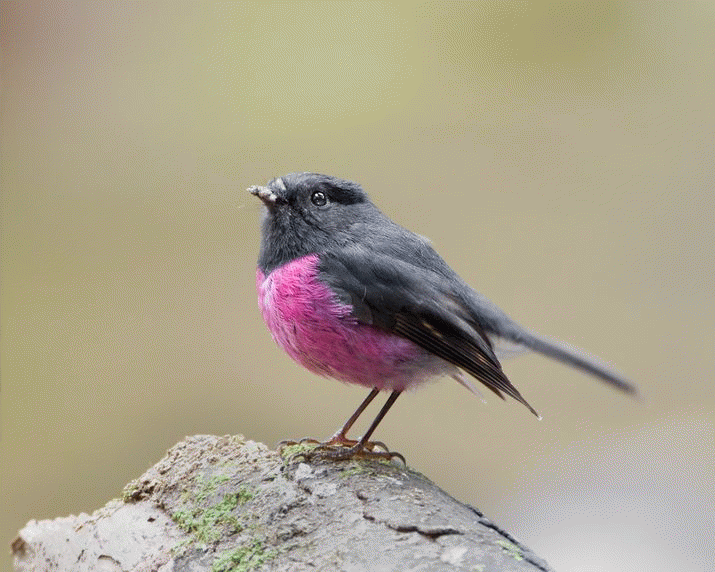
The names of features on the mountain are so curious, even bizarre, that they no longer have a literal meaning, if they ever did. They are lost in the lexicon of a lost age, the age of Victorian discovery. Amid Devils Gulch, the Disappearing Tarn, Snake Plans and Potato Fields on the south-west side of Mount Wellington, St Chrispin’s Well had escaped my attention. And now I found a signpost pointing towards it, leading a short distance off the Pipeline Track. A soft, rhythmic twitter told me a pink robin was ahead and suddenly I saw the bird leading me to the well. Though named a “well”, it is in fact a waterfall, enclosed in manfern and the hanging branches of myrtle and sassafras, true rainforest tree species more likely to be seen in the forests of Tasmania’s West Coast than on Mount Wellington.
A Bassian thrush and then another brush bronze-wing completed the picture, of a world in the clouds.
A small wall of rock creates a rockpool at the base of the falls, and clearly it was once a place for people working on the mountain, loggers maybe or those collecting ice for the ice works in Hobart, to gather water.
And on a bench overlooking the falls a poem is carved into the woodwork.
Seasons of life, seasons of rain
Nature’s ancient water wisdom flows on.
The autumn may be approaching but there was no sign of nature’s shutdown, the dramatic changing of the seasons that occurs in northern Europe, Asia and North America. There leaves are shed and pile high on the forest floor. In Australia, the leaves remain on trees and sprout new growth. The shedding of old leaves is a gentle, unhurried affair.
Looking across the mountain there was a two-tone effect, dark green infused with lighter shades, sometimes maroon and amber, the latter the colours of the northern autumn.
The flush of new growth, pea-green and translucent, was at its most powerful in the gullies which caught and held the rain, and dew.
A fan-tailed cuckoo called, possibly the last I would hear that summer and perched in silence, a female golden whistler watched me as I passed along the upper Lenah Valley Trail, a ghost of summer.
After the recent rains, silver waters washed and gushed through the mountain’s gullies and ravines, sometimes out of sight, never out of earshot. And instead of the wood smoke and eucalypt oil of recent weeks, now a damp, dank smell floated in the air. A new growth of leaves might be sprouting but dead ones had to make way, tumbling to the floor on the weakest of winds. A pungent damp smell would build through the last week of summer and build further as the autumn progressed.
And it was not just the smell of autumn hanging in the air. The air itself had lost its warmth in the early morning, even with the sun rising. Days growing shorter, and the black cockies keened.
I felt the chill as I stood on Sprinx Rock, the breeze hitting my face and the slight wind lifting the last of the dying flowers of the mountain tea-tree and snow berry and carrying them away; the new leaf growth of cheeseberry and mountain berry hardly a compensation.
A juvenile black currawong following me. Silent, and ghostly like the whistler. I call the females of the golden whistler species “ghost birds” because they hang in silence under the canopy as the males sing loudly, but they are without apparent menace. The sharp hooked bill of the currawong, te bird’s wild yellow eye, its large funereal black size. They can be a frightening sight up close. This bird, though, looked more comical than a cause for alarm. It appeared as though the young bird had not mastered the art of moving through branches agilely. It was cumbersome, ungainly and awkward. All alone and I wondered where the other members of the family were. Had this bird been ejected from the flock? After a while he looked less menacing than lonely, dejected, adrift. Birds of a feather might flock together but this bird appeared a loner, from his own choosing or fate. Does the human expression, “his face doesn’t hit” work with birds? I pondered the question, standing alone like a bereft currawong, gazing out over the Derwent and the city.
Down on the river an ore carrier made its way slowly through the Tasman Bridge, to the zinc works along the river. I had seen the pilot boat earlier heading to the mouth of the Derwent to greet the carrier as it entered the wide harbour. An ore carrier once brought down the Tasman Bridge. Twelve people died, five in four cars that plunged into the water and seven crew on the ship, the Lake Illawarra which still rests below the water’s surface.
Small posy of flowers …
The mountain was witness to that disaster, as it has been to the others to befall Tasmania. The great bushfire of 1967 that killed 62 people and an atrocity at Port Arthur in 1996. A panorama in the look-out at the summit arrows to Port Arthur, pointing to the site of the penal colony, but how many people cast their eyes south and think not of colonial history but of the massacre of 35 people by a lone gunman. I could make out the hills surrounding Port Arthur, far away on the horizon, now that the fires and smoke of summer had finally cleared.
As usual from my summer sorties to the mountain, I returned to my home with a small posy of flowers. These were not for my wife but for a squat and thick bourdon glass that acts as a mini-vase on my desk. You shouldn’t really pick wild flowers from a designated park, even a few blooms, but I tell myself this in the interests of science: identification so I can include specific mountain plants in my diary of all things spotted.
And it’s not just plants I take home, some with prickly stems and leaves that pierce the shirt pocket I put them in, and bloody my chest. I also collect dead leaves, not so much to identify the tree that produced them but for display, to view time and again their intrinsic beauty. And sometimes the hard and dry leathery leaves act as book marks for my bird field guides.
Hailing from Britain where the four distinct seasons are measured by the ever-changing shape and form of deciduous trees, each autumn I’m caught off-guard by the eucalypts that still sing of summer when a chill in the air suggests a season is coming to an end and a new one beginning. From a European perspective I have to gaze from the mountain towards South Hobart to see streets of exotic trees decorated in gold, copper and bronze. The expectation of trees dying for winter, dropping their leaves so they can be reborn again in spring, must be planted in my genes, as strongly as the fear of snakes I seldom see.
How many times during my youth in Britain did I study the rounded patterns of oak and elm leaves lying on the floor, the intricate veins radiating from a central spine attaching leaf to twig, and wonder what stories of the season just past they could tell. Each leaf was a diary entry of the sunshine, rain and winds that had shaped the canopy over the spring and summer. An individual leaf, lying dead now like a traced outline on neatly cut and coloured paper, told not only of its own lifecycle from bursting bud to death in golden glory, but of the journeys of butterfly and beetle; of the migratory travels of birds from Africa which came to Britain to forage and feed, rear young, and then return.
Each leaf was an individual, and now in my new home of Australia I find the leaves of eucalypt and acacia more individual than most. Leaves that do not automatically fall in autumn, on trees with canopies regenerated over time, fall hard and parched and in the dying and drying process not only assume their full-bodied, leathery shape, but colours to rival the bright shades of deciduous leaves. The dead leaves of yellow gum are crimson, or flame; others have more subtle hues. The blue gum dies in burgundy and carmine, the stringybark in shades of olive and maize, the peppermints in straw and saffron.
I’m not a trained scientist and wrestle between a conflict of science and poetry in my descriptions of the natural world. I know, though, that each leaf is a diagram of biology for the carbon cycle; photosynthesis, respiration and transpiration, terms that hardly describe the magic of sunshine and rain turned into forest and fern. And fresh air.