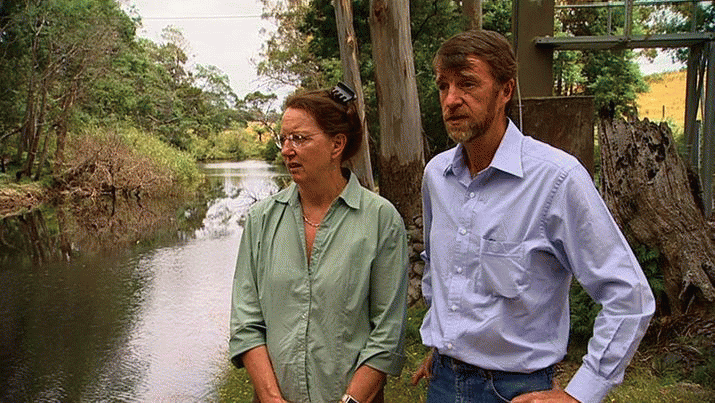
*Pic: ABC of Dr Alison Bleaney and Dr Marcus Scammell at the George River …
In Feb 2010 Bleaney and Scammell released the research findings of their research on the identification of a previously unknown group of toxins in freshwater in the George River catchment on Australian Story “Something in the Water”.
From water testing came the discovery of several unknown chemicals in the water samples. The presence of these chemicals in water samples made it hazardous to marine and freshwater organisms and to human cell lines.
The structure and pharmaco-toxicity of these chemicals is still the subject of research. A recent paper published in Dec 2014 in the International Journal of Environmental Studies by Bleaney, Scammell, Hickey and Stewart (NIWA was the main collaborating laboratory) and Sengen, demonstrates validation of preliminary work on the characterisation of the Eucalyptus nitens (E.nt) toxin.
This is our rebuttal of the George River Water Panel’s findings (late June 2010) which was conducted with no formal chemical testing or evaluation undertaken by the Panel and validation of our preliminary work on the characterisation of the E.nt toxin.
See http://www.sourcewatch.org/index.php/Water_pollution_in_Tasmania
The plantation company Forico is currently applying for FSC certification, (100,000 HA E.nt in Tasmania) with submissions due regarding their forest management plan due at the end of January 2015.
TEPHN has made a submission citing this research.
In light of these findings those Government Departments responsible for ensuring the safety of drinking water to Tasmanians urgently need to re-evaluate the risk assessment and management from human-induced changes to these water catchments substantially converted to Eucalypt monocultures to ensure the safety of water supplied to water users..
Citation ..
Alison Bleaney, Christopher W. Hickey, Michael Stewart, Marcus Scammell &
Rye Senjen (2014): Preliminary investigations of toxicity in the Georges Bay catchment, Tasmania,
Australia, International Journal of Environmental Studies, DOI: 10.1080/00207233.2014.988550
http://dx.doi.org/10.1080/00207233.2014.988550
Download ..
2014_Bleaney_Preliminary_investigations_of_toxicity_in_the_Georges_Bay_catchment,_Tasmania.pdf
1-15_Sub_to_Forico_re_FMP__HCV_MP.pdf
Forest_Management_Plan_December_2014_DRAFT.pdf
EARLIER on Tasmanian Times … a long and tortuous history …
• Something in the water … it’s far from over …
• The panel seems to have disregarded data
• Response to panel media release
• Findings of the George River water quality panel
• Today: Findings of the George River water quality panel
• George River water quality panel extends deadline
• Toxicity in Water of George River – Public Release of Research Findings (2004 to 2008)
• Dr Andrew Lohrey: George River Water Quality Panel Bias: Claim
• Open letter to Members of the House of Assembly
• The George River water quality panel
• George River water quality panel receives report
• Fear toxin review is tainted
• George River water quality panel
• St Helens water supply update
• TT’s Tasmanian of the Year on Australian Story
AUSTRALIAN STORY … links to the orginal programs …
• Something in the Water, Part 1
• Something in the Water, Part 2
• Karl Stevens, in Comments: I suspect there has been a systematic cover-up concerning clonal tree plantations. For example: How many people have seen a flowering e.nitens or e.blugum tree in a plantation? How many people have seen a young or sapling e.nitens or e.bluegum in a tree plantation? How many people have seen young trees after the harvesting of a tree plantation? Plantations have also trashed the landscape of Northern Tasmania. I traveled from Holwell to Exeter on Nettlfolds Road and Rookery Road yesterday and saw how an amazing landscape has been ruined by this mono crap.