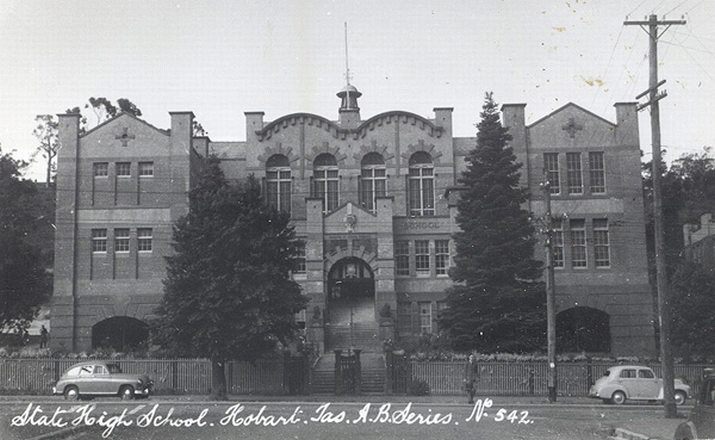
The way we were … Hobart High School …
*Cobbers: A personal record of a journey from Essex, in England, to Australia, Tasmania and some of the reefs and islands in the Coral Sea, made in the years 1930, 1931 and 1932. By Thomas Wood, Oxford University Press
Tasmania is one of the six States in the Australian Commonwealth. Federation, now thirty-three years old, has bound them into one.
This means, roughly, that Canberra issues orders about most things that matter and takes first chop at the taxes in return. Tasmanians, I found, gumble. Their money goes to bolster up ‘those Eastern States’; their orchards are sacrificed to benefit the secondary industries of other people. Like Western Australia, Tasmania feels that Federation has not given her a square deal.
The first-class passengers in this Commonwealth train have pushed her in the van and locked the door. And they have taken away the key.
Look at that Navigation Act, growl the prisoners in the van. In the old days men and goods could enter Tasmania in any ship that would take them. Now the Australian lines have a monopoly. An Orient and a P and O are allowed, on sufferance, to call in the season and load apples. For the rest of the year the island is served with ships clamped tight in the iron hands of Australian trade union rules, which govern her from the bridge to the netting under the gangway.
These hamperings gall a people who are convinced that their country could do more than serve as a holiday centre, and a home for sweepstakes. ‘Cool off in Tasmania’ and ‘Hobart Every Mail’ (an invitation to bet that every tobacconist throughout the Commonwealth advertises) are not the only catchwords they would like their State to be known by.
But they are tied to Australia – ‘the mainland’, they call it. So far as their good manners will let them betray what they feel and so far as you can judge by what they say, ‘the mainland’ is an object of suspicion, envy, and dislike.
It gives them little except patronage, and it tempts away their children and their artists to look for bigger chances and a wider sphere.
All this, somehow, gave me the feeling that Tasmania is a country for the middle-aged, not for youth. I may be wrong; I hope I am. But even if I am right I can suggest no remedy. The only good I can do is to tell those who are not as young as they used to be, and are quite prepared to face the fact, that they could search for a long time before they would find a better place than Tasmania to live in.
If you, Sir, or you Sir, have finished your job overseas and think England fullish when you retire, go to Tasmania and never grow old.
Remote it may be; but plenty of public school and ‘varsity men have found their way before you. Take a rod and a gun and your skis and your climbing boots; and take all your rackets. You can play tennis in Tasmania – Royal Tennis they call it there – in the court just behind the Club in Hobart.
If you like sailing, buy your boat on the spot. You will not be cheated and craftsmen will do the building – men who like a good job.
You will find a sun to warm you, wild life worth any one’s homage, the King’s English spoken, and the best of good fellows to welcome you.
Give them my love and say I told you to go …