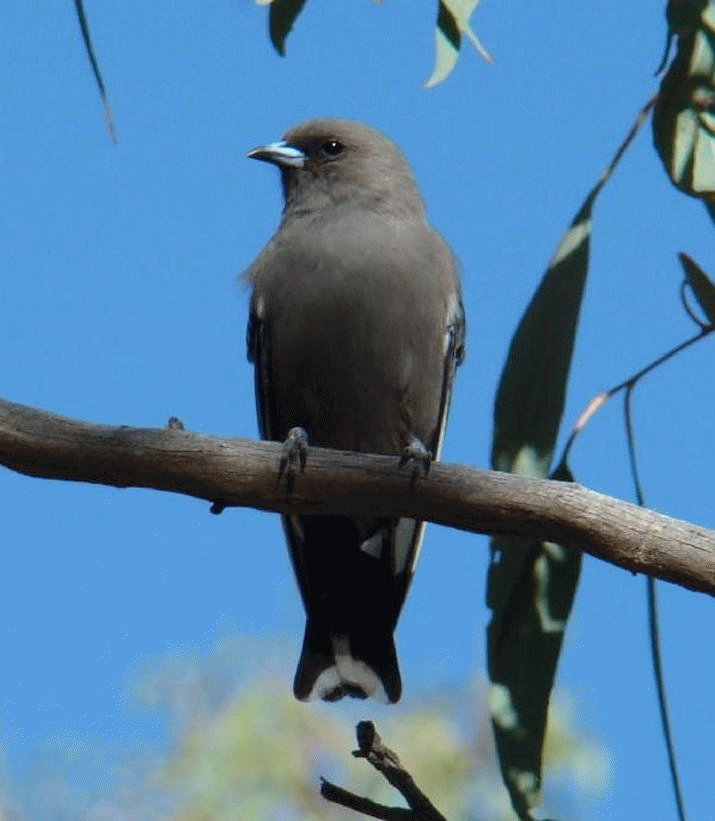
*Pic: A woodswallow …
The “Respect the Mountain” forum ( here, here, and here ) at the Hobart Town Hall earlier this year prompted Don Knowler to return to a diary he compiled after daily rambles on Mt Wellington during the previous year. In what promises to be a momentous year in the modern history of Kunanyi, the weekly diary gives the mountain and its wildlife its own voice. All Don’s Mother Mountain columns – and much more by this superb writer – can be found under the Category, Don Knowler, here
It’s our mountain. It’s a common refrain and during the year of my project to visit the mountain virtually every day I hear it all the time. It comes from both those who see the mountain ripe for development and those who want it preserved in its near natural state.
And I learn a new word: anthropocene, a world that does not belong to Mother Nature but to man. And Mother Mountain belongs solely to us, we are the landlord and all the other creatures who make it their home are purely our tenants, the strong-billed honeyeaters, the platypus, the dusky antechinus, the Hobart brown butterfly, the jewel beetles and the dead man’s finger fungus, representing a life form that spans the world of plants and animals.
Talk of cable cars, of extensions to the development zone at the summit, plans for a restaurant at the Springs; development for our mountain from the businessmen and women. And calls for greater protection for our mountain and its fragile eco-zones, and conservation of life forms, from the other side, the conservationists. But they all have something in common – the firm belief that the mountain belongs to them, it’s theirs.
Yes, it’s mine too. I try to argue it belongs to the birds and animals and insects and plants. The sight of the mountain, however, demands subjectivity. I can’t talk for the birds, or the platypus, and give voice to how they regard it. If I was a strong-billed honeyeater or scrubtit perhaps I’d just say the mountain is.
These thoughts occur to me at sunset, looking toward Mount Wellington after a visit to the bottle store in South Hobart. Tonight it stands a dusky dark blue against the magenta sunset, its edges razor-sharp as though they have been drawn by someone with a sharp pencil.
And I’m thinking of the anthropocene, and thinking Mount Wellington has stood there from before the evolution of man. And I’m thinking she will stand there long after homo sapiens have gone.
Black-faced cuckoo shrikes, the magical summerbirds of a new season, flew in distinctive undulating flight across the fire trials bordering the lower Fingerpost Track. I had seen them at last, two months after I had expected to find them.
The summerbirds had not just arrived, somehow delayed on the journey, or moving on after scouting areas for nesting habitat perhaps a little further north. They had been on the mountain all the time, I had just not noticed them, either seeing them in flight or hearing their song, a soft churring, chuckling that sounds like something shuffling a pack of cards. And when they alight from slow flight they always seem to shuffle their feathers.
And I had not seen rustle and shuffle all spring. Now I found a nest, a remarkably small structure for the size of the bird. Peering into the lower branches, I could see it was a shallow saucer of sticks and bark, bound together with cobwebs. It already had two or three young.
A day later dusky woodswallows swopped above my head, in the same location.
The last piece of the summer jigsaw was in place.
The bight yellow flowers of the silver wattle which had heralded spring in the last weeks of winter had now been replaced by dense, hanging seed pods and these were being raided by green rosellas. The birds performed acrobatic manoeuvres in the acacia branches to get at the pods, hanging upside down to strip them of their seeds. The rosellas crunched and munched, the seed husks dropping from their beaks, and gliding to the forest floor.
In the flowering waratah, the young of the fantails were now thrusting their heads out of the nest and one bird managed to free itself from the tight confines and perch on the twig holding the nest structure, swaying precariously, trying to maintain its balance.
I thought the parent birds would try and usher it back into the nest, but they seemed content to let the bird find its balance and bearings. All the while they watched about them, especially skywards from where a goshawk could mount a surprise attack and snatch a bird out of the bush. They nest and the twig holding it were well protected, however. Goshawks hunt by ambush but they must have a little space to manoeuvre and the nest site did not offer this. A goshawk, with self-preservation in mind at a crucial time when it would be feeding young of its own, would not want to run the risk of a wing injury.
The study of nests is called caliology and I told myself I could not be called a true caliologist until I had found what I consider the most difficult nest to find – that of the satin flycatcher.
I had finally tracked down the stain flycatcher to a location where I thought I might find them, near the Junction Cabin, in previous weeks and now I scanned the treetops each time I saw satin flycatchers at that location. They seemed to be in greater numbers than in the previous year. Also, I had read that they sometimes nested in colonies and this seemed to be the case in the dry forest near the Junction Cabin. In one area flycatchers were calling from all directions. I could clearly hear their sharp, rising whistle, also the metallic contact call, harsh grating buzzes, repeated frequently.
First I saw a female flycatcher and as I watched her, a male arrived with an insect in its bill. He then offered the insect to the female and she took off to an adjoining tree. I followed her flight and saw her alight on a thick branch about 20 metres up. She then hopped along the branch to what appeared to be a bulge in the bark and I could clearly see that this was a tiny, round nest structure somehow anchored to the limb. There was a slight rise near the tree and I climbed this to get a better view of the nest. It was still way up but I could make out the shape of a shallow cup, which my bird books told me would be made of shredded bark and grass, coated with spiderwebs and decorated with lichen.
Still clearly in its construction phase, the nest would be another one to monitor, although it was some distance from where I usually parked my car in forays to this side of the mountain. Getting to the nest would require a morning of walking, but the effort would be worth it.
I saw the fantails again about an hour later, the male conducting the same ritual. He might have progressed from merely wooing the female with song and dance, but he was still determined to maintain the initial bond between them, even though nest building had started. The nest is built by both species, and they also share in the incubation of eggs and the feeding of young.
The lapwings on the Fingerpost Track fire trails now had fully-grown young but the parents still watched over them intently, crying out an alarm call when I approached and then mounting swooping attacks on me. The grass was far shorter than the height of the juveniles and they struggled to be hidden by it, lying low but the whites and greys of their developing adult plumage was clearly visible.
The lapwings were lucky their main foe, the swamp harrier, was not a bird of the mountain, preferring meadow and marsh in the lowlands instead.
Blue gums on the lower slopes were still in fluffy, white flower. The blooms dripped in clusters from the green-blue foliage, partly obscured by the large, pear-shaped leaves.
I scanned these trees now for swift parrots, hoping that I would catch the fast, darting flight of these small streamlined birds as they rushed from tree to tree, consuming as much pollen and nectar as they could. I searched in vain but the trees all the same were attracting a host of honeyeaters. Yellow wattlebirds laid claim to one of the trees with a profusion of blooms and chased off a clan of black-headed honeyeaters, who were no match for the wattlebirds’ large size. Once the wattlebirds had seen off the black-headed honeyeaters, they encountered a bigger foe in a party of yellow-throated honeyeaters but still these birds were no match for the aggression displayed by their bigger cousins.
The young of striated pardalotes were well on the wing now, the first of this spring’s avian output I had seen flying. They uttered a chirring call, more the sound of an introduced European species, the greenfinch, that the short melodies usually associated with the pardalotes.
I thought for a time the greenfinch had invaded the mountain from its usual stronghold in suburbia, until I actually saw a pardalote calling to its parents. Also on the wing at the end of the last week of spring were the young of silvereyes, the birds remarkably similar to their parents, but lacking the russet feathers of the adult’s sides, and the richness of the silvereyes’ mossy-green back.
Away from the mountain, a pair of welcome swallows had built a mud-cup nest on the ceiling of an enclosed BBQ hut at the Waterworks Reserve. Each year the swallows nested there, and remarkably, tolerated the people using the hut, and the weekend visitors to the reserve, tolerated the swallows.
I neglected the mountain for a few days. Low cloud hung over it, promising rain and in the previous week I had been caught out, travelling to the peak in sunshine and getting drenched without a coat in a series of showers.
The mountain called, however, and I headed there despite a storm cloud threatening rain; this time I carried a rain-proof coat with me. The clouds soon cleared and I was greeted by bright near-summer sunshine. This time I stopped before reaching the Springs, my usual destination for bird-nest forays, and chose a new walk, a short track to the Octopus Tree off the Shoebridge Bend, lower down on the winding Pinnacle Road. The Octopus Tree is so named because of the roots that spread from its base, resembling octopus tentacles.
The forest around the tree comprises wet sclerophyll and is rich in deep-woodland birds, like the strong-billed honeyeater and the olive whistler. Both were calling as I viewed the cluster of towering gums at this location; eucalypts that had somehow survived the great forest fire of 1967. I can only assume the wet forest had somehow dampened down the flames.
It was such a lovely day and, instead of searching intensely for nests, I decided I’d walk a new trail and I chose the recently completed North-South track built with mountain bikers in mind. The track extends across the face of the mountain, more or less parallel for much of its way with the higher Lenah Valley Track and they meet at the Junction Cabin before the biker’s track rises higher into the mountain, dropping down again at the New Town Rivulet in the suburb of Lenah Valley itself.
Spring flowers presented a kaleidoscope of colour in both the wet and dry sections of the track. Not just flowers. In closed wet sections near the Octopus Tree a cluster of myrtle trees were adorned with copper new leaf. A short walk heading east revealed a dry scattered woodland dominated by silver peppermint and then eucalypt johnsonii in drier stretches amid dolerite rocks.
Black cockatoos called and then a mountain currawong arrived as I walked. It lingered, curious but not pestering, as they can be at tourist spots, but I suspected all the same it had been fed in the past and was looking for a hand-out.
The dry woodlands opened out to a section of scree which had tumbled from below the Organ Pipes. The Pipes loomed above me and in the opposite direction there was a clear view down to Hobart and the Derwent. The track crossed the scree in a section of carefully laid flat rocks, a pavement of sorts not unlike the natural Tessellated Pavement at Eaglehawk Neck on the Tasman Peninsular.
Kangaroo grass fought for light among the more scattered sections of scree rocks and amid this I spotted a moving shape, of spikes. An echidna was on the hunt for food, scratching at the dry earth before retreating back to the fringing forest. There it used its nose to turn over leaves. It did not appear to be a very happy hunting ground for the echidna and it was soon off, with a rolling waddle.
The days were getting hotter, very hot. Now I could see birds at mid-day sheltering from the heat and down off the Pillinger Drive a kookaburra sat on a stump, panting and appearing too exhausted to move.
The pademelons I often saw by day now sheltered well inside the forest, and in favoured glades I saw wallabies spread out in the cool shadows at their rim.
It was the end of November and summer had arrived. Young of the season drawing to a close were now everywhere, calling for food, flitting in uneven, ragged and unpractised flight; launching uncertainly from perches, crash-landing in bushes on their return.
No young, though, from the Tasmanian thornbills nest along the Lenah Valley Track. The nest was destroyed, either by vandals discovering it in such an exposed position, or by predators raiding it for eggs. In the timespan of my observations, it would never have held young and no doubt the thornbills retreated to thicker bush away from the track to start their nest-building all over again.