USA has a good reputation, and a bad one. American imperialism has caused great harm around the globe, and in cafés in Cairo, Islamabad and Sao Paulo the readers of newspapers agree that many of the world’s problems have their source in Washington. But at the same time it’s the USA everyone turns to for military and emergency aid, when disasters come crashing down.
USA is a land of paradox. In its insatiable greed for oil and profit, American capitalism ravages the planet. With barbaric brutality, blind to local cultural values, the superpower has invaded centres of disturbance on all continents. This behaviour is ugly and heartbreaking.
But there is another America. Peace activists, the Womens’Movement, artists and the academic bastions in the universities, where free research and the free exchange of ideas are taken for granted. The most influential critics of American imperialism are USA’s intellectuals – just think of Noam Chomsky, famous for his books and his razor-sharp contributions to contemporary debate.
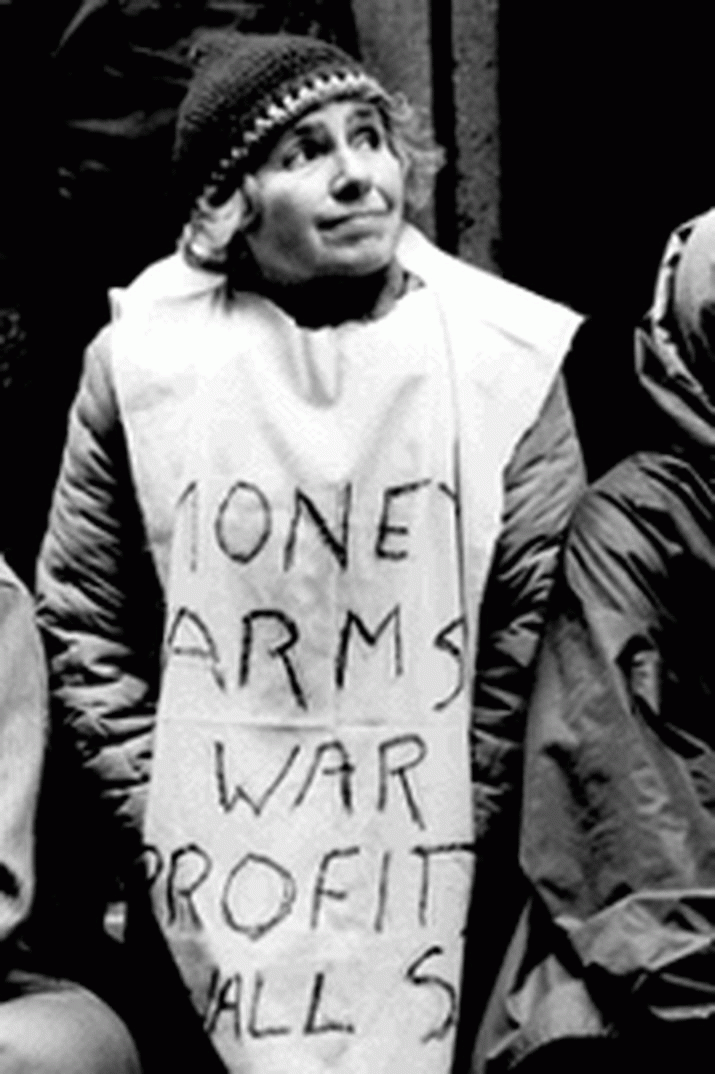
When Grace Paley, the American writer, died, I wrote an obituary for the paper. A month later I was in New York; I’d come down from Canada to join my wife at the Artbreak Hotel. That evening we went for a walk in Manhattan, and I thought of Grace Paley – it was here she lived for most of her life. Author of three short story collections, a volume of poems and some essays. Yet with this modest output, she achieved almost cult status.
Everything she wrote has a genuine quality, as if her poems and stories are a direct reflection of reality itself, lifted unaltered into her finely crafted work. Most of the tales are set in Manhattan, it is women’s lives, with men and children, which fill her books. As in the short story “Wishes” about a woman who meets her ex-husband on the library steps: she is on her way in to return some books. He accompanies her, and they talk a little together. In three pages, Paley succeeds in engaging us in a whole life, its pettiness and magnanimity.
But there were long intervals between Paley’s publications. In 1974 after “Enormous Changes at the Last Minute”, 11 years would pass before her next book “Later the Same Day”. When Grace Paley was asked why she had not written more books, she pointed out that she had many other important things to do with her time, such as raising children and participating in politics. “Art,” she explained, “is too long, and life is too short.” Besides being a mother, she was a peace activist and engaged in the civil-rights movement. During the Vietnam War she travelled to Hanoi to bring American prisoners of war home.
As we walked that evening through Manhattan, I thought of all this. We had eaten dinner and had a beer, now we just strolled. My wife spoke of her coming concert, and I studies the small piles of refuse set outside each household for the garbage collectors. Then I noticed a stack of books, and I stopped. I lifted aside the worn paperbacks on top – and what did I see? “Just as I Thought” by Grace Paley. A collection of articles, reporting and speeches written over 30 years, published by Farrar, Straus & Giroux. “As close to an autobiography as anything we are likely to have from this quintessentially American writer,” says the cover.
Here in the trash in the middle of Manhattan lay the book, waiting for me, a Hello and a smile signed Grace Paley. Today it stands among the reference books on my shelf. Now and then I open it and read a little, like the short essay “Jobs”, where Paley writes about her time as telephone operator and housewife – “the poorestpaying job a woman can hold. But most women feel gypped by life if they don’t get a chance at it.”
Put your newspaper aside for a moment and look around in your café. How many women are there on the premises? If there are far more men than women, then something is askew with equal rights in your area. Maybe you are sitting in a café in Paris, and women and men mingle. Maybe you are in a café in Istanbul, and at other tables are groups of laughing women, talking eagerly. Maybe you are sitting in a café in Sulaimaniya, and everything is normal.
In Copenhagen there are often more women than men in the cafés, just as in Berlin, Calgary and Rome. Women love to meet with their friends after work over a cup of coffee or a glass of wine, and tell about the happenings of their day, discuss and hear the news. Exactly as men do.
Take note that in strong countries with a healthy economy, the women are also strong. What is reason and what is result? The first qualification for a free country with a strong economy is that women be strong and free. No country can compete successfully in the global market without the contribution of its women.
Men have run this world for thousands of years, with no great success. Violence and wars ravage the planet. In many cultures, women are treated as second class citizens without the same rights as men. Maybe the women’s rights movement is, at present, by far the most important global arena of all. Women have just claim to the same rights as men: that ought to be a matter of course.
To straighten out this wretched state of affairs, I would suggest that we give all the political power, and all the seats in parliament, to women – for example, for 100 years – as an experiment. Not all women are angels, but maybe there is a fair chance that women will be able to bring about a more peaceful planet, with respect for each individual. Both in America and in the rest of the world.
Shortly before she died Grace Paley managed to complete a new book: “Here and Somewhere Else.” All her poems are collected in one volume: “Begin Again: New and Collected Poems.” A good place to start.
© Niels Hav – translated by Heather Spears
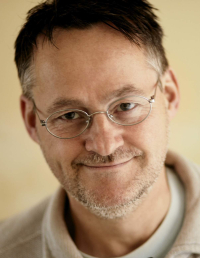
Niels Hav is a full time poet and short story writer living with his family in Copenhagen. In English he has We Are Here, published by Book Thug, and poetry and fiction in numerous magazines including The Literary Review, Ecotone, Exile, The Los Angeles Review and PRISM International. In his native Danish the author of six collections of poetry and three books of short fiction. His work has been translated into several languages such as Arabic, Turkish, Spanish, Dutch, Polish, Serbian and Chinese. Raised on a farm in western Denmark, Niels Hav today resides in the most colourful and multiethnic part of the capital. He has travelled widely in Europe, Asia, North and South America. Awarded several grants from The Danish Arts Council. “… Niels Hav’s We Are Here… brings to us a selection from the works of one of Denmark’s most talented living poets and is all the more welcome for that reason….” – Frank Hugus, The Literary Review