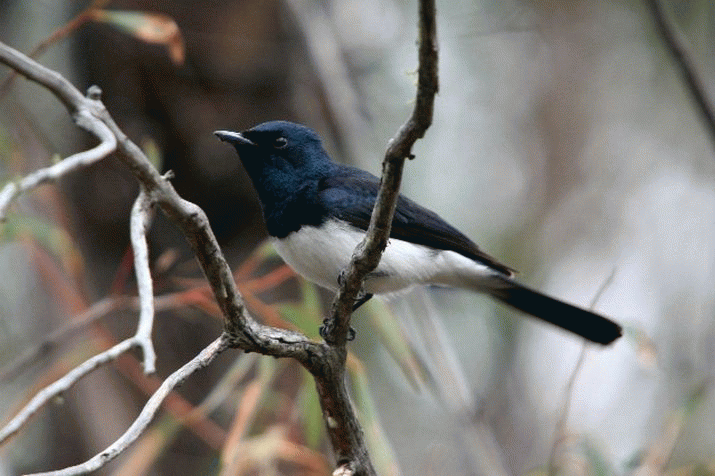
Satin Flycatcher from Wikipedia.
The “Respect the Mountain” forum ( here, here, and here ) at the Hobart Town Hall earlier this year prompted Don Knowler to return to a diary he compiled after daily rambles on Mt Wellington during the previous year. In what promises to be a momentous year in the modern history of Kunanyi, the weekly diary gives the mountain and its wildlife its own voice. All Don’s Mother Mountain columns – and much more by this superb writer – can be found under the Category, Don Knowler, here
A flash of dark blue, shimmering in the sunlight. A flash of colour again, a slender aerodynamic shape darting through the upper branches of a silver peppermint gum.
The shiny bluish-grey foliage of the gum gave the dark-blue colour of the flashing shape an added luminance, I was blinded by beauty and the light.
It could be only one species of bird decorating the silver gums in the Waterworks Reserve, the satin flycatcher, usually the last of the migrants to arrive from the mainland.
It was a thrill to see the flycatcher, and hear its metallic call and then trilling song, but the species would have to wait to be recorded on my official checklist for the year. Waterworks birds, although calling in sight of the mountain, did not count.
Being lower, and warmer, I usually see migrants at the Waterworks Reserve before they turn up on the mountain but that same day in the first week of November I went up the mountain anyway in the hope of finding them.
Good flycatcher territory is along the mid-Lenah Valley Track, in dry woodland around the Junction Cabin. I was in a hurry to make it to the cabin and back in good time and I resisted the temptation to check the flame robins’ nest I had found earlier to see if the eggs had hatched. That could wait until the next day, and besides I wanted to take my time with this and not rush to the nest to have a look. I’ve learned from experience not to pay too much attention to nests, to visit them too often or even stand at a distance viewing them for long periods. Forest ravens and currawongs – incredibly smart birds – might learn of my interest and watch my movements. Although it might sound improbable, I know of several researchers who have had projects involving nesting birds ruined because they have shown watching ravens where nests are.
So I left the flame robins’ nest to another, day when I would have more time and I could view the activity of the parents – like the male bringing more food, to feed young – for a longer period than usual.
Ignoring the flame robins for once, I tramped again towards Junction Cabin, intending to reach dry woodland where the search for the mountain’s satin flycatchers would start, for my checklist. I’d also be on the look-out for pallid cuckoos, wood swallows and tree martins, summer species that had so far eluded me.
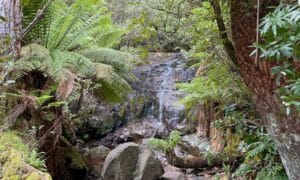
I was delayed on my journey, however, by a profusion of flowering plants in sub-alpine sections of the trail where it climbed into gorges carved by tumbling stone and water, damp but still managing to catch the rays of the sun passing across to the north for a large part of the day.
My passion is birds, but here I discovered plants to fuel a growing interest in botany. As if there was not enough time to learn of the way of birds, now plants intruded. So much to do, so little time.
I had in previous weeks bought a booklet on the plants of Mount Wellington and now I was armed with knowledge to identify them. How could I have missed such wonder and beauty in the past? How could I have overlooked the prickly beauty on warm, lower slopes with its small pea flowers, yellow with maroon centres, on short spiky leaves?
Along a section of track before and after the turn-off to the Sphinx Rock, amid shady, tightly-packed forest that could be termed the “jungle” of the children’s books of my childhood, the thrusting candle-like flowers of Richea dracophylla thrust through cutting grass and fern. The plant, related to the pandanus of the peat-bog and buttongrass plains of the state’s higher mountainous regions, had a single, stacked flower in white and flesh-coloured pink, rising to possibly half a metre.
The white button flowers of snowberry, five petals with a pink centre, were clustered above pale green-grey, serrated and long and slender leaves.
Two species of blanket leaf in white and yellow flower and heading towards the Sphinx Rock, in a location that caught more sun, the short trail was adorned with golden shaggypea, with bright yellow pea flowers on pointed green leaves.
I became distracted by birdsong …
Although distracted in my bird safaris by plants, I became distracted in turn by birdsong. An olive whistler called, incredibly close and I peered into tangled foliage to find it. These birds blend so perfectly with the rainforest that, even at close quarters, they are sometimes impossible to see. All the while they call a strange far-carrying, foliage-penetrating single note “wheeze” of a song. It’s not like bird sound at all. Does this call originate in the age of the dinosaurs, air thrust through cartilage and membrane to create the first animal sounds?
The re-creations of dinosaurs I’ve seen in museums, given sound-effects, always seem to make the same sound without notes as such, just rising and falling rushes of air thrust through small apertures, a horn-like shape on a nose, a bellow from the mouth.
The song of the olive whistler is not the sound of birds, like its close relative the golden whistler that doesn’t exactly whistle, but has a pleasing descending melody which, nonetheless, ends in a most unbird-like sound, as sharp crack.
Scanning the “jungle” for the olive whistler, I literally backed into the nest of a Tasmanian thornbill that had been strung up in a cheeseberry. The shrub is usually squat, hung with bright red berries, but this one was uncharacteristically tall, overhanging the Lenah Valley Track.
The nest appeared as a loose bundle of grass and moss, elongated in shape. At about 15 centimetres, it appeared too large for such tiny birds. I soon confirmed it did indeed belong to thornbills. When the bulk of my body rocked the cheeseberry supporting the nest, the birds flew out in panic. I wanted to inspect the nest more closely. It was the first thornbill nest I had found and I wanted to establish if it was cupped or domed; instead I backed off not wanting to disturb the birds any further.
It was clear, though, that the nest was still undergoing construction. It was untidy and still had to be bound with a spider’s web to give it shape and strength against the winds. All the same I feared for the safety and survival of the nest. It was literally overhanging the path and I was surprised I had not noticed it on previous days when I tramped the route. Sooner for later it would be seen, especially with the tiny birds fluttering to it, and it would be the target of the inquisitive, however innocent, or the malicious. It was in such an exposed location that I also feared that if humans did not disturb the nesting birds, then currawongs or shrike-thrushes most certainly would.
Next day it was back to the flame robin nest and I was delighted to see the male making more frequents visits to the nest than usual, his beak loaded with food.
I trained binoculars from afar on the nest and I could see the female restless and fidgety, tiny bodies writhing no doubt below her. The male was still feeding the female, but paying more and more attending to what lie beneath.
Returning to the Springs I thought it time to check on another nest I had found, tht of the Bassian thrush, and when I reached this I could see the female sitting firmly within the cupped grassy shape. She remained motionless for long periods and it was clear that incubation was in process, the nest would be snug and warm and soon the thrush young would fight their way out of eggshell and be ready to be fed. Meanwhile, the male Bassian thrush delivered worms and grubs to his female with frequent sorties.
During the first week of November, the nesting and breeding season was reaching its peak – at least for the first wave because birds generally deliver two clutches of eggs and two broods of young during the spring and summer.
Soon the songs to declare territory would be replaced in part by the calls of young on the wing calling for food from their parents, in the weeks before they were competent and confident to find food for themselves.
I hadn’t seen any young on the wing yet, just a few yellow beaks thrusting up from nests and males still bringing food for incubating females. Along Dunns Creek the nest of a currawong now revealed female incubating eggs. She received a juicy, thick skink from her mate.
The dangers for parent birds were increasing by the day with eggs and now vulnerable young in the nests, featherless birds unable to fly and defend themselves. Predators, with young of their own to feed like the currawongs, were scouting the woods for prey. On the fire trails adjoining the Finger Post Track, masked lapwings constantly called to their striped young to lie low when the kookaburras came to call. Then they took to the wing to drive the kookaburras off with swipes of the wings.
The flowers of prickly moses began to fade to be replaced by later flowering blooms of golden rosemary, in dry locations on the mountain that received plenty of sun. And amid scattered blue gums on the lower slopes the delicate flowers of white flag iris decorated the grassy glades.
Ten weeks into spring and snakes were about, engaged in the same mating rituals as the birds in the trees and bushes above their heads, and in some cases in the same much-sought after hollows and holes on the ground. Tasmania has only three species of snake – the tiger, copperhead and whipsnake – and they are all found on the mountain, and are all poisonous. The Mercury reported that in recent days snakes on the move after a winter of hibernation had bitten a dog, and warned readers to beware.
The yellow-tailed black cockatoos were not heading from the mountain as they did in autumn and winter but towards it, to exploit its rich flowers and, later, rich fruits, a change from the diet of insects prised from bough and bark.
In central Hobart on the morning of November 10 I saw three block cockies crossing the sky above Macquarie Street, a male and female with a youngster from the previous breeding season, the mountain in their sights.
At the same time the north-eastern sky as painted in purple and black, a swirling mass of cloud gathering in torment. The cockies’ wingbeats gathered in speed as the cloud also gathered pace, the leaden air swirling and pitching and swaying across the horizon, rising and then dipping. It dropped so low that it hid at one point behind Knocklofty before emerging to roar across the rooftops of South Hobart. Trees swayed deliriously and window panes heaved and sucked, and leaves and pieces of paper were tossed by the wind. The South Hobart mini-tornado was one of three to hit the area, spiked with lightning, thunder and heavy rain. When the winds died down, and the dust settled, it emerged Hobart had escaped serious damage, and black cockie wings were intact.
Calm next day. A female golden whistler slowly and quietly going about her business, plucking grubs from leaves, a grey ghost of a bird without the bright yellow, white and black plumage of the male. And amid trees on the mountain’s lowest slopes showing torn branches and shredded leaves, a pallid cuckoo called, the first I had heard that spring. Within minutes I caught sight of the bird to confirm identification, a big male being chased by yellow-throated honeyeaters.
Of the migrants, summerbirds and dusky woodswallows where the last of the more common ones I still had to find. Along with the satin flycatcher.