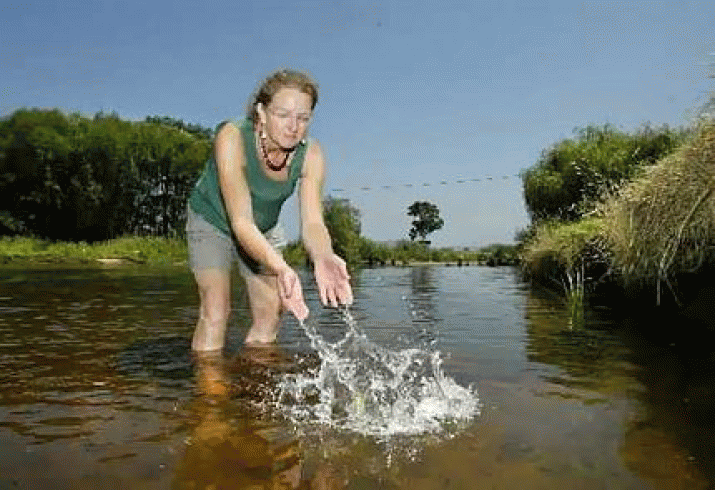
*Pic: Fairfax picture of Dr Bleaney in the George River 2004.
Confirmation of the cessation of any routine pesticide monitoring in any waterways in Tasmania ( including all drinking and ground waters) was given by DPIPWE this week (Stuart Bowman). The announcement coincided with substantial funding cuts in the recent State budget.
With regard to pesticide monitoring in waterways, Tasmania now reverts to where it was in 2004 prior to the helicopter crash in the upper catchment of the George River where the highly hazardous insecticide alpha-cypermethrin was being aerial-sprayed onto eucalypt plantations. Shortly after and following a very heavy rainfall, 90% of intertidal oyster along with other insects and aquatic life died in Georges Bay.
At that time Tasmania undertook no pesticide monitoring of any waters.
Forestry Tasmania is about to increase its plantation workings and has just applied to the Forest Stewardship Certification (FSC) body for permission (a derogation) to aerially spray alpha-cypermethrin in eucalypt plantations. FSC does not ‘normally’ allow alpha-cypermethrin to be used as it is a highly hazardous pesticide.
Meanwhile, drinking water in Tasmania undertakes no pesticide monitoring despite nearly all Tasmanian water catchments being multi-use catchments including agriculture and agroforestry.
Background to Water Quality in Tasmania
In July 2004 Dr Marcus Scammell PhD and Dr Alison Bleaney MD submitted a report on behalf of the Tasmanian Seafood Industry Council.[19] The specific findings were:
‘The aerial spraying (using helicopters) of plantation timbers appears to be responsible for large-scale losses of commercial oyster following heavy rainfall events. The normal environmental protection methods do not appear to be in place and no policing of the State’s own Forestry Code of Practice appears to be occurring. More disturbingly, the problems associated with oysters also correlate with tumours and mortality in Tasmanian Devils. Further there appears to be a risk to human health as contamination of local drinking water supplies is also possible.’ Ref 19
http://www.sourcewatch.org/images/7/7c/Tasmanian_Seafood_Industry_Council_Report_to_DPIPWE_-_Environmemtal_Problems_Georges_Bay_Tasmania_Feb-Jun_2004.pdf
Download, submission re Forestry Tasmania: Alpha-Cypermethrin Derogation Application to FSC 2014:
10-14_For_Tas_Alpha-Cypermethrin_Derogation_Application_to_FSC_2014.pdf
Tasmanian Public & Environmental Health Network (TPEHN)
http://www.sourcewatch.org/index.php?title=Pollution_Information_Tasmania
• Andrei Nikulinsky, in Comments: Are we honestly being told that while there is money to sponsor a different state’s football team, to subsidise one of Australia’s richest retail company’s buildings, to puff up the gambling industry and even continue to throw good money after bad by paying to send woodchips overseas like it was waste… …that there is no money to test our water supply?
• Download Clive Stott ( http:www.cleanairtas.com ) Submission:
ft-alpha-cypermethrin-derogation-application15.10_.14_.pdf
• ABC Rural: Forestry downturn reduces routine pesticide and chemical testing of Tasmanian waterways