The “Respect the Mountain” forum ( here, here, and here ) at the Hobart Town Hall earlier this year prompted Don Knowler to return to a diary he compiled after daily rambles on Mt Wellington during the previous year. In what promises to be a momentous year in the modern history of Kunanyi, the weekly diary gives the mountain and its wildlife its own voice. All Don’s Mother Mountain columns – and much more by this superb writer – can be found under the Category, Don Knowler, here
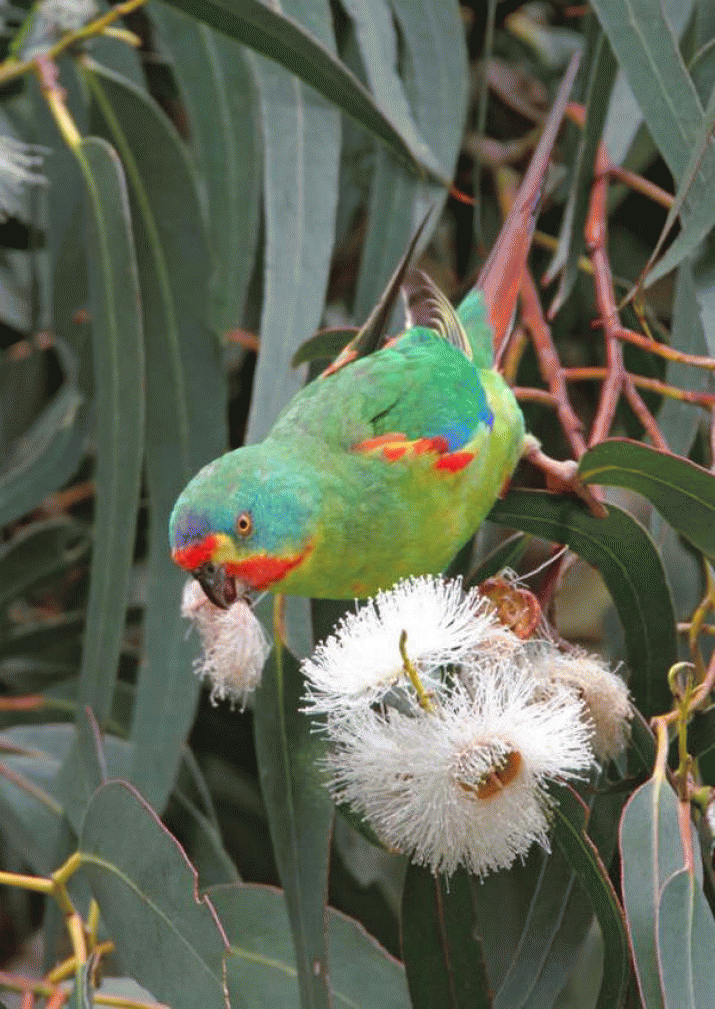
Word spread through town that the swift parrots had arrived from the mainland.
The excitement among nature lovers was palpable. If there is a bird of spring in Tasmania this has to be it. Swallows might herald spring but they can arrive in late winter, with snow still on the peaks. The swift parrot on the other hand, waits. It seeks the blooms of gums – especially blue gums – and will not move from its wintering grounds in the ironbark forests of Victoria and southern New South Wales until the innate knowledge buried in parrot DNA says the time for the eucalypts to bloom has arrived.
I searched high and low. The blue gums are largely found on the lower slopes and foothills of the mountain and I did the rounds of giant trees of the species in which I had found swift parrots, but only rarely, in the past.
The white clusters of flowers were just emerging on both blue gums and another towering eucalypt found on the mountain, the stringybark, but I did not have any success in the first week of October.
Then I switched my focus to other blue gums in the city which are known to be visited by swift parrots when they first arrive from the mainland. One of these is in the grounds of the Angelsea Barracks and I drew a blank there, finally trying my luck at a red-flowering gum in the Woolworths car park in Sandy Bay, where to my surprise I had seen a pair of swift parrots feeding during the last spring.
Although swift parrots largely feed and nest in blue gums they home in on any flowering plants when they first arrive, often in the Hobart suburbs. Only after this early spring feeding frenzy, to top up supplies of energy exhausted on the long journey across Bass Strait, do the swift parrots move out to their main breeding grounds, largely within sight of the coast on the south-eastern and eastern side of Tasmania.
The last of the snows were vanishing from the mountain. The air grew warmer, birds sang and trees and shrubs sprouted into flower. Spring had finally, definitely arrived.
I searched again for flame robins along the Lenah Valley Track to Sphinx Rock and found a male in full courtship display, and a female looking on approvingly close by. The spot was ideal flame robin country of dry woodland with scattered yellow gums, and scattered dolerite boulders. Next day I check on the flame robins again, and found them copulating in the sun, the male gently mounting the female amid twitters.
I noted the nest site, on a ledge between two boulders that in past times had tumbled down the mountain and come to rest against each other. The biggest of the boulders was about a metre high and the second pushed against it, about halfway up. From the base of the larger rock a mountain tea-tree had taken root, growing to the height of the larger rock and shielding the site with a rightly-packed cluster of woody stem and hard and shiny dark-green leaves.
Soon I saw the female taking nesting material to the site wedged between the two rocks, and the nest taking shape within a few days. The female alone built the nest, making trip after trip to a patch of dried grass between the gums, to collect material. A little later I took a close look at the emerging nest, when the birds were well out of sight. It was finely craft from both grass and shreds of bark, forming a neat cup. After the nest appeared to be finished, the female inspected it, along with the male, and then paused for a few days. I thought she was going to lay eggs but instead she returned to the nest with spider webs, with which straggling pieces grass were bound together in an even neater formation. Lastly, the female went in search of lichen, and decorated the nest with this. Whether it was for pure decoration, or camouflage, I will ever know but all the same the nest blended perfectly with the rock, the lichen dotting it with flakes of silver and green.
All the while the sound of calling fan-tailed and shining bronze-cuckoos echoed across the rocks and scree, and I urged the female and her mate to beware.
October is known for its highs winds and these grew in intensity as the month progressed. On one day with particularly strong winds I hurried to get off the Lenah Valley Track, the gums and acacias swaying and creaking above me, but paused at one point to view the spectacle of golden silver gum petals being were swept across the mountain slopes in vast clouds, a shimmer of gold-leaf on the wind, as prospectors of old would have found flakes of gold in mountain streams in the goldmine country to the north.
Suddenly the wind would stop on these days, and a peace of sorts would return to the mountain. Walking to Sphinx Rock, I came across a pink robin on the first part of the trail which goes through wet woodland. It sang lustily from a low perch, instead of the more common territorial perches higher off the ground, its tail quivering with every note. I decided it was time to descend the mountain and check out the pink robin territory I had found previously along Dunn Creeks. I had not seen the male bird there yet, only heard it singing, but knew in time I would find it, unless it had been frightened out of its prospective territory by the sight of currawongs, grey shrike-thrush or cuckoos.
I soon found the bird, and found its nest. Work on its construction had just begun and I was filled with joy because some years I failed to find the nest of the species, which I rate as the finest, along with that of the fantail.
This time both male and female appeared to be building the nest, placed in the fork of a dogwood right above the stream. It was partly obscured by the leaves of the tree and I had to position myself on a footpath, some distance away, to get an angle to view it from slightly above.
When I discovered the nest it was merely a rudimentary platform of tiny twigs to give it foundation but over a few days this was built on, to produce a perfectly rounded, if small shape. As far as I could see the nest was mainly constructed of moss on its firm base and this was shaped and moulded by both birds to produce what I can only describe as a donut with a hole in the middle. The moss shone bright green and yellow, sparkling and moist, at the smart but it soon merged into the more subtle forest colours, with the addition of lichen.
I knew when the beautiful nest was finished. Both birds took time out from their frenzied activity to perch on a nearby branch and view it. Perhaps this behaviour was designed to determine whether it was truly camouflaged from the gaze of currawong and cuckoo. It appeared the birds had succeeded.
Fascinated by the earnestness of the pink robins, I had wandered a little too close to the construction, worrying the birds by pushing back the leaves shielding the nest to get a good look. I immediately backed off to give the birds breathing space. I didn’t want them to desert, and would have been angry with myself if they had done so.
And at that point I decided to give them complete privacy from prying eyes, and let them copulate in seclusion and peace.
It was all happening on the mountain, as a sports writer might say, in both nature’s and man’s world, although from a different perspective in these heady days heading towards summer. Amid the breeding and nest-building frenzy, and the frenzy of feeding to build strength for the busy period ahead, the busiest in the bird world, the fine, sunny weather had brought out the human visitors to the mountain. Rock-climbers scaled both the Organ Pipes and the cliff below Sphinx Rock. Without seeing the climbers, I could hear their excited conservation echoing across the cliff faces.
And it was not snow responsible for the closure of the Pinnacle Road in the first week of October, but the mountain stage of the Tour of Tasmania cycling event. Out on the Derwent the sailing season had started, the blue waters of the estuary dotted with the white sails of yachts. As yellow-tailed black cockatoos and black currawongs called on the mountain, the traditional sail-past on the Derwent was marking 131 years since those sails were first unfurled in competition on Hobart’s waterway.