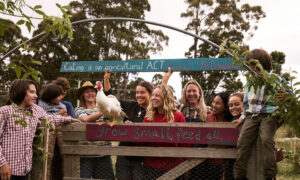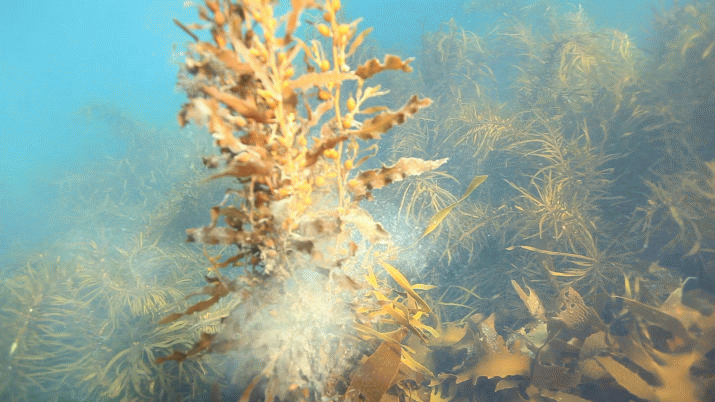

Pics: The top picture is at Hope Island, close to a number of salmon farms at Dover. The bottom picture is at Lady Bay with no nearby fish farms but a new expansion proposal very close by. The concerns over the dusty sediment found at Hope Island is that this affects marine life and fish like abalone and their ability to survive and prosper, but research into these impacts and ongoing monitoring is not occurring. The Abalone Council will be releasing a report tomorrow with their concerns …
Community and Conservation Concerns Over Salmon Farms Rising
Environment Tasmania have today called for a thorough upgrade of the monitoring, planning and management systems regulating salmon farms in Tasmania after a new report shows that scientific monitoring of the salmon farms is inadequate and a regional planning review is in need.
“Right now, salmon farming is the ocean equivalent of overcrowded caged chicken farms. They are polluting Tasmania’s clean waters, damaging the health of the marine environment,” said Rebecca Hubbard, Marine Coordinator with Environment Tasmania.
“The damaging, polluting impacts of salmon farms have spread well beyond the shore, with noise, pollution and debris impacting on coastal communities and other industries such as fishers.
“We know that at least 144 protected seals have died as a result of fish farming since 2009. We know that farmed salmon is not naturally pink, but dyed to be the classic salmon colour that most Australians would think is natural.
“However what this new report demonstrates is that we do not know just how big the pollution impacts of salmon farms are on other important ecosystems such as reefs and kelp forests, and species such as abalone and rock lobster. These are not being monitored, and what monitoring is done is not available to the public,” said Ms Hubbard.
Lady Bay landowner Ms Karen Harvey is concerned about the impacts on locals and tourism businesses. “As Tassal continues to expand their profits, Tasmanians and visitors to Tasmania are increasingly robbed of this stunning coastline. This expansion is happening without many Tasmanians even realising.
“We’re concerned about the impacts on our environment from noise, lights and rope debris, and impacts on the fishing industry and local swimming, kayaking, boating and surfing. We are greatly concerned that the proposed farms would have a devastating impact on the growing ecotourism businesses in south-east Tasmania.
“We’re running out of accessible untouched coastline – people move here and tourists visit to get away from it all. But how far do we have to go?” concluded Ms Harvey.
Marine Coordinator Rebecca Hubbard asks, “What coastal communities need right now is a greater say in the monitoring, planning and management of salmon farms. The government’s process of considering applications for salmon farms has to be more transparent if Tasmanians are going to feel confident the farms are in their interests as well.
“Salmon farming does have a future in Tasmania, but it has to be done smarter, so that the industry works with the natural environment, not against it.
“If the industry is really committed to transparency and sustainability, then they should have no problem investing in a thorough, independently audited, monitoring program that looks at key community values,” concluded Ms Hubbard.
The report can be downloaded from:
www.et.org.au/fish_farms
Summary:
Review of Monitoring the Environmental Effects of Salmon Farming in Tasmania
Author: Hugh Kirkman Private Consultant
Commissioned by: Environment Tasmania Inc
Background:
Salmon aquaculture in the D’Entrecasteaux Channel and Huon Estuary can have serious ecological and social impacts which may get worse as the industry expands. As the effects of climate change become greater, there is a need to increase natural areas’ resilience, and even more important to reduce other environmental stresses within our control.
Recent research suggests there has been environmental degradation including the creation of dead zones (localised oxygen depletion), nutrient enrichment in bottom waters of the Huon Estuary, a long-term increase in phytoplankton, and toxic algal blooms.
Recommended monitoring:
Additional research is urgently needed to assess impact and recovery of seafloor ecosystems over time.
There is no meaningful reference site to compare against sites in the Channel that are impacted by salmon farms, which needs to be immediately rectified.
The current annual frequency of video samples is inadequate for a meaningful assessment of impacts on sediment under cages as it does not alert managers to impacts that may do permanent damage to the seafloor and fauna. These video images and transects should be made monthly and triggers for action set.
A regional planning review should be undertaken to cover all uses of the waterway resources and conservation of the environment. This “strategic plan” will establish how the waterway is planned and managed.
There are a number of environmental parameters that have been recommended for monitoring that do not have baseline figures or trigger levels to determine if there are changes in ecological function or ecosystems. Without monitoring of these parameters and known baselines, we cannot know the scale of the impacts.
Monitoring should be designed from a water movement model and the current Broadscale Environmental Monitoring Program (BEMP) should provide data that could be compared with the baselines or trigger values relevant for the identification of change in ecological function.
There is no data available for the effect of nutrients or salmon cage detritus on reefs or seagrass in south-east Tasmania despite recent studies showing impacts of nutrients on macroalgal communities occurring hundreds of metres away, and impacts legally limited to just 35 m from lease areas.
More nitrogen in the sheltered water habitats in the southern D’Entrecasteaux Channel could result in significant environmental effects on marine vegetation communities within the broader southern D’Entrecasteaux Channel and Great Taylors Bay region.
• Guardian: Earth has lost half of its wildlife in the past 40 years, says WWF Species across land, rivers and seas decimated as humans kill for food in unsustainable numbers and destroy habitats
• Gavin Collier, in Comments: A travesty shielded by communities in dire financial trouble aided by Corporate thugs, Salmon farming. The nets are toxic to organisms, the food is derived from Our native fish stocks at a unsustainable ratio 4kg native fish produces 1kg private fish, Salmon have one of the most sensitive navigation systems in the fish world and do not naturally exist in the Southern hemisphere. I have lived in Scotland and caught wild Atlantic Salmon, have seen the pollution from farms destroying fragile natural ecosystems, then watched in abject horror when it arrived in Tassie. Having discovered, exploited and collapsed native commercial fish stocks it would appear we are hell bent on destroying what remains of a very fragile environment. Explain this to your kids and how you did nothing but continue to consume to the death of all that was natural around you. Finally I would like to remind people of the take over by Korda-Mentha (who were the receivers) many years ago and how locals working at Tassal held shares which were wiped, altered and re-floated without compensation, during this turmoil the factories never missed a beat.
• Download, Risks to the Tasmanian Abalone fishery from expansion of the Salmonid industry, from Dean Lisson, CEO, Tasmanian Abalone Council:
• Paul Harriss: Labor Join Greens in Opposing Growth in State’s Aquaculture Industry