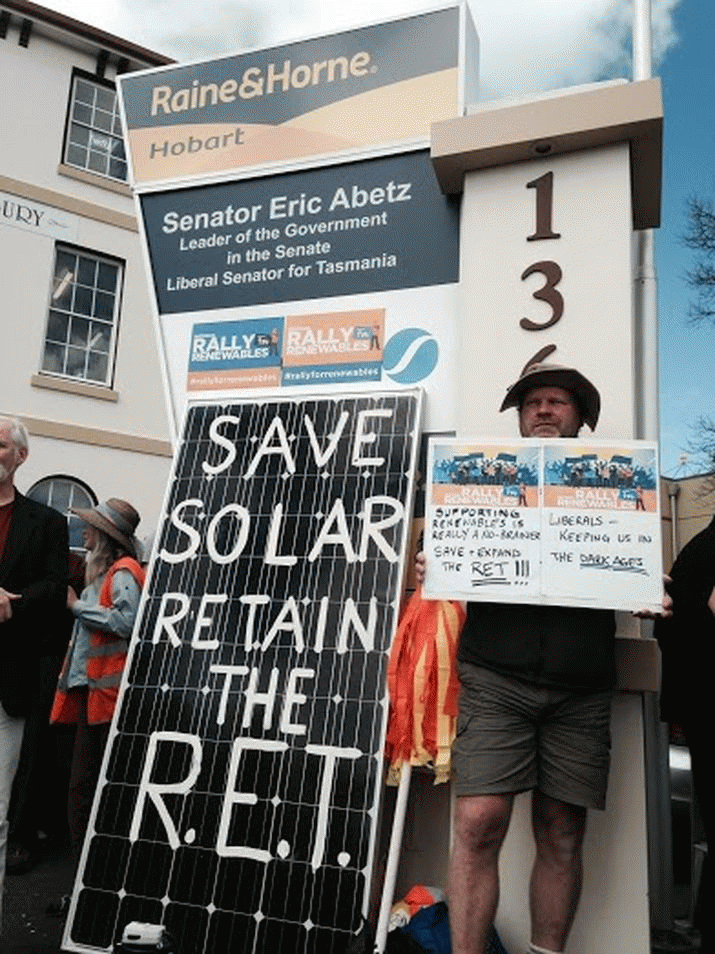


Talk for Rally for Renewables, Hobart 26 Sep 2014,
Tasmania has a long and proud history of developing renewable energy. Nearly 120 years ago the Duck Reach Power Station in Launceston replaced gas street lighting with modern electric lighting. Tasmanians know how to do new technology!
Today, Tasmania, with less than 1% of Australia’s land produces almost half of Australia’s renewable electricity.
Renewable energy is an important source of jobs and investment in Tasmania: the solar industry provides direct employment for around 450 Tasmanians. These are skilled, professional jobs and provide employment in rural as well as urban areas. This is in addition to the over 1100 people employed by Hydro Tasmania.
This week over 120 heads of government met with the UN Secretary General to explore ways to urgently reduce our emissions of greenhouse gases. You would hope that given this goal, the renewable energy industry in Tasmania would be booming.
There is certainly plenty of potential for future expansion; in small, medium and large wind farms, in hydro power on run-of-river and on irrigation schemes, and in the further expansion of solar power. We have the potential to export renewable energy to the mainland through Basslink and while we are close to 100% renewable in our electricity use, we are almost totally dependent on imported fossil fuels for transport. Electric transport would provide energy security and new economic possibilities, as well as reducing the billion dollars a year Tasmanians spend on imported transport fuels.
Hydro Tasmania is investigating the development of a 200-turbine wind farm on King Island, connected to Victoria via a high-voltage underwater cable. If it proceeded it would cost around $2 billion to construct, could bring 500 jobs to the island during construction and up to 45-60 direct and indirect jobs for the longer term.
But the renewable energy industry in Tasmania is under serious threat from the policies of the Federal Government. Already the abolition of the Carbon Tax has reduced Hydro Tasmania’s annual profit by $70m. Hydro predicts that it profit for the current financial year will drop by 90%, due to abolition of the carbon tax, uncertainty about the RET and lower demand for electricity. That’s hundreds of millions of dollars less for Hydro’s owners, the people of Tasmania.
Without continuation of the RET no further medium and large wind projects will be built in Tasmania, our potential for small scale hydro will be wasted, and employment in the solar industry will shrink when it could be expanding.
The RET is an effective policy which had bipartisan support from when it was introduced by John Howard in 2001 right up to the last federal election when Greg Hunt said “We … agree on the renewable energy target.”
82% of Australians want the RET retained, it is supported by the Tasmanian Liberal State Government.
Tasmania has 17 representatives in federal parliament to represent our interests. This should be one issue on which Eric Abetz, Christine Milne and Jacqui Lambie can form a united front to support jobs and investment in Tasmania.