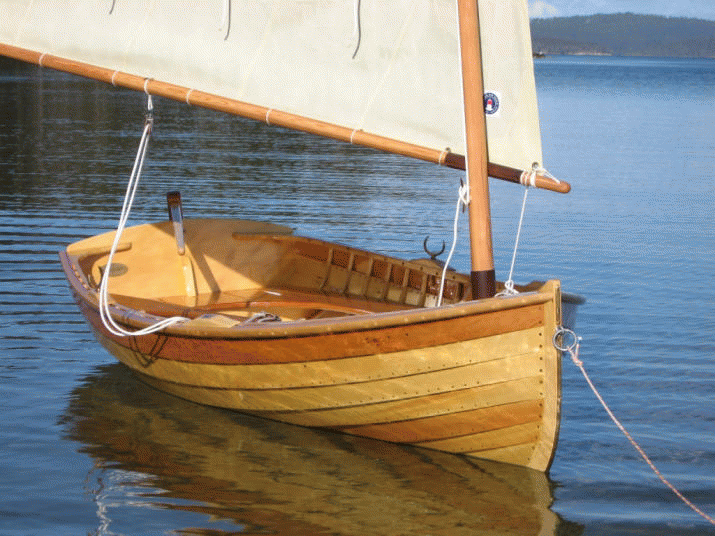
*Pic: End product of specialty logging … a Huon Pine Denman Marine dinghy
THERE has been much comment by the environment movement in the wake of the State Government’s new forestry legislation.
This commentary has been alarmist, inflammatory and most decidedly incorrect when it comes to the issue of specialty timbers and, disappointingly, is a far cry from the exalted position previously advocated for the sector by its new-found detractors over the past decade.
Some of the most vocal opponents to the new Forestry Act are the former and current Greens leaders — Peg Putt (Markets for Change chief executive), Kim Booth and key Tasmanian Forest Agreement non-government organisations, Environment Tasmania and The Wilderness Society. One claim being made is that the new legislation opens up 1.5 million hectares of reserves for specialty timber harvesting, which is completely incorrect.
The two governing Acts that deal with our reserves are The Nature Conservation Act and the National Parks and Reserves Management Act.
These define the class of reserve land tenure and the purpose of, or allowable uses, within that tenure.
Enacted in 2002, both specifically allow for the use of natural resources in conservation areas and regional reserves, which includes mining and the use of other natural resources such as timber and marine resources.
This is not new and has been the case since enactment.
A review of Hansard from November 2002, when these bills were before the Parliament, shows that both passed on the same day without amendment or opposition from the Greens, including Ms Putt and Mr Booth.
To find the truth …
They now conveniently hope Tasmanians will not delve that far back in the past to find the truth.
Ms Putt’s own forest policy, released when she was Greens leader in 2004, advocated strong support for the specialty timber sector saying it should be the “icon” of the state’s industry.
This policy stated the sector was worth $100 million a year to the economy and used 20,000 cubic metres of timber per annum.
The policy also advocated for providing $5 million to grow the sector, including establishing a specialty timber sawmill tourist attraction in Maydena cutting specialty timber from the Styx Valley, and another in the Huon Valley.
It also stated “New Specialty Timber Zones will be created to sustain the valuable contribution of this sector to the Tasmanian economy”.
This policy was revamped in 2010 by Mr Booth and Mr McKim (the new policy stated it “is important to be able to hold a $4000 guitar, to sit at a $7000 table”) and was subsequently taken to the most recent state election.
The Wilderness Society’s Vica Bayley issued a media release at the time strongly supporting the Greens’ revised policy.
Like its predecessor, this policy advocated for special timber zones to be established that were “outside areas earmarked for reservation” yet when the areas chosen in these policies are plotted on satellite imagery, many are actually throughout the exact reserves where the new Forestry Act will allow for harvesting.
In reality, the Government is actually implementing a Greens initiative in the new legislation so why are the Greens opposing it?
In 2004, every major ENGO in Tasmania including The Wilderness Society, the Australian Conservation Foundation, the Huon Valley Environment Centre, the Tarkine National Coalition, and 17 other ENGOs supported a document called Protecting Forests Growing Jobs.
This document states: “Labour-intensive boat building, fine furniture and craft-based timber industries use relatively tiny volumes of special species timber 18,500m3 p.a.). Further industry development and access to specially managed forests would see this industry grow.’’
A far cry from the rhetoric
This document also wanted to provide $5 million to the sector to “ensure specialty timber supply for artisan and other high-value/low-volume users”.
These statements are a far cry from the rhetoric now being espoused by these groups.
The latest derogatory catchphrase being bandied about to describe the special timber industry is “rainforest loggers” and previous support for light-touch selective harvesting of specialty timbers over a wide area has all but vanished from environmental quarters.
So what about the TFA? Was it the panacea that those who opposed the new legislation would like us to believe?
Well, from a specialty timber perspective, absolutely not.
The TFA process deliberately excluded the sector, placed the majority of previously set aside special timber management units into reserves, and the replacement areas which the ENGO signatories chose had little special timber in them, and in many cases didn’t even have any trees in them.
According to evidence given by The Wilderness Society at a recent Senate inquiry, these areas were “very specifically and very deliberately” chosen by the ENGO TFA signatories, which speaks volumes.
What many don’t realise and some don’t want to admit is the TFA Act 2013 went much further than the new legislation in access for specialty timber harvesting.
Change ideological goalposts
The TFA Act allowed for harvesting on any land in Tasmania including national parks and World Heritage Areas so, if anything, the new legislation is actually much more restrictive as it does not allow for access to these areas.
So was the support for the specialty timber sector over the past decade (including the TFA) only lip service by the environment movement?
Given current comments, it would appear so but if not, the actual challenge now is for the environment movement to support their previously held public positions and work with the industry and be part of a sustainable future.
To just change ideological goalposts and create an issue where there isn’t one is cynical and hurtful to our community and I doubt there is a “social licence” to shut down a $100 million industry (which employs more than 2000 people full-time) and drag Tasmania back into conflict.
Maybe the real truth is that it is not the trees that are endangered here but some people’s raison d’être.
Andrew Denman is a Tasmanian wooden boat builder and spokesman of the Tasmanian Special Timbers Alliance.
• First published, Mercury HERE
• ABC: Greens consider major reforms amid member discontent in Tasmania