The “Respect the Mountain” forum ( here, here, and here ) at the Hobart Town Hall earlier this year prompted Don Knowler to return to a diary he compiled after daily rambles on Mt Wellington during the previous year. In what promises to be a momentous year in the modern history of Kunanyi, the weekly diary gives the mountain and its wildlife its own voice. All Don’s Mother Mountain columns – and much more by this superb writer – can be found under the Category, Don Knowler, here
The Spring Equinox had arrived, making day and night of equal length at 12 hours each.
It was an event playing havoc with my senses and internal clock. I can’t explain the confusion deep inside my body, it was other worldly like the word equinox itself.
Magical, mysterious, celestial. The Winter Equinox was celebrated in ancient times as the darkest day in the calendar – both literally and metaphorically – but at the same time it signalled a way out of the darkness, the start of the long drag to Spring.
The Spring Equinox was leading me not so much out of darkness but into a murky light, a muddled frame of mind, I could not comprehend. I was not alone in my confusion. The birds didn’t seem to know when to feed and when to sleep. The Autumn Equinox after all tricks birds into thinking it’s Spring and, with snow clouds gathering over the mountain in March, they start to sing.
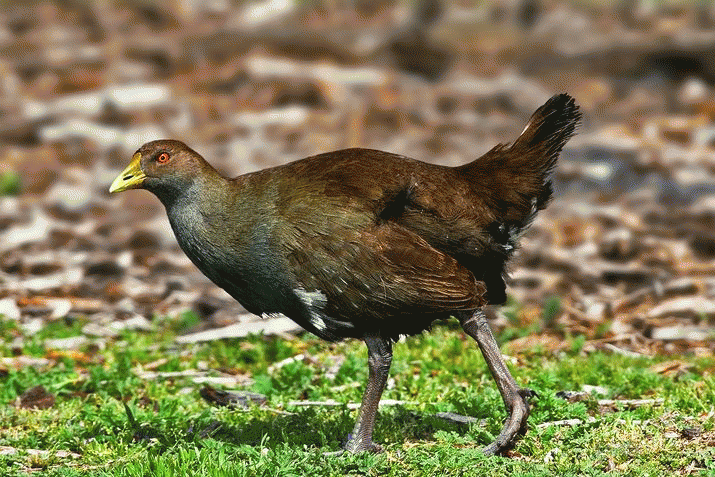
An exact 12 hours of daylight, 12 hours of dark, was playing tricks on me now, and to add to this sense of the bizarre I came across a Tasmanian native-hen on Sphinx Rock, the last place I would have thought to find a bird of wet pasture and swamp.
Native-hens are not rare, they’re not particularly unusual once you get to grips with their out-of-the-ordinary mating behaviour, but this particular bird made an impression on me. It was as though for a brief moment in time we had become soul-mates. And I blamed the Spring Equinox
There I was out on the flat surface of Sphinx Rock half-way up the mountain, looking down on the city spread before me, contemplating life, and my place in it, as I often do from such a lofty position.
Usually I prefer to be alone on my rambles in and out of the clouds tumbling from the summit but this time I felt another presence, not in a sinister or malign way, just another being out there seeking solace and perhaps a little silence away from the hubbub, the hurly burly of life.
I was not mistaken. As I looked to my right, looked in the direction of the azure Southern Ocean, the native-hen, a young male, casually strolled in my direction from a cluster of bushes hugging the precipice of the scenic rock.
The native-hen walked slowly, and purposefully, straight towards me, then paused for a moment and gave me a curious stare. Starting on his travels again, he moved around me, crossing the rock before vanishing into bushes that this time spread towards the Organ Pipes and the summit of the mountain.
I see native-hens all the time, in small family groups, at lake or stream-side, sometimes with fluffy, jet-black chicks at the Waterworks Reserve close to Hobart, but I could never, ever recall seeing one on Mount Wellington.
What’s more, I could never recall seeing a lone native-hen.
I immediately dubbed the bird “Triabunna” (the name of Aborigines on Bruny Island gave to the species) and sat down on a tree stamp a little way back from the Sphinx Rock precipice to contemplate his fate, amid the circling of mountain currawongs and forest ravens.
‘Triabunna’ had come a long way …
At 720 metres, Triabunna had come a long way for a flightless bird. As a young male, was he the prodigal son, exploring pastures new, making a new life for himself away from the flock?
Perhaps the stresses and strains of native-hen life had proven too much for him. The endemic native-hen is unusual in the bird world because it belongs to a matriarchal society in which females take a harem of attentive males. The males, many of them in their first flush of youth, vie for attention, forever trying to catch the female’s eye. Much pushing and shoving, and pecking, goes on for sexual favours.
Sitting on my log, I was thinking not of life in the city below me now, but life as a young, male native-hen. Was the lone male who had nonchalantly sauntered by me genuinely trying to make his own way in the world, or was he merely lost; losing his sense of direction, and heading for a harsh, rocky environment totally unsuited to a bird of paddock, water and marsh.
I’ll never know. I looked for Triabunna on subsequent walks from the Springs to Sphinx Rock. I didn’t see him again but now when I hear the native-hen mating cry, sometimes at night from the end of my garden, I always think of him.
A flightless bird, spreading his wings away from the flock.
Blackwoods had burst into yellow flower, a lighter shade and less showy than the blooms of the silver wattles. And the last of the crescent honeyeaters and eastern spinebills were finally heading up the mountain, ones that had been slow to move and had kept their distance, as though wary of Mother Mountain’s unwelcoming, unfriendly mood in the first weeks of September.
Lapwings are by nature nervous birds
Fan-tailed cuckoos, though, continued to defy the chill winds. Their trilling rang out From all over the mountain during the increasing hours of light, and often after it when their notes were the only ones in the night sky save for restless lapwings easily put to flight from ground roosts by predators real or imagined.
Lapwings are by nature nervous birds – vulnerable as ground feeding, roosting and nesting species – and observing them by day I could see the reason for their neurotic state.
I sought out the lapwing pair with two young again after a week or so. I was pleased to see the youngsters doing well, rapidly growing in size. They appeared more agile, more sure-footed and more likely to run when threatened. And I could see traces of the subtle plumage, mixing whites and greys and blacks, of the adults. The young birds moved through the grass, picking at insects as they went, all the while still guarded by parents with an eye on the forest ravens passing across the Fingerpost Track, high in the sky.
The weather was warming, and you could smell spring on winds heavy with pollen, fecund and sweet. The sun graced the mountain for more and more hours each day, and more and more birds were climbing to the summit to select breeding sites. Many of the migrant species had yet to arrive, but the volume of resident birds was growing has they completed a domestic migration from lowland to highland.
I could see numbers of fantails building up – some of these no doubt coming from across Bass Strait, to join fantails who had braved the Tasmanian winter – and at the site of the old Springs Hotel I found a female flame robin, identified from other female robins by the white “tick” shape (like the Nike sportswear logo), on her closed wings. And all the while the cuckoos called.
The last few days of September saw high winds, which forced the closure of the Salamanca Market in the city. I avoided the mountain for a few days and when I returned the trails and paths were littered with fallen trees. Heavy rains had swollen streams and rivulets as water poured from higher ground.
Amid fallen trees, gusting winds and raging streams a spotted pardalote quietly, gently and fastidiously gathered nesting material for a nest at the end of a tunnel that had been dug into an embankment under the Silver Falls Track.