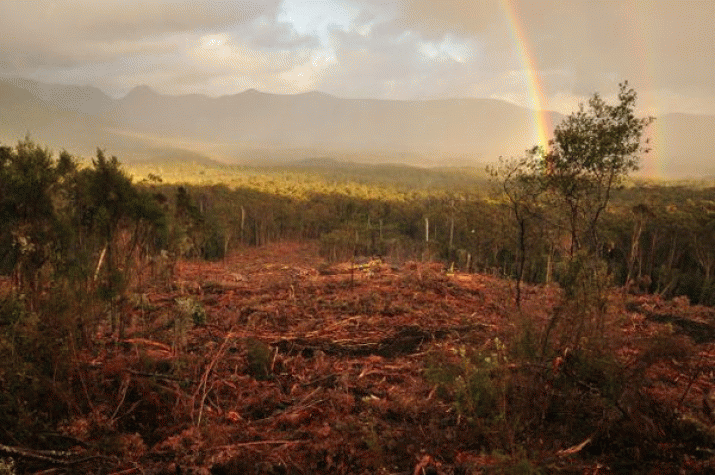
As community concern rises over provisions to open 1.1 million ha of established reserves and rainforests to logging, the Tasmanian government has attempted to deflect pressure by making seriously misleading and incorrect claims.
They still have not responded to the basic issue – that 1.5 million ha of forests (existing and future reserves) will lose their current protection and may be immediately opened to logging for specialty species under new forestry legislation which was delayed in the Legislative Council during last week.
This was exposed by Markets For Change in a briefing to Legislative Councillors, and in a new leaflet co-produced by Markets For Change and The Bob Brown Foundation that is awakening concern as it is distributed to households and on social media, where the news has gone viral.
Leaflet with map available here: Map available here: http://www.bobbrown.org.au/protected_no_more
“The Hodgman government has been sprung trying to sneak this unprecedented assault on Tasmania’s reserves through the Parliament and instead of owning up to their plans they have responded with seriously misleading and deceitful claims that seek to downplay the undoing of 30 years of forest protection,” Markets For Change CEO Peg Putt said.
“Why won’t the government admit that they are embarking on a massive new assault on forests that goes far beyond their election promises by opening all 407 Conservation Areas and all 147 Regional Reserves across Tasmania for logging that particularly targets rainforests?”
“From the backlash we are already seeing to this news it is clear that the new forestry law is going much too far and we think the government knows it.”
Fact: the new provisions change the objectives for management and the purposes of creating these two types of reserves so as to open them for specialty species logging.
Currently a provision exists that if Regional Reserves were created in future over a handful of ‘contingency coupes’ of around 1,000 ha or less identified for specialty species in the Tasmanian Forest Agreement, logging could be conducted there if all other sources of wood failed.
Government claim: The government is claiming that applying specialty species logging to all Regional Reserves and also opening all Conservation Areas, a total of 1.1 million ha is simply removing an inconsistency in wording.
Response: The effect is that 1.1million ha is opened to logging – not a minor matter. It is much more than addressing an inconsistency in wording. Such logging, known as ‘partial logging’ is not environmentally sensitive and has significant impacts on pristine forests – modified clearfelling allowing removal of 25-70% of canopy cover and especially targeting mature trees that are also wildlife habitat, permanent snig tracks inserted, and post-logging fires. It could occur in reserves that were set aside specifically to maintain forest values under the Regional Forest Agreement, initiatives by Paul Lennon and John Howard, and much earlier forest processes.
Fact: Specialty species logging targets blackwood, myrtle, celery top pine, sassafras, huon pine and silver wattle, and other species can be added to this list by regulation.
Government claim: the forestry bill does not provide for native forest harvesting in reserves.
Response: These are weasel words. The new legislation defines native forest harvesting in such a way that it excludes special species logging. This is not what the ordinary person would understand, and native trees, particularly rainforests, will become subject to logging in reserves.
“The government is using tricky definitions of native forest that exclude rainforest species destined to be logged inside longstanding reserves to pull the wool over the eyes of concerned Tasmanians,” Ms Putt said.
“They are also saying that expanding access in reserves to 1.1 million ha from the current contingency provision of approximately 1,000 ha is simply removing an inconsistency of wording, which is deceitful and an attempt to pull the wool over the eyes of the people.”
“If these forests are opened to the chainsaws Tasmania’s reputation will be at risk and the products unacceptable to consumers,” Ms Putt concluded.