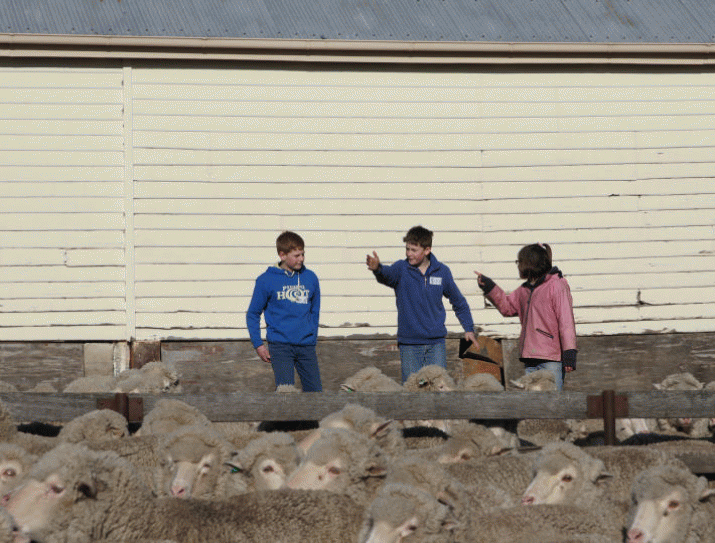
*Pic: Henry Napier (centre) directs Charlotte Loane and Lachie Warren on the finer points of moving sheep through the yards
“Attitude is everything” was the focus of a unique livestock handling school held in the Tasmanian Midlands recently for 27 young participants aged from 11 to 18 years of age.
The Next-Gen Low Stress Stockhandling (LSS) school was the brainchild of 14-year-old Scotch Oakburn College student Henry Napier.
For Henry, the school achieved two goals: it provided a platform for his Inspire Y8 school project and also allowed him to share with his peers the opportunity to gain a life-changing experience with renowned trainer and friend Grahame Rees.
“Last year I attended one of Grahame’s schools with a group of Tasmanian beef producers and I thought it would be a great idea to organise a school for young adults like myself,” Henry said.
“One of the key things Grahame taught us at the school was ‘attitude is everything” (it is the motto of the school). This is not only true when handling stock but is a valuable rule for life in general and something that has stayed with me.”
“Our Inspire Y8 project requires us to focus on one or more of the six Round Square IDEALS: internationalism, democracy, environment, adventure, leadership and service.”
“Having attended one of Grahame’s schools I thought the school had a great fit with several of these ideals.”
Participants in the school included young men and women from both farming and urban backgrounds. But the common factor among all participants was a passion for learning more about how to work safely and quietly with livestock.
For many of the young participants, their goal was to get an insight into the minds of livestock and discover how they could control them in a safe and calm way — and control themselves as well.
Grahame Rees says the principles of low stress stockhandling are timeless and he is confident they will stand his pupils in good stead across all aspects of their lives.
“We discussed the importance of body language when working with stock and the need to be aware of when to apply pressure and more importantly, when to release it,” Grahame explained. “Interestingly these principles are as relevant for working with people as they are with livestock.”
This was the first time Grahame had run a school exclusively for young adults and he found it incredibly rewarding.
“What takes two days to teach adults can be absorbed in one day by these enthusiastic young people,” Grahame said. “They are quick to learn and haven’t been indoctrinated with a certain way of doing things.”
The other inspiring aspect of the school for Grahame was to have so many young people passionate about a future in agriculture.
Henry’s cousin, Will Fergusson and his partner Sophie Murfitt-Cowen were guest speakers on the first night of the school. Both Will and Sophie have recently finished school and are pursuing careers in agriculture.
After 12 months working on a Merino stud in the northern tablelands of NSW, Will is currently working on his family’s mixed farming property on Tasmania’s east coast. For Will it is the diversity and the people that have attracted him into agriculture as a career.
“I love that every day you can be doing a different job,” Will said. “My time in NSW gave me the opportunity to see so many different ways of doing things, not only on the property I worked on but through meeting neighbours and learning more about the things they are doing.
Will says he is enjoying spending evenings round the family kitchen table discussing genetics and the future of the family’s Merino flock with his father.
Growing up in Lauderdale, on the outskirts of Hobart, Sophie is a relatively new entrant to agriculture. She described some of the more surprising aspects of her journey so far.
“I think the thing that has surprised me most is how incredibly clever farmers are,” Sophie said. “I certainly suffered from a number of common misconceptions about agriculture before meeting Will and spending time in farming businesses.”
“Farmers can do almost anything and have such a wide range of skills and knowledge. Not only do they need to know how to care for their livestock, but they know how to run a business, fix machinery, mend a fence and grow many different crops. I can’t thing of any other career where people have such a broad range of accomplishments.”
All the participants of the school came away full of enthusiasm to out into practice the principles they had learnt. For Henry Napier the experience was a rewarding one.
“The best thing about the school for me was seeing the smiles on the faces of all 27 participants and seeing so many young people keen to give up time in their school holidays to learn skills that will benefit them throughout life,” Henry said.
Now that’s an attitude to be proud of.