

The “Respect the Mountain” forum ( here, here, and here ) at the Hobart Town Hall earlier this year prompted Don Knowler to return to a diary he compiled after daily rambles on Mt Wellington during the previous year. In what promises to be a momentous year in the modern history of Kunanyi, the weekly diary gives the mountain and its wildlife its own voice. All Don’s Mother Mountain columns – and much more by this superb writer – can be found under the Category, Don Knowler, here
The Hobart ritual of snow sculptures on car bonnets was taking hold. The snow on the mountain’s pinnacle was now firm and hard from previous days and it was easily sculpted into snowmen and snow women. The Huon Road down to Hobart was littered with clumps of ice as the snowmen, and women, slowly slipped off the warm bonnets and shattered on the tarmacadam.
Skies overcast with heavy snow cloud, the sun trying to break through at the clouds’ splintered edges. Winter had truly arrived by June 21, the winter solstice marking the shortest day of the year. Sunset 4.43pm, sunrise tomorrow at 7.42am. The Brunswick Hotel in central Hobart celebrated with a $5 glass of champagne in front of a log fire. The State Cinema held its “Longest Night” film festival the previous evening, culminating in two documentaries featuring Antarctic explorers Scott, Shackleton and Amundsen.
I had a winter celebration of my own, walking to Silver Falls. I glimpsed a female pink robin flying across the track ahead of me, a grey shrike-thrush called its “Joe Witty” song, and then a Tasmanian currawong came into sight. In spring the shrike-thrush and currawong would turn their attention to the female pink robin and her nest of eggs and young.
That evening I joined a friend who lives at the start of the Finger Post Track at lower Fern Tree, drinking steaming gluhwein on her deck. Wood smoke may have been in the air, but the sky was brilliantly clear, the Milky Way meandering above our heads.
Snow clouds were soon to gather, returning within days. Flurries turned to blizzards, and a snowstorm eventually closed the Pinnacle Road to the summit beyond the Springs.
Such road closures always spark debate about all-year access to the summit, and whether a cable car should be built linking Mount Wellington to the city. Ambitious plans have come and gone like the winter snowstorms, but a campaign for a cable car had gathered pace in recent years driven by a new proponent, Adrian Bold.
After the first road closure of the winter, the Mercury next day carried the headline on its front page, “Cable Car hopes rise, council warms to idea as ice turns hundreds away”. Bold was pictured standing at the barrier at the Springs, which had been lowered to prevent access further up the mountain. The report said that among those joining calls for the cable car was the Hobart Mayor, Damon Thomas.
I didn’t know the road was closed the previous day until I turned from the Huon to Pillinger Drive, and saw the illuminated map at the first bend with a red light indicating the road beyond the Springs was barred. I drove up anyway, happy to make it that far.
I always need a snow experience, a snow fix, at the start of winter. The fresh flakes, piled thick, crunched below my feet as I made my way to my favourite location on the mountain, Sphinx Rock. Along the trail I had a good view of a scrubtit, creeping up a patterned peppermint gun, the bird bathed in soft sunlight with a backdrop of snow. A yellow-throated honeyeater disturbed snow on branches so the flakes tumbled down around me. Scrubwrens fossicked on the snowy footpath. A walker had drawn a heart in a thick layer of snow that lie on a flat rock. The rock was mossy and the rich green of the moss contrasted with the sparkling virgin snow. It was surreal and beautiful. Man’s winter intrusion on the landscape of the park took a difference shape at the Springs. Returning to the car park, I saw that someone had empted a dashboard ashtray on to the tarmacadam so ash and dog-ends formed their own sodden artwork in the snow.
The snow persisted for days. At one point the Pinnacle Road reopened for motorists wanting their own snow experience but was promptly closed again with each fresh snowfall. I drove to the Springs again, my car slipping on a patch of black ice and drifting sideways before I could correct it. I was grateful no one was driving in the opposite direction. Ahead of me a policeman was halting traffic from going further. There must have been an accident further up.
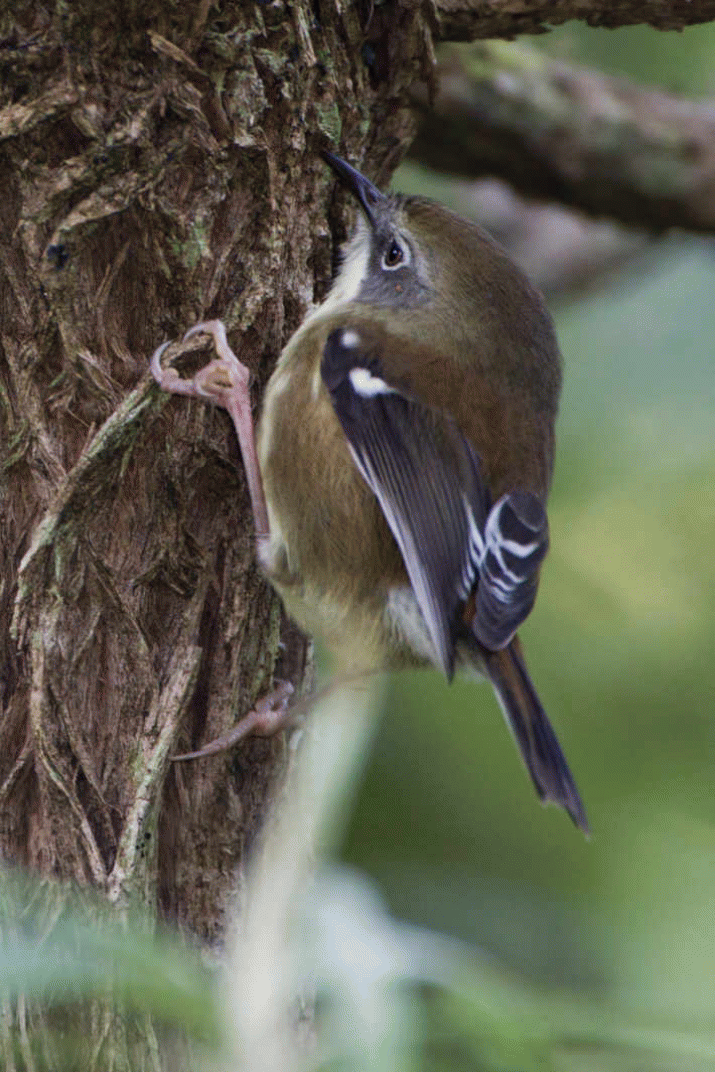
My destination was Sphinx Rock and within a few minutes of leaving the Springs I came across a scrubtit. I had gone virtually the whole year previously – although admittedly my visits to the mountain were infrequent – without seeing scrubtits and now I was seeing them virtually daily. I now had named the trail to Sphinx Rock “scrubtit alley”.
The scrubtit blended beautifully with its surroundings – white peppermint gum and snow. The tiny bird scaled a tree in front of me, creeping upwards until the trunk was too narrow to offer it protection from a swirling wind, which rearranged its feathers. The bird then dropped in a flutter of wings, swooping to another, adjoining tree before starting the whole climbing process again.
The snow muffled the voice of the mountain, the murmur and sometimes shout of wind. It muffled the human sound of Hobart drifting up from below. I felt strangely alone, more alone than I sometimes feel on the mountain, just me and the scrubtit, the snow also muffling the shuffle and whirr of its feathers as it flitted from tree to tree. Just the scrubtit and me, that same mute wind forcing us to shelter well below the canopy, dodging flakes of snow.
We were not alone, of course. Not a hundred metres away, on the Pinnacle Road at the Springs, cars were banked up, parked in front of the red barrier that restricted access to motorists to the higher elevations of Mt Wellington. And the clamour grew for a cable car.
All this was lost on the scrubtit. It was merely going about its business, as scrubtits had done for eons, prising eggs, pupae and grubs from under the bark of gum and wattle.
As I watched the scrubtit two walkers appeared along the footpath and stopped to ask what I was looking at through my binoculars. As they approached the scrubtit had taken flight and I did not have bird to show them. It was a shame. The bird, as I told them, was unique to Tasmania, found nowhere else on earth. They were from Sydney and said they would have liked to have seen it. But then a yellowthroat called, and we looked up into a long-dead yellow gum, its bare branches standing out against the blue sky, to watch the honeyeater scaling the tree and prising insects from dead bark, just as the scrubtit had done.
The tourists did not need my binoculars to see its beauty, its mossy green plumage on its back, the grey head and the prominent yellow feathers under the throat.
“And that’s another one only found in Tasmania,” I said to the tourists, and they went away with a story to tell their friends back in Sydney.










