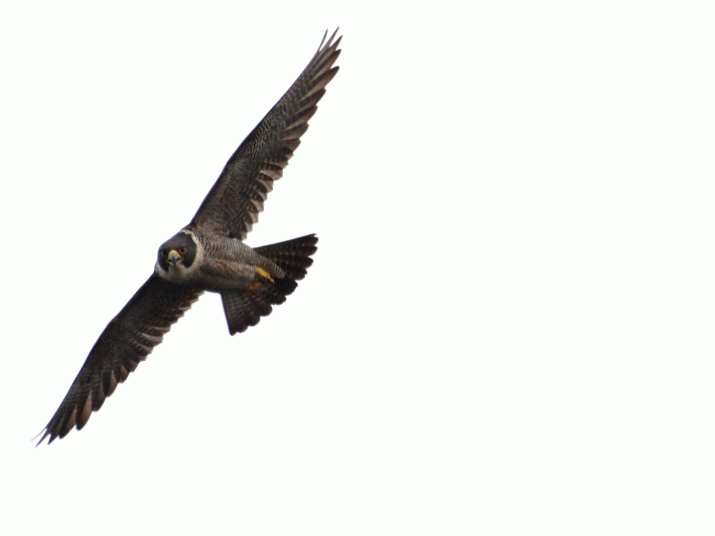
*Pic: Bert Quant’s 2012 picture of a Peregrine Falcon at Table Cape
The “Respect the Mountain” forum ( here, here, and here ) at the Hobart Town Hall earlier this year prompted Don Knowler to return to a diary he compiled after daily rambles on Mt Wellington during the previous year. In what promises to be a momentous year in the modern history of Kunanyi, the weekly diary gives the mountain and its wildlife its own voice. All Don’s Mother Mountain columns – and much more by this superb writer – can be found under the Category, Don Knowler, here
On the sierra
I love the glorious mountains, proud and bleak!
No tree, not e’en a flower, does set its foot,
On the white shroud that clothes the lofty peak,
Whose bare crags give no holding to a root.
No vine’s love-clinging arm, no golden wheat,
Nothing that tells of man and servile toil;
In the pure air and free, sail eagles fleet,
no vulgar sound their majesty to spoil.
They are not useful. True! No profit yield
Their might, their beauty is their only boast;
Yet please me more than the fat fertile field
So far from heaven, that sight of God is lost.
Theophile Gautier, “Dans la Sierra”, from Espana (1845)
The New Holland honeyeaters in the Waterworks Valley below Mother Mountain screamed in terror as the most fearsome predator of the skies streaked overhead. A peregrine falcon – the fastest creature known to nature – darted towards the mountain from its city centre roost, sending honeyeaters, robins and fairy-wrens into a frenzy as it went.
Although such small songbirds would hardly make a meal, not even a snack, for the powerful falcon, the birds of the valley were on their guard all the same. A bird of prey shape is after all, a bird of prey and it could well be the most feared of predators for small birds, the goshawk.
With the honeyeaters twittering, I could clearly see the anchor shape of the falcon, heading at first directly towards the Organ Pipes, then banking in a sharp turn to come back in a full circle.
On the first day of winter the mountain provided a stunning backdrop to aerial manoeuvres in which peregrines have been clocked in 350 kilometres an hour in their dive or stoop to kill prey. A low cloud covered the Mother Mountain’s summit but the early morning sun was still able to thrust its rays below it. A streak of yellow sunlight cut across the mountain face horizontally – white cloud sitting above the shaft of light, dark shadow below it. In the sun’s spotlight, the peregrine flew in rapid flight.
Then I saw the reason for the peregrine’s change of direction. The honeyeaters twittering in alarm had put up a flock of green rosellas who had foolishly strayed into the slipstream of the peregrine, and were now in its path. The peregrine had spotted them and now they flew north-east into the sun, blinded by it.
The peregrine on outstretched wings flew in a wide arc, encircling the rosellas and marked out one flying slower, trailing behind the others. The falcon, with a few rapid beats of its wings, climbed higher and then I could see it was moving in for the kill.
Wings closed now, the peregrine dropped like a stone from above the hapless, trailing rosella and when it was just above it, stretched out its wings and hit the parrot with full force.
The rosella tumbled from the sky, spiralling on flaying wings, green feathers fluttering above it. The peregrine came round a second time and I could see its wings outstretched again, and its talons splayed. The rosella fell rapidly now and the peregrine grabbed it just before it hit the roofs and neatly manicured lawns of South Hobart suburbia.
I had my first species of the checklist I was to compiling of birds spotted on the mountain, even if the peregrine was technically not within the official boundaries of the mountain at all. The Mother Mountain was in sight, however, and everything that had happened was in one way or another influenced by her. I’m not one for artificial, man-made boundaries and, like the peregrine and all that it surveys, I refused to be fenced in.
A hour after witnessing the peregrine kill, I’m getting a peregrine’s eye-view of Hobart. I’m sitting at the summit of Mount Wellington, 1200 metres above the level of river, estuary and ocean spread out in three directions below me. Beyond the city I can make out the broken outlines of distant mountains, the farthest traced in faint blue lines before they drift away to infinity.
I’m lucky to get a view at all. For much of the morning the mountain has been wreathed in cloud and on these days people drawn to the mountain usually settle for a tramp on its lower slopes, below the cloud line.
But the first day of the month, the start of nature’s new year in which I would monitor the mountain for an entire 12 months, demanded that I drive to the summit, whatever the weather.
I stopped briefly at the Springs half-way up, as I always do. This is productive bird-watching territory, especially for many of Tasmania’s endemic species found nowhere else on earth and serves the writer’s notion of time and place, of cementing a spiritual zone.
I hear the birds of the Tasmanian forests here, the chuckle of the yellow-throated honeyeater, the trumpeting of the black currawong but for once the location is strangely silent. I learn later that during the coldest, bleakest months of the year the birds do not sing all.
It was not particularly cold, but all the same anyone or anything venturing to the mountain, for flying across it, or through its forests and ravines – negotiating craggy cliffs and skeletal dead trees in the mist – would perceive winter was in the air.
Only a lone olive whistler, calling its weird, piercing metallic song from within a mountain needle bush, betrayed the mountain’s silence.
I pushed on to the summit. There I emerged from the mist on the Pinnacle Road to find the cold grey rocks bathed in sunshine. At the summit car park I scanned the surrounding plateau that sits behind the hard dolerite edges of the peak for birds – perhaps an Australasian pipit or a late-departing flame robin braving the cold. I saw nothing and moved to the lookout point that takes in the view of Hobart.
Within a few minutes, a drifting thin cloud, rising like steam escaping a hot bath, drove me back from the edge. The view across the city was blanked out and I retreated. I wasn’t complaining, like a frustrated tourist feeling cheated when a curtain of cloud closes across the vista and their 30-minute journey up the mountain has been in vain. At these times visitors view the mountain as fickle and moody, with a malicious intent in her luring them 1,271 metres (4,170 feet) into the sky with promises of sunshine and spectacular views, only then to pull a veil over herself. The people of Hobart know their mountain, and her unpredictability, and they know she is not so much contrary but playful and seductive.
By the minute the wispy mist grew thicker, turning to cloud, thick cloud like a blanket, grey and carrying rain. It was time to go.
One last trip to the mountain edge, in the hope of seeing a hint of blue sky again. This time a dark feathery shape swept before me. It had landed on the clustered, tight growth of snow-beard heath and I walked in that direction.. The shape rustled from the inside the packed foliage, low foliage; a biggish bird rifling the plant’s thick and glossy rain-proof leaves. Suddenly the head of a green rosella popped out, with a berry in its beak.
A male bird, greener than is usual. The bright yellow of its belly contrasting with the bottle-green back suggested it was an older male, an experienced bird who had learned the wiles and ways of the summit, and how to dodge the fearsome peregrine and where to find berry food. Despite a splash of bright red on the face, sky-blue iridescence in its fluttering wings, the stunning bird still managed to merge with the mosaic of shapes and sizes, and colours, of the alpine shrubbery. Even a sharp-eyed peregrine would have difficulty picking it out such a seasoned bird of the peaks, which carries another name – the mountain parrot.