Financial Feasibility Of Cable Car, Hobart, Tuesday 1st July, 2014:
Research released today by ROCC (residents Opposed to the Cable Car) has raised serious questions about the financial feasibility of the Mt Wellington cable car project proposed by Adrian Bold.
Spokesperson for ROCC Ted Cutlan says: “Comparison with other cable systems around the world shows Mr Bold’s estimate of AU$37 million to build two cable car systems from the Cascade base station to the summit of Mt Wellington to be extremely low.”
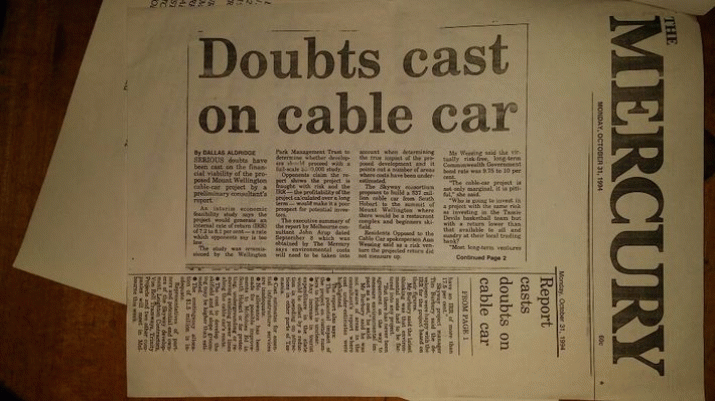
The Skyway proposal of 1994 was projected to cost AU$37 million over 20 years ago and at the time it was concluded that it would not generate an adequate rate of return to investors. Accounting for inflation that figure would now be around AU$62 million.
“Today the majority of systems cost more than AU$20 million per km to build and at this rate the 4.6 km MWCC system would cost AU$92 million.”
ROCC shows that even if the Mt Wellington Cableway Company (MWCC) proposal is compared to two of the less expensive systems to build, the Sea to Sky gondola in British Colombia (comparable to section 1 of the MWCC proposal), and the CabriO aerial tramway in Switzerland (comparable to section 2 of the MWCC proposal) the cost would still be AU$66.9 million, 1.8 times the figure announced by Mr Bold.
Mr Cutlan says that: “The AU$66.9 million estimate of cost does not include high cost components of the proposal such as the Cascade Rd overpass/underpass, building a new section of road at the Cascade Brewery, building a 390 space car park behind the Cascade Brewery, the construction of the Pinnacle Centre, or the possible cost of burying the two high voltage power lines that will be crossed by the MWCC systems, so it is considered to be a conservative estimate.”
ROCC therefore finds the financial viability of MWCC’s proposal questionable and asks the proponent to come clean and demonstrate the business case for the proposed project to the people of Hobart.
“Hobart rate-payers should be wary of being left to pay for this cable car gamble,” said Mr Cutlan. “We certainly do not want it turning into a financial nightmare for Hobart ratepayers. Clear answers are needed from the proponent about the financial viability of this project.”
SUPPORTING DOCUMENTATION
Residents Opposed To The Cable Car (ROCC)
Question: Financial Feasibility Of Cable Car
The Mt Wellington Cableway Company (MWCC) is proposing to build a cable car and Pinnacle development on Mt Wellington. Few details of the MWCC’s project have been released publicly. However, even without substantive information from the proponents, it is still possible to compare the cost of the proposal with similar developments elsewhere in the world to examine the feasibility of the venture.
The MWCC’s proposal is actually for two completely separate cable car systems1: 1) a 1 km gondola system with multiple eight-seater gondolas running from a base station at Cascade Brewery to a mid-station at Golden Gully; and 2) a 3.6 km aerial tramway system with two cabins that can each transport up to 60 people that will run from the Golden Gully mid-station to a Pinnacle Centre at the top of the mountain. Mr Bold has estimated that it would cost approximately AU$37 million to build the two cable car systems2.
The following chart shows the cost per km to develop ten other cable car systems compared to the MWCC’s proposal (costs adjusted to 2014 dollars).
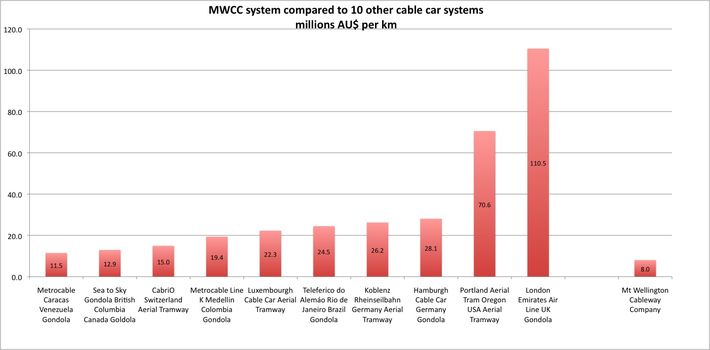
The majority of cable cars cost more than AU$20 million per km and at this rate the 4.6 km MWCC’s proposal would cost AU$92 million. Even if the MWCC system is compared to two of the cheapest systems, the Sea to Sky gondola in British Colombia3 (comparable to section 1 of the MWCC’s proposal), and the CabriO aerial tramway in Switzerland4 (comparable to section 2 of the MWCC’s proposal) the cost would still be far more than AU$60 million.
The first section of the MWCC’s system may be compared to the Sea to Sky Gondola in British Columbia as both are gondola type, tourist cable cars built on the side of a mountain. The cost of the Sea to Sky Gondola was AU$12.9 million per km. The first section of the MWCC’s system is only 1 km in length so the cost of this section may be estimated as AU$12.9 million.
The second section of the MWCC’s system may be compared to the CabriO aerial tramway in Switzerland, as both are aerial tramway type, tourist cable cars that go to the summits of mountains. The CabriO aerial tramway cost AU$15.0 million per km to construct. The second section of the MWCC’s system is 3.6 km in length. It is therefore reasonable to estimate that the second section of the MWCC’s proposal would cost AU$54.0 million.
The combined cost of the two cable car systems is therefore likely to be AU$66.9 million (AU$12.9 million plus AU$54.0 million). That is 1.8 times the figure announced by Mr Bold. The AU$66.9 million estimate of cost does not include high cost components of the MWCC proposal such as the Cascade Rd overpass/underpass, building a new section of road at the Cascade Brewery, building a 390 space car park behind the Cascade Brewery, construction of the Pinnacle Centre, or the possible cost of burying the two high voltage power lines that will be crossed by the MWCC systems. The estimate of AUS$66.9 million is therefore considered conservative and a far cry from the stated figure of AU$37 million.
ROCC therefore finds the financial viability of MWCC’s proposal questionable and asks the proponent to come clean and demonstrate the business case for the proposed project to the people of Hobart.
ROCC (Residents Opposed to the Cable Car) has recently re-formed in response to the campaign by Adrian Bold to build a cable car and Pinnacle Centre development on Mt Wellington. ROCC was formed in the 90s to support the local community voice its opinions on the 1993 cable car development.
1. http://www.mtwellingtoncablecar.com/#!cable-car/c21b7
2. http://www.themercury.com.au/news/tasmania/international-investors-join-mt-wellington-cable-car-project/story-fnj4f7k1-1226805445057
3. http://www.canada.com/mobile/iphone/story.html?id=9813098
4. http://www.stanserhorn.ch/en/travel/cabrio/
• Adrian Bold: Mount Wellington Cable Car (MWCC) takes significant exception to the claims released on July 1, 2014 by Residents Opposed to the Cable Car (ROCC)..
Speaking from Switzerland, MWCC’s investment CEO Steven Dale said ROCC’s unconscionably biased analysis is designed to deceive Hobart by using a select and tiny sample of the 20,000 ropeway installations operational around the world today.
“ROCC has cherry-picked those systems that best prove their point—insulting the intelligence of the wider Hobart community they claim to represent. “
ROCC’s assertion that “the majority of systems cost more than AU$20 million per km to build” is categorically untrue and displays their habit of distorting facts to suit their narrow anti-economic-growth agenda.
While it is easy to find systems around the world that have cost more than AU$8 million per kilometre to build, it is equally easy to find systems that have cost less than AU$8 million per kilometre to build.
For example:
1. The Telluride Gondola in Colorado was built for a per kilometre cost of ~$4.8 million USD. This system is 4.8 km long and has 4 stations—longer than the Mount Wellington Cableway with one more station.
2. The Ba Na Hills Cable Car was built last year in Vietnam for ~$6.8 million USD per kilometre. This system holds numerous Guinness World Records for its achievements and offers capacity more than double that which will be offered for the Mount Wellington Cableway.
3. Lastly, the Cairns Skyrail in Australia was built for a per kilometre cost of ~$5.4 million USD. This system is 50% longer than that proposed by MWCC, traverses some of Australia’s most ecologically sensitive rainforests and won a multitude of environmental tourism awards in the process. (See note below).

Mr Dale said the above statistics are no more indicative of the cost of the Mount Wellington Cableway than those provided by ROCC. They are, however, indicative of the dishonest means by which ROCC seeks to engage with the Hobart community.
“As each and every cable car system is unique unto itself, per kilometre calculations are an unacceptable and unprofessional method of benchmarking the economic feasibility of a cable car system and lead directly to the kind of misinformation ROCC has been spreading.
MWCC Project Lead Adrian Bold said MWCC are supported by a professional team of ropeway specialists, engineers and suppliers with hundreds of years of experience in the cable car industry, along with a reputable design and construction team in Hobart.
“We trust these experts in their field, and we can provide Hobart with the costs of the project once various negotiations are resolved.
“We have progressed a long way since we formally started the concept in 2012. Any previous cost estimates are in no way relevant to the preliminary proposal we launched recently in April.
“Put simply, ROCC is playing fast and loose with the facts; seeding unnecessary fear and division in the local community.” Mr Bold said.
Healthy and vigorous debate about projects such as the Mount Wellington Cableway has been an integral part of Hobart’s development tradition and MWCC respects that tradition.
ROCC’s dishonesty and deception, however, have no place in sound debate.
Note: All numbers inflation-adjusted to 2014. As the United States and Australian dollars have floated around parity with one another for the last two years, the United States dollar numbers given above are considered roughly equivalent to Australian dollars.