One of the last projects agreed by the now departed Giddings government was awarding a licence for unconventional oil and gas exploration.
South Australian company Petratherm advised the Australian Stock Exchange in February, that its wholly-owned subsidiary, PetraGas Pty. Ltd., has been awarded a five-year petroleum Exploration Licence (EL3/2013) covering approximately 3,900 square kilometres, north of Hobart in central Tasmania to explore for conventional and unconventional oil and gas.
This covers an area from near the Orielton Lagoon extending to north of Boothwell and Oatlands. Importantly, this license area is bisected by the Tasmanian Gas Pipeline which runs between Hobart and Victoria. This pipeline will allow access to major gas markets.
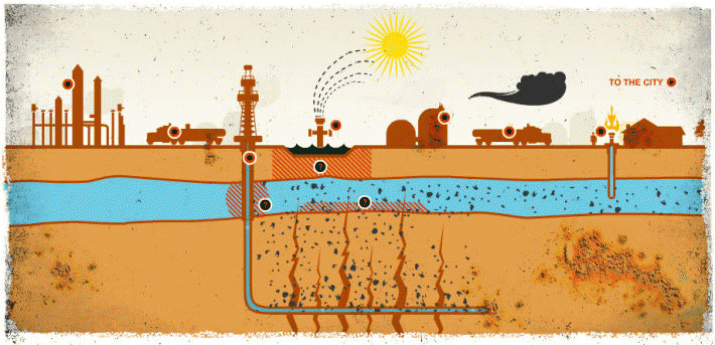
Unconventional oil and gas exploration refers to the various alternatives to normal oil production. In this case the company will be targeting oil shale, or to use the more accurate term “tight oil.” This is considered unconventional processing, as the oil is not produced using the iconic oil well. Due to the lack of pressure underground, the impermeability of the rock the oil is within, and the “heaviness” of the oil, it is likely hydraulic fracturing will be needed to produce this resource.
This is only an exploration licence and is not for production. The company will spend the next two years studying reports and previous surveys, and performing surveys to understand the basin geology. To conduct drilling, public consultation and approvals will need to be sought.
Unlike the traditional oil well, tight oil production will require hydraulic fracturing (fracking.) Fracking is a process of inserting pressurised water into the seam of oil-bearing rock, fracturing the rock, freeing the oil. To access this oil requires the introduction of various chemicals.
This exploration and potential exploitation will stimulate the economy, and also carries many risks that will have to be properly managed.
These risks include possible contamination of the water table due to the introduction of chemicals. This type of exploitation is very water intensive, using up to five barrels of water for every one barrel of oil. As well as the excessive water usage unconventional mines take up large amounts of land. There is also the question of disposal of waste. Unconventional mining generates more greenhouse gases than conventional mining. These potential problems result in a resource that is only economically viable if the price of normal crude is very high. A major incident may have grave consequences to the local environment, and in the longer term can erode customer confidence in the Tasmanian agricultural sector.
This does seem to be a case of government departments not communicating, as much of this area is soon to be irrigated. The irrigation would be a boon to local farmers, but agriculture is heavily dependent on reputation. What would be the effect on farmers if there was, and there will be, contamination of the water table.
Various government departments involved in granting this exploration licence were contacted, but declined to comment. At present the Greens are calling for a complete moratorium on all fracking in Tasmania.
The Labor Party obviously support this project, while the Liberals are asking for a one-year moratorium on any new licences for unconventional mining. The main community opposition to the project is the Lock the Gate group, more can be found on their website http://www.our-tasmania.org