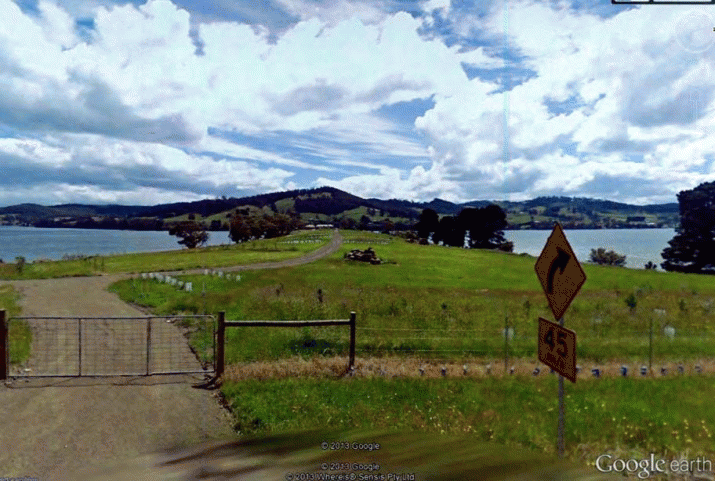
This was the view to the west over Green Point from the Channel Highway before the wall was built and new vegetation soared. This view no longer exists from the highway.
Green Point reaches several hundred metres out into Port Cygnet a few kilometres southeast of the township of Cygnet. To the south, boats are moored in Helms Bay; to the north, Jurgen Harder works his oyster lease, someone’s luxurious yacht moored nearby. In the Port Cygnet Planning Scheme 1988, Green Point is celebrated as “an area of outstanding scenic significance” — and its zoning is “open space”.
Now, in 2014, Green Point no longer enjoys such respect or protection from our elected representatives, at least not a majority of those on the Huon Valley Council (HVC); nor, it seems, in the state bureaucracy, where lies the ultimate authority in making binding decisions.
Since the titles on Green Point changed hands several years ago, planning rules seem to have become alarmingly flexible in relation to that strip of land. And HVC has offered next to nothing in way of resistance to the planning changes that have been wrought.
Green Point is no longer redolent of the pastoral charm for which it was admired for decades. In fact, from the Channel Highway, where it runs along Green Point’s eastern boundary, the peninsula is no longer even visible. All trace of its existence has become obscured by a stone wall and fast-growing gums on both sides of the boundary.
At HVC’s January 22 meeting, this striking landmark was nudged yet further towards more despoliation of its bucolic qualities — and towards much more disfiguring artificial development.
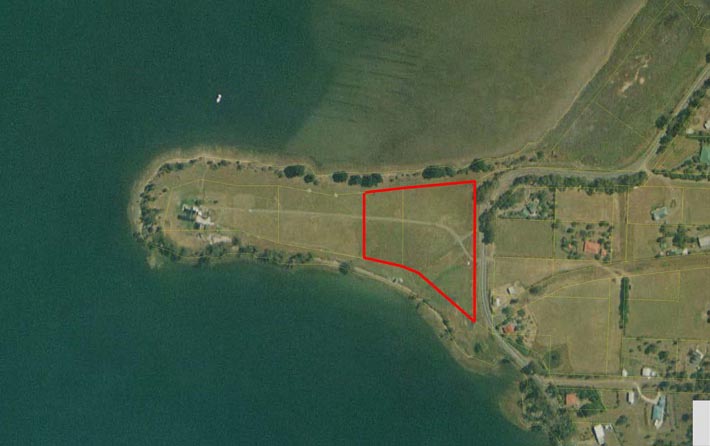
The outlined area of Green Point (pictured early this century before developments began) embraces Lots 3 and 4.
Only Greens Liz Smith and Rosalie Woodruff voted against a motion to approve yet another development application (DA 129/2013) by Green Point’s developer-owner, Roger Hart, to build two “guest houses” (each with a manager’s quarters): one, in a small triangle of Lot 4, that would dominate the south-eastern corner of the peninsula; the other, on the north-facing slope of the adjacent Lot 3, to the west.
Hart, in 2010 was granted permission (DA 3/2010) to build two “guest houses” on the same titles. That permission, after a two-year extension, may have lapsed on February 14 this year. It seems there has been no significant development on DA 3/2010. (The seven titles that existed on Green Point up to 2009, have since been adhered into four, which are now referred to as Lots 1, 2, 3 and 4.)
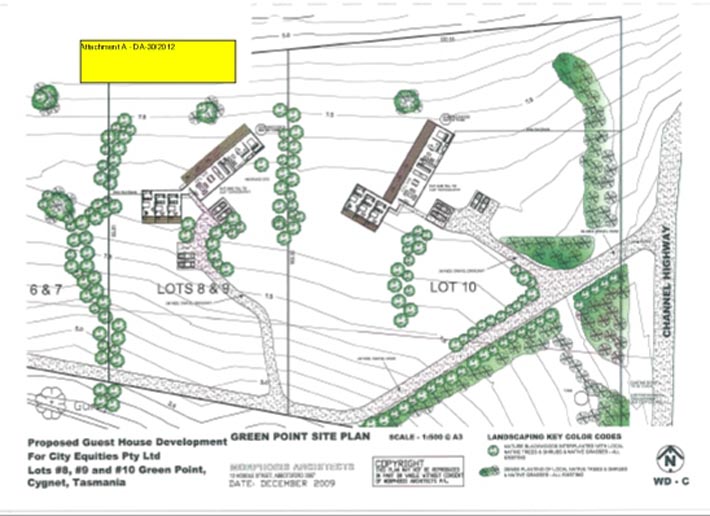
This is where the “guest houses” were to be placed (both on the northern slope) under DA 3/2010. The “guest house” on Lot 4 (designated Lot 10 in the above site plan, when the DA was lodged) had a setback of 50 metres from Channel Highway (at right of picture).
Hart lodged DA 129/2013 in August last year. It was this DA that council approved, 7-2, on January 22. The seven votes in favour of the DA were cast by Mayor Robert Armstrong, his five fellow Futures Group members (Deputy Mayor Mike Wilson, Bruce Heron, Tony Duggan, Rohan Gudden and Ian Paul), and council newcomer Amy Robertson.
Planning appeal
Now, all that stands in the way of the latest DA is an appeal to the Resource Management and Planning Appeal Tribunal (RMPAT) by representors opposed to a plan that, this writer believes, would detract even further from the qualities of a landmark that was accorded such kudos in the Port Cygnet Planning Scheme 1988.
All RMPAT decisions are based strictly in law, so there is little chance of sentiment helping to sway the argument in favour of those who believe that what is happening to Green Point is a tragic scenic loss to the wider community that far outweighs any benefit that might flow to the Huon Valley economy.
HVC, last year, misleadingly advertised Hart’s DA as an application for “two holiday cabins”. Even the heading in its January agenda talked of “holiday cabins” (as did RMPAT’s recent advertisement regarding the Green Point DA). Yet, in the first sentence of council’s ‘Description of proposal’, its terminology shifts: “Planning approval is sought to construct two ‘Guest Houses’ on two separate titles on land known as ‘Green Point’.”
So, at last, council was ready to call a spade a spade, or, rather, a guest house a guest house — or am I splitting hairs in suggesting there is some distinction between holiday cabin and guest house? I don’t think so. What we have seen has been a council advertising “holiday cabins” when it really meant “guest houses”.
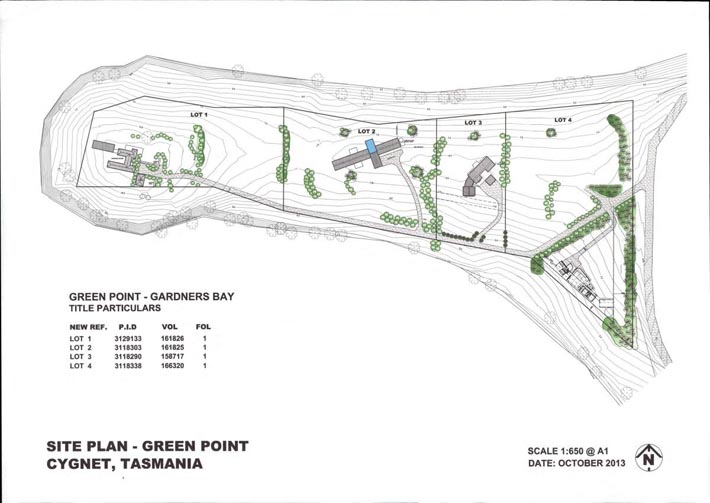
This shows where the Lot 4 “guest house” would now be under DA 129/2013 — on the southern slope below the main driveway and set back 5 metres from the Crown reserve above the beach. (Under the DA 3/2010, the approved structure for Lot 4 (with a 50-metre setback from Channel Highway) was on the northern slope to the east of Lot 3.
The proposed guest house on Lot 4, facing southwest onto Helms Bay, has, at one end, a manager’s quarters above a garage and a laundry. At the other end are two “guest” bedrooms with en suites. The two ends are linked by a living/dining area that includes a kitchen. Off the back of the building are a breakfast room and office. A 9×6 metre workshop is angled off the eastern end of the guest house.
DA 129/2013, given council’s nod in January, would allow the normally required 50-metre setback from the road to be reduced to 15 metres for the workshop; and the setback from the front of the guest house would be the minimum allowable — five metres — from the foreshore reserve, which is Crown land. Some “holiday cabin”! Some position!
A Green Point observer tells me that earth-moving equipment has been working on Lot 4 in the area involved in the latest DA since council’s decision, and certainly well before the expiry date of the period allowed for an appeal to be lodged. “It looks like they are preparing for foundations,” he said. “Also, there appears to be some pipework protruding from the ground.” Questions need to be asked, and answered. What activities are allowable when a DA is still subject to appeal? Can any permits to commence construction be issued before a DA has cleared its final hurdle? It is to be hoped council is ensuring that conditions imposed on DA 129/2013 are being adhered to. (These conditions, in the minutes of council’s January 22, 2014, meeting, are on the HVC website.)
As a representor to HVC on the Green Point issue, and as someone who cares about the well-being of the Huon Valley in general, I’m pleased to note, in the Mercury (February 15), that council’s decision is being appealed. The initial hearing is set for Tuesday, February 25.
The workshop on Lot 4, according to the council staff report, “would be utilised as a studio for guests”. Oyster farmer Harder, who was among representors concerned about the impact of DA 129/2013, pondered why a guest house needed a workshop. Now another reason is offered: for “maintenance purposes”. A dual-purpose structure, it seems.
In an October 31, 2013, letter to HVC planning officer Amanda Beyer (Attachment D to council’s documentation), re a traffic-impact assessment (TIA), Roger Hart requested that “Council approve DA 129/2013 for Lots 3 and 4 at Green Point and concurrently cancel DA 3/2010 for Lots 3 and 4 at Green Point, which is superseded by the new DA”.(DA 3/2010, approved in 2010, was for a guest house on the northern slope of Lot 4 to the east of Lot 3 and with a full setback from the Channel Highway to the east.)
In the same letter, Hart says: “I have also attached a new set of plans for the development of Lot 4. These plans are for the same size Guest House in the same location as the originally submitted plans [lodged in August 2013]. The change has been made to introduce a simpler and more practical and affordable design for Lot 4 . . . Kindly replace the original plans for Lot 4 prepared by Liminal Spaces with these prepared by SMA Architects.”
The TIA attached to Hart’s October 31 letter refers to the “proposed guest house accommodation and residential development”. Is this yet another description for what is proposed for Green Point?
For the record
BEFORE continuing, I have two “interests” to declare in this issue: (i) so concerned was I at what I felt was yet another act of environmental vandalism about to be perpetrated in the Huon Valley, I lodged a representation in response to council’s advertising of a DA for “holiday cabins” on Green Point; and (ii) I am a friend of councillors Smith and Woodruff.
For the record, my representation to council reads: In relation to the above application (DA-129-2013 – 6933 Channel Highway, Gardners Bay – Visitor Accommodation), I wish to protest at the despoliation of Green Point, Cygnet, described in the Port Cygnet Planning Scheme as ‘an area of outstanding scenic significance’ that was ‘zoned as open space’.
Some time ago, permission was granted to increase the number of buildings on Green Point by granting applications for guest houses. At the time, I thought that decision was unacceptable. Now it seems that the proprietors of this very special place are intending to change their development plans. These involve two so-called ‘holiday cabins’ close to the Channel Highway.
Already, developments on Green Point have greatly damaged the scenic value of this lovely area, including trees planted along the property’s boundary and a massive stone wall close to the road, both of which impinge heavily on the amenity of the area.
The DA 129/2013 also attracted a detailed and wide-ranging representation from near neighbours Rodney and Maree Direen, and “other neighbours”; and from Jurgen Harder, who lives at Lymington but whose direct interest is his oyster farm. Fifty-nine people also objected to the proposed development via a petition. Many of the names on the petition are of people dedicated to the preservation of the beauty in general of the Cygnet region, and who are especially strong in their belief that Green Point is/was(?) “an area of outstanding scenic significance”.
The Direens’ previously unimpaired, more-than-90-degree vista across Port Cygnet — embracing features from the sailing club in the north to the hills hiding Dover in the south — has now been totally obscured.
The Boat House
ALREADY, one prominent 60-metre-long structure, ‘Boat House’, has been built in the middle of, and length-wise along, the peninsula. This is on what is now Lot 2. Although not altitudinally intrusive, it disfigures the horizon of Green Point, especially from the northern aspect. Sitting there like an abandoned long grey largely glass coffin, it is an insult to the integrity of “an area of outstanding scenic significance”. And so little like a “home”. It’s more like, say, a convention centre, something that might be hired out at a score or more thousand dollars a week.
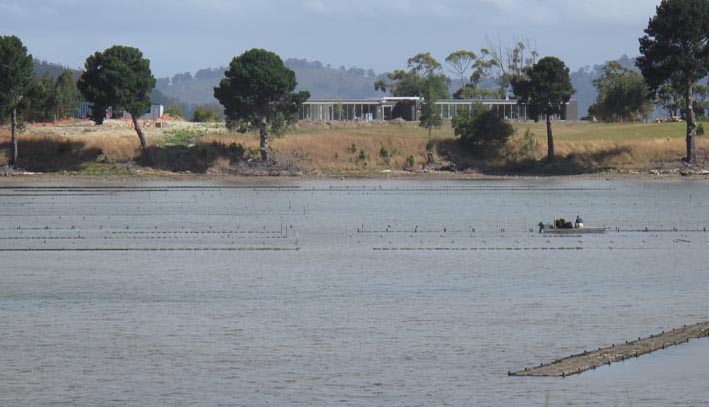
The 60-metre-long Boat House “home”, on Lot 2, looks out onto the oyster lease off the northern shore of the peninsula.
Boat House was sold to an un-named buyer through Harcourts Real Estate, for $1.1 million, on July 31 last year.
The Harcourts sales spiel talked of “views to the Cygnet yacht club and township over Gardner’s Bay to the north”. Sadly, these and other views to the west coast of Port Cygnet, as a consequence of extensive plantings at the eastern end of the peninsula, can no longer be seen by the Direens or by travellers along the Channel Highway.
Harcourts also said Boat House was on “1 hectare of gently sloping pasture, with dual water-frontage on both sides of the point, that features excellent direct water access over the crown reserve to the foreshore”. It was built, it said, on: “. . . a gated private waterfront estate that offers the potential for only 4 homes to ever be built on this magnificent peninsula”. There it is, that “home” word again: this time, in fact, “four homes”, a number that has never been permitted. Structures that house “manager’s quarters” and luxurious facilities for “guests”, and need workshops for “maintenance”, are hardly “homes”. They may be “units”, “apartments”, or simply “buildings” — but “homes” they are not.
Harcourts talked of “ideal places to moor your boat on either side of the property . . . and a secluded small beach in Helms Bay to the south of the home”. It did no more than hint that Helms Bay foreshore is public space, open to anyone who might wish to enjoy its amenities; as is the whole of the foreshore of Green Point.
When Harcourts had Boat House on the market in the first half of last year, “the home” — there’s that word again — was “at lock-up stage offering the purchaser the opportunity to choose some of the finishing touches and colours along the already completed specifications”.
One option was that the property could be bought “as is” to “complete in your own timeframe and style and take advantage of the owner’s thoughtful design and planning”. Also: “The property has been landscaped with a nice blend of native and exotic trees to give an excellent privacy for the future and a range of colours through the seasons.” The grounds, it said, were “manicured”.
All very nice — but, I’m sure, that’s not what the authors of the Port Cygnet Planning Scheme had in mind for this “area of outstanding scenic significance” when they envisioned Port Cygnet’s future in 1988.
An addendum to the minutes
DEBATE on the Green Point DA at the January council meeting was largely unedifying, almost non-existent apart from the contributions of the two Greens councillors.
Gudden, a builder and earthmoving contractor, felt it sufficient to say, as he tends to when DAs are the topic, that he is “pro-development”. Deputy Mayor Mike Wilson, a tourism developer, observed that the word “developer” had become regarded by some as a dirty word. I couldn’t agree more. Once, several years ago, when Wilson and I met for coffee, although we impressed upon each other how “passionate” we were about the Huon Valley, we found little or no common ground then on what we think is good or bad for the valley. I doubt we would now.
SMITH, supported by Woodruff, argued against approval of the DA. She spoke of several apparent deviations from the various rules and regulations, and parliamentary acts, that are supposed to ensure developments are appropriate.
Because council staff went to such great lengths in preparing their report to council (in the process, ironically, practically proving that the recommendation to approve the DA was unjustified), the other side of the argument also needs stating, especially as council’s minutes are so abjectly devoid of any mention of councillors’ contributions to debate. Here is an edited version of Smith’s address to council on January 22:
The full heading for this agenda item is Planning Application (DA-129/2013) – visitor accommodation (two holiday cabins) – land directly to the east of 6933 Channel Highway, Gardners Bay (CT 158717/1 and CT 166320/1).
. . . Throughout the [staff] planning report, the “holiday cabins” referred to in the title of the report are described as “guest houses”. What is the distinction? The development application was for two guest houses, so why was it advertised [as] two holiday cabins? The advertisement was misleading and should be re-advertised.
. . . [The] report sanctions what is clearly a dwelling for a manager — which is the larger part of the building — with guest rooms as a subservient use, when it should be the other way around for a guest house.
Clause 6.6.4 of the Port Cygnet Planning Scheme clearly states that the total number of houses on Green Point shall be limited to two houses. These so-called guest houses are clearly designed as a way to circumvent the planning scheme.
How could council’s compliance officer(s) possibly enforce the proposed conditions for occupation of the “guest houses”, especially when the whole of Green Point has been so effectively screened from the public?
. . . Clause 6.6.1 of the Port Cygnet Planning Scheme depicts the zone intent for the Low Density Residential B zone as,
“The intent of this zone is to provide for a mixture of hobby farming and low density living”. This proposed development is neither of these.
The report acknowledges that Clause 6.13.1 of the planning scheme is not relevant to the assessment of this application due to the site’s remoteness from the township of Cygnet.
The State Coastal Policy 2.4.2 states that “urban and residential development in the coastal zone will be based on existing towns and townships”. This development is not based on a township, so is not compliant with the policy.
The report states that “the proposal is considered to enhance the economic base of the municipal area” as it “would provide high-end accommodation that is not provided elsewhere in the Cygnet area”.
There is already a considerable amount of “high-end” accommodation in the Cygnet area, and this development of two guest houses with two rooms each would not contribute significantly to what is already available. The guest house on Lot 4 in particular would contribute to loss of coastal amenity — from the road, the water and the Public Reserve around Green Point.
. . . An aspect that is of great concern is the way in which public access to the foreshore reserve has been cut off by the developments that have already taken place on Green Point….
A proposed guest house on the southern side of the peninsula would mean that any member of the public using the foreshore reserve would find themselves practically on the doorstep of a “guest house”.
The front of the building is only five metres from the coastal reserve — and people would be looking into living and sleeping areas from public land!
This is one reason for set-backs, and just because the public land is not a road it doesn’t mean that we, as a planning authority, should allow the minimum setback of five metres from the coastal reserve.
The development application stated that the proposal does not involve land owned or administered by the Crown. However, it is adjacent to Crown land, and Crown Lands have presumably approved it. We didn’t get any information on this.
The report states that the proposal would not affect public access to the coast as set out in 2.6.1 of the State Coastal Policy: “The public’s common right of access to and along the coast, from both land and water, will be maintained and enhanced where it does not conflict with the protection of natural and cultural coastal values, health and safety and security requirements.” The [Green Point] landowner has told a local resident fishing on the beach that he owns the land down to low-water mark. My understanding is that the landowner has a maintenance licence for weeding etc, but public access is not restricted because the coastal strip is a Public Reserve and is Crown Land.
The setback from the road [Channel Highway] is proposed to be relaxed from 50 metres to 15 metres because the section of land on Lot 4, on the south side, is so small and the guest house would still be only 5 metres from the reserve.
Why is the guest house being sited there, and why does the report say that siting a guest house there “does not significantly affect future development (such as an additional dwelling) on adjoining land”?
This looks like the start of more plans to circumvent the planning scheme and completely destroy the coastal and rural qualities of Green Point that are so highly valued in the Port Cygnet Planning Scheme.
Woodruff told me: “Green Point is the only place in the Port Cygnet Planning Scheme 1988 that has been specifically singled out as having special natural values that should be protected. To protect the vista from the point, only one house was allowed to be built.”
Developments since, she said, were “a clear breach of the spirit of the scheme”; and enforcement of many of the conditions that had been added to the approvals (such as ensuring that the proposed buildings are not lived in for lengthy periods) was almost impossible.
Ways had been found “to work around the spirit of the scheme”, she said, thus turning Green Point into “a large private-accommodation village”. Most disturbingly, “it appears this might impede public access to the coastline, which has substantial Aboriginal middens and other special features”.
The fast lane
THERE are other arguments against further development on Green Point. For example, the winding road as it passes the frontage to 6933 Channel Highway poses obvious dangers, especially when a vehicle travelling from the direction of Cygnet slows to turn right into the “private estate” (Harcourts’ description of the peninsula). The Channel Highway in this area has a 100kmh speed limit. It might be fairly safe for a vehicle turning right when it stands alone, but when two or three vehicles pull up waiting for the lead vehicle to turn, reaction time for other drivers approaching from the rear is shortened.
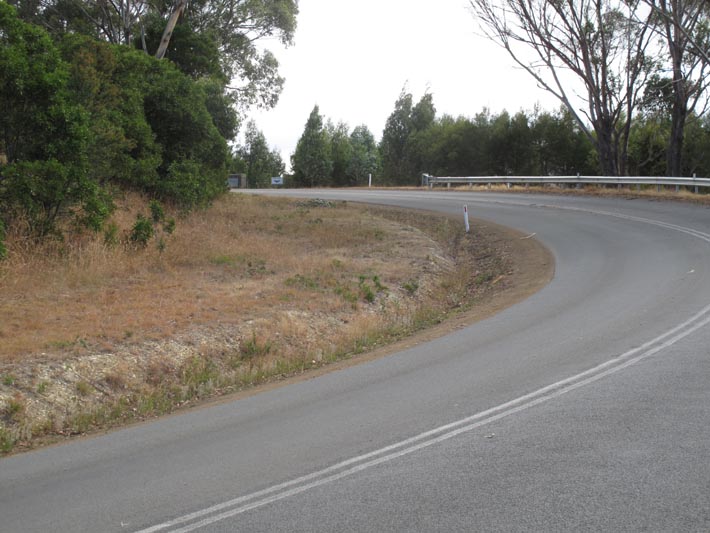
On Channel Highway, travelling south: Green Point’s new entrance, flanked by a stone wall, is on the righthand side of the road just beyond the sign.
The Department of Infrastructure, Energy and Resources (DIER), responsible for the traffic aspect of access to Green Point, in a TIA (traffic impact assessment) report, finds “no requirements from an operational point of view”.
My understanding is that the latest TIA barely differs from a TIA conducted in 2008. Its traffic figures are based on November movements. Those figures, I would imagine, would be quite at variance — probably substantially smaller — with those that would be observed at any time between Christmas and Easter, or when Green Point was fully booked with a dozen or more people in temporary residence.
SMITH’S arguments against the agenda recommendation got short shrift from the mayor and his men. Wilson — following on his comment about “developer” becoming a dirty word — observed that it was important to spread the word that the Huon Valley was “open for business”.
It seems the message from Tony Abbott, Australia’s poor-man’s Putin, is trickling right down to the grass roots. That message is: “Bugger the Great Barrier Reef, bugger forest reserves, bugger the wild rivers, bugger the environment, bugger coastal reserves, bugger foreign neighbours . . . The only things that matter are the economy, the almighty dollar — and development!”
No reasonable person argues against development per se — but surely not at any cost? Surely the interests of the wider community matter as well. Not to mention the sometimes intangible economic benefits that accrues to the tourism industry through the preservation of eye-catching vistas. For example, vistas such as the one that was once observable down the length of Green Point, vistas that excite the imagination of visitors and locals alike. Tasmania may not be as “clean and green” as the outside world is kidded it is; but it sure is dramatically beautiful, frequently awesomely spectacular, and — as was once the case with Green Point — still a wondrous world of welcome sights for city-sore eyes.
Sorting out crossed wires
TRYING to digest the details of council’s January decision on Green Point is a bit like blundering about in a maze. Here and there one gets a sense of crossed wires: clause numberings ring wrong; and, though numbers were changed in the slightly amended, final, version of the recommendation, they seem still to be wrong. Council should scrutinise carefully the minutes of its January 2014 meeting. They are confusing, and in places just plain wrong.
Amy Robertson, the nearest HVC has to an independent councillor, in successfully moving a small amendment to the original recommendation, did her best — but still largely failed — to sort out the nonsense of points 2 and 3 in the original recommendation. But none of that seemed to matter to council’s six elected male members. “Development” is their refrain, no matter what kind of a hash council might make of its words.
A few other observations:
— The building applied for on Lot 4 is intriguingly positioned. It leaves vacant a huge amount of space on the same lot on the north side of the driveway into the peninsula. That is where permission to build a guest house, with a 50-metre setback from the Channel Highway, was granted in 2010. Surely no one would be dreaming of squeezing even more structures onto this place of “outstanding scenic significance”?
— Local talk has it that a plan is afoot to make Boat House into a “convention centre”, for hire at “$30,000 a week”. Would someone please scotch this horrific rumour?
— Harcourts’ advertisement said: “The Boat House is in two wings and has been designed with an owner’s wing that features the living dining and kitchen and the master suite, and the guest wing features 3 bedrooms and 3 bathrooms along with a media room . . .” That surely wouldn’t be a “media room” for news-hounds to work from at convention times, would it? Of course not. Just joking.
— Harcourts asserts that the Green Point estate offers “the potential for only 4 homes to ever be built on this magnificent peninsula”. My understanding is that the rules as they stand state that only two “homes” can ever be built — and they are both already there. Harcourts’ description of Boat House as a “home” also raises question marks: it’s an odd kind of “home” that has only one bedroom for residents yet features a “guest wing” that can “easily be closed off when not required”.
Tasmanian laws and rules tend to be holey writ, and, with a council that seems to have its priorities permanently swayed in favour of development at any cost, Harcourts’ not-ever assertion might be just a bit of unconscious sales-pitch spin. Does anyone know something that most of us don’t? If so, please put us in the picture so that we can all relax in the knowledge that the worst that can be done to Green Point has already been done.
— Changes to the structure and number of titles on Green Point around 2010, opened possibilities of a plethora of artificial alterations to the landscape. Had only two “buildings” (rather than “two houses”) been the ruling in 2010, most of the present circumstances might have been averted. The aerial shot of Green Point, with the 2010 DA approvals written on it, shows the peninsula at its bucolic best, and over which everyone viewing it from the east could see almost for ever. Seems it was all too good to last.
— The guest house on Lot 4, along with the maintenance workshop, is in the southeastern corner of the lot, directly overlooking the Crown reserve and beach frontage. If this gets RMPAT’s go-ahead, it would signal that there could never be a rock-solid defence against any sort of disfigurement to Green Point. Just imagine! Eventually, it could be littered with holiday cabins, guest houses, swimming pools (indoor/outdoor, whatever you fancy), airstrips, helipads, saunas, tin sheds, wooden sheds, sustainable sheds, biodegradable sheds, lean-tos, greenhouses, plastic tents, caravans, motor-homes, campervans, perhaps even a fish-farming depot, or a lumber company . . . If the latest developments cannot be stopped, there’s no saying what lies in store for beleaguered Green Point.
— One informant tells me the yellow notice of the latest Green Point DA, legally required to be displayed in front of a property, was up “only for a couple of days” before disappearing, never to return. I am also told council did nothing when informed of the notice’s disappearance. (It is, of course, not uncommon for such notices to disappear, and such a happening can easily be blamed on the weather, vandals etc.)
— Then there’s the wind sock. That wouldn’t be an indicator of an imminent helipad, would it?
Enough is enough!
THERE’S no hope now of preserving Green Point as the bucolic and lovely landmark so enjoyed by locals, and visitors, perhaps even for 40,000 years or more. Aboriginal authorities seem to have shown little interest in the fact that there’s substantial midden evidence, especially at the western end of the peninsula; or in local tales that there’s a grave somewhere on the promontory. (This writer is unaware of official Aboriginal “heritage” research having been done on Green Point.)
There must still be time for the people of Cygnet and further afield (and, for that matter, the relevant authorities in whose hands Green Point’s future lies) to say, “Enough is enough!”, and to ask for (or order) a reopening of the now obscured fabulous vista across Port Cygnet from the Channel Highway.
Don’t expect support to come from Huon Valley Council. Its record of environmental vandalism is long and sustained — and there are no signs that this is likely to change. But there must be out there people who care enough, and have courage enough, to stand in defence of such treasures.
Perhaps as a token of resistance, at least a ‘Green Point Foreshore Friends Group’ could be started. It would also be a great exercise spot for members of the local dog-walking association. I, for one, would be willing to walk the Green Point foreshore once a month to help to clean up the rubbish that washes ashore — or is dumped there, like the scores of concrete tiles that lie in a crevice on the Crown reserve and are now being spread by the tides onto the beach.
No one should ever say never, especially in a state in which the only thing that seems fixed is the deeply embedded cultural mind-set that money is everything, even among a population that has notoriously been lacking in material riches since the first convicts arrived.
I sense a hidden agenda to develop Green Point until it no longer resembles the enchanting Port Cygnet feature described in the 1988 planning scheme.
One would wish HVC were more circumspect in its deliberations. But no, to its mind, “development” is always its priority. The disturbing plethora of unsold residential blocks in Cygnet is largely a result of slack subdivision policy, and council’s slap-happy approach to developing the municipality’s assets. Steadily, Cygnet is becoming a dogs’ breakfast, a mongrelised mix, as a consequence of inappropriate, discordant development. One should never expect a council seemingly devoid of any kind of aesthetic sense to stand in the way of the destruction of natural beauty when there are the alternatives of bricks, concrete, gravel, bulldozers . . .
RMPAT’s job is to ensure that the law (no matter how slack or irresponsible it may be) is followed. Planning law, of course, is open to interpretation because of the many varied situations that must be dealt with. The only hope now is that the values Huon Valley Council usually ignores (in fact seems blissfully unaware of) will be given their proper weight by RMPAT in the appeal process. — Bob Hawkins
(This is written for posterity. I doubt that anyone who started reading it could have got this far before succumbing to boredom. Nevertheless, Huon Valley historians may one day be grateful that they have something more than just hopelessly inadequate council records to construct their images of early-21st century Cygnet.)