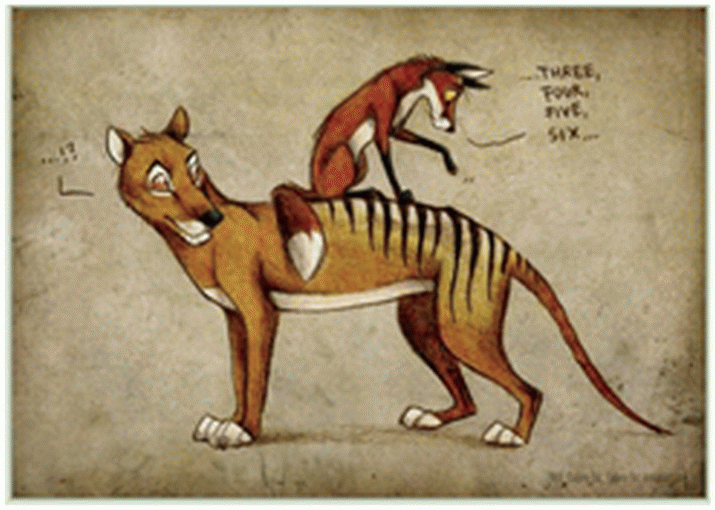


Extant, Extinct or Eradicated?
Does Tasmania’s economy depend on maintaining the existence of two mythic (cryptic) creatures?
Over the past 70 years more than 4000 alleged sightings of the believed-to-be-extinct [i]thylacine[/i] have been reported. And over the past 10 years there have been a similar number of alleged sightings of the believed-to-be-present [i]fox[/i].
Yet not one piece of credible evidence has ever been put forward to prove that either the thylacine or the fox are any more than charismatic wanna-beTasmanian animals.
One is immortalised and loved to death; the other hatred and feared to death. So what creates the mojo for both these cryptic creatures in Tasmania?
If a thylacine population has somehow managed to cling on, proving the existence in 2014 would be ranked along with the Resurrection.
And as Ivo Edwards highlighted in a recent a Tasmanian Times article, how can Tasmania eradicate foxes that cannot be found?
http://oldtt.pixelkey.biz/index.php?/article/why-the-tasmanian-fox-eradication-program-has-been-/
Maybe declaring the eradication of an animal that cannot be detected is easy. The authorities need say so when it suits them. [The thylacine was declared officially ‘extinct’ in 1986.]
[b]Tiger “is good for publicity”[/b][i] Most would be sorry if a Tasmanian tiger was found and captured, the Premier, Mr Eric Reece said yesterday. He said Tasmania probably would score more publicity from the tiger if it was “extinct and joins such departed species as dinosaurs, moa birds and kiwis.”
“The now almost legendary Tasmanian Tiger has done much to create the awareness about Tasmania abroad,” he said.
“In recent years this elusive animal has had the same effect on anthropologists as flying saucers have had upon those who scan the skies.”[/i][Reference: The Advocate newspaper, 30 September 1968]
Better extinct than extant, according to 1960s Premier Electric Eric Reece.
Today proof of a live thylacine still evades us. Even physical evidence of a dead thylacine collected over the past 60 years has been strictly controlled by the same authority that believes there are foxes in Tasmania.
A few large rewards [The Bulletin magazine’s $1.25 million in 2005; Ted Turner’s $100,000 reward in 1983], combined with several true believers, have failed to flush a thylacine out of extinction.
After another alleged thylacine sighting in the Victorian Otway Ranges in 2008 local Tasmanian thylacine-believer, Col Bailey had this to say: [i] ‘A good many of these reports are as good as it gets; fluent in content and graphic in detail. And yet, despite this, the ever paradoxical question remains – Where is the evidence? Hard evidence is paramount to any in-depth investigator worth his or her salt and, in this case, there simply isn’t any. Short of a reasonably fresh cadaver or live animal, it’s going to be almost impossible to prove.’[/i]
So what’s has Tasmania learned from its thylacine and fox hunts?
How will Tasmania be taken seriously on its cryptobiological sensations?
Perhaps these elusive Tasmanian ghost stories are an opportunity to demand higher standards of evidence and field investigation.
Back to Col Bailey: [i]‘Sadly the situation has been inhibited somewhat in recent years by certain publicity-seeking individuals, ever eager to over-sensationalise the sighting report and see their name in print.’[/i]
Welcome to Taz-mania – Exploit the Opportunities!
• Ian Rist, in Comments: Question 2: The papers that placed ads for fox scats on the mainland to send to Tasmania (including the NSW Game Council’s newsletter) were seriously taken to task by the NSW Health Department. The ads placed for fox scats contained no mention of protective gloves or precautionary measures to insure the poo collectors didn’t contract serious diseases. Will we have a repetition here from our vigilant Health Department? Or will they too, be subject to gatekeepers like the Tasmanian media?
• Jack, in Comments: Importantly, unlike most other states where 1080 was used for rabbit (dog and fox) control, Tasmania instituted a policy of using the poison on a large scale to kill native species as a forestry ‘management’ tool. This required very high concentrations of 1080 than those used for rabbit control. It also introduced 1080 into forest habitat and impacted upon wildlife very substantially, while this was a much rarer for rabbit control in other parts of Australia especially in places where wildlife were tolerant to 1080. Its worth considering that the Tasmanian use of 1080 has deviated substantially from that in other parts of Australia and the world. This was largely driven by the Tasmanian forest industry. One might speculate that if it had 1080 remained as a properly regulated and increasingly refined method of rabbit control in agriculture lands, that it would never have generated the (largely deserved) bad reputation it received through its broad scale application in forestry here.