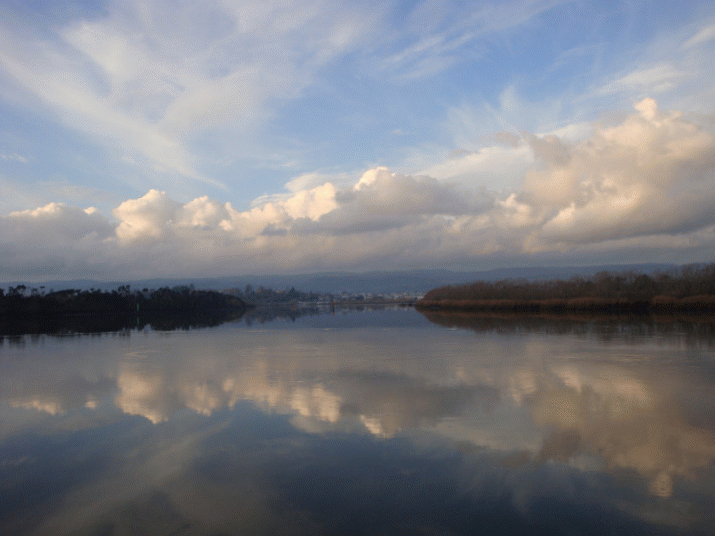
Estelle Ross: Evening (cloud) reflections on the Tamar River …
The Earth’s climate is far more sensitive to carbon dioxide emissions than previously thought, heightening the likelihood of a 4C temperature rise by 2100, new Australian-led research of cloud systems has found.
The study, published in Nature, provides new understanding on the role of cloud formation in climate sensitivity – one of the key uncertainties in predictions of climate change.
Report authors Steven Sherwood, Sandrine Bony and Jean-Louis Dufresne found climate models which show a low global temperature response to CO2 emissions do not factor in all the water vapour released into the atmosphere.
Models typically simulate water vapour as rising to 15km and forming clouds, rather than updraughts of water vapour that rise only a few kilometres and pull away the cloud-forming vapour. This prediction of cloud cover is important because clouds reflect sunlight, lessening the impact of global warming.
The report, conducted between the University of New South Wales and the Université Pierre et Marie Curie in Paris, finds “real world observations” show the accepted models are wrong.
In reality, the study found, water vapour is distributed to different heights in the atmosphere, causing fewer clouds to form as the climate warms.
In turn, this increases the amount of sunlight entering the atmosphere, making the level of warming far more sensitive to heat-trapping gases such as CO2.
As a result, the world can expect a temperature increase of “at least” 4C by 2100 if, as predicted, there is a doubling of CO2 in the atmosphere. This could then rise by more than 8C by 2200.
REad the full article, with full links, here
• Fairfax: Maurice Newman’s flat-earth thinking ignores climate facts