A response to Hans Willink: Grammar – A Selective Public High School
A late contribution. The creation of a selective high school in Tasmania would be greeted favourably by Christopher Pyne as it supports his thinking behind growing the number of independent public schools in Australia to 25% by 2017.
It is good that Hans has raised the option but it would exacerbate the problems we are facing rather than reducing them.
In Queensland I am told that if a child’s enrolment application to a selective high school is unsuccessful, enrolment in the private sector becomes the second best option rather than their first. Having created the problems our country is facing in education, politicians are unable politically and to do a U turn and have us return to the large comprehensive high school.
The Liberal party is looking at adding years 11 & 12 to high schools but the merits of doing so will need to be weighed against having adolescents massed and educated in larger cohorts. They were created so that students would be thinking about those who were four years older and still in education or work rather than being role models to those who are four years younger.
Colleges and comprehensive high schools provided teachers who were skilled in their craft or with expertise and qualifications to up skill and guide others, support and lead on-site professional development and for students, courses appropriate to their ability and across a broad spectrum were available.
The numbers supported this. In the 70s I didn’t learn Science in years 9 & 10 at Rose Bay High School. I was streamed into Physics and Chemistry and taught by teachers qualified or professionally assisted by others. I missed out on Biology but it was all available. It provided CHOICE for everyone and if the passion, ability or interest existed, there were no obstacles. Education and opportunity for all existed and every school was a great school.
With this said it will never return.
The private school sector is entrenched and different rules apply even though they are heavily funded by taxpayers. The first statement made by Peter GarretT when proposing the Gonski model was that no school would be a loser. It needed to be said or it was going nowhere. All agreed that Geilston Bay needed to close as only around 100 students would have attended in 2014 as it was simply not viable – did we? – when on the corner opposite are a few handfuls of students being educated at Seabrook Christian School K to 12 and a Tiger Woods golf drive away in Warrane is Eastside Lutheran College that educates 58 students in a K to 10 environment (Av less than 6 per year group).
It receives 10% less combined government support than Rose Bay High School, according to My School. It is a good school by all accounts but so was Geilston Bay.
Non-government school enrolment is now main stream as Australians believe in middle and upper class welfare. The paid parental leave scheme is a case in point. At $6 billion per year, it is more than double the cost of the Gonski-lite version we are now receiving and are so enthused about.
In the ACT this year, three private schools were supported in their establishment with 60 expected to enrol in each while at the same time a public school was closed in the same area with greater numbers. We are third in nations in the level of government funding we provide to support our non-government systems. Only Chile and Israel provide more.
We now consistently have over 95% of year 6 students leaving a large un-named primary school every year bypassing their local high school in cars and carbon polluting buses daily to attend a host of secondary schools and Tasmanians are forking out $18 million per year to subsidize their transport costs.
This is above the other $18 million that is needed to transport students to their local schools in rural settings or to their local school. Naturally these families are interacting less with their neighbours, the children are playing in different sporting competitions and they are unable to organize lifts together as they cross Hobart to play in school-night and week-end competitions.
If the truly comprehensive high school could be brought back then ….. but it can’t. There is not the political will or the community desire.
What’s good for the country is simply not viewed by parents or voters as what’s best for their child anymore. It’s why we are at a loss as to how we can turn things around and why we will continue to talk about selective schools, IPSs, principals on contracts, performance pay, NAPLAN testing, MySchool data, but it will do nothing to address the concerns that exist in education.
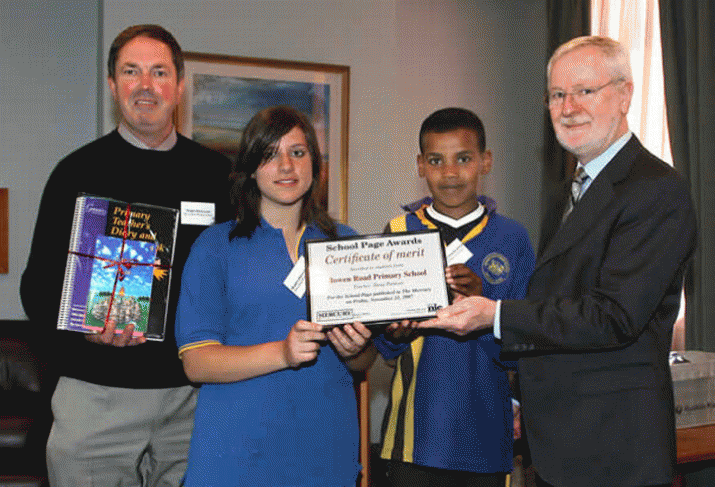
*Pic: Bowen Road Primary School principal Terry Polglase and students Marina Djekanovic and Arif Mohamad Gamar with Education Department secretary John Smyth.
• Who is Christopher Pyne to determine what the curriculum should be?