Greg Bearup has written a superb article in The Weekend Australian magazine on war’s terrible cost: The Army’s Top Brass claim the extent of Post-Traumatic Stress Disorder among veteransis minimal. But try telling that to soliders like Liam Haven …
LIAM Haven scans the tarmac with his cane as he strides along the old highway to Canberra, recalling his childhood in Western Australia.
His old man, Craig, now a prosecutor, was a policeman who was posted to stations around the state. His mum, Debbie, is Burmese; she’d emigrated as a child. “Growing up in rural WA with a father as a cop I got picked on a lot. My dad had locked up some of my classmates; you can imagine how that went down. Mum’s Aussie as, but looks Asian, and so I copped it for that too.” His early teenage years were “best forgot” – he was a gangly, pimply kid who couldn’t wait to leave school and he did, not long after he turned 15.
Haven moved to Broome, where his dad was posted, and started work as a cement renderer. It was an OK job but the tropical lethargy of the place – work in the morning and then fishing, surfing and the pub every afternoon – started to get to him. And so he joined the army. It wasn’t out of any great sense of patriotism; that came later. He wanted adventure.
He loved army life the moment he laced up his desert boots. It gave him a sense of purpose. He slotted in and no one gave a rat’s about what his old man did and where his mum came from. “When you first join the army everyone’s a piece of shit, but you’re all equal pieces of shit.” He celebrated his 18th at basic training. The skinny teenager hit the weights and bulked up to 120kg. He was big and strong and they turned him into an infantryman, a machine gunner in the Brisbane-based 6th Battalion of the Royal Australian Regiment, 6RAR, famous for its gallantry at the Battle of Long Tan.
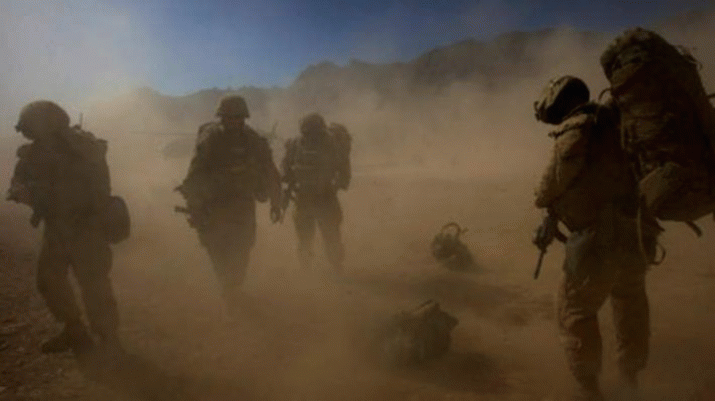
His unit went off to East Timor, his first time overseas, and the experience made a better soldier of him. He grew up. And then he was off to Iraq. It was what he’d dreamed of, a proper deployment. His unit departed on November 30, 2007 and, on top of his infantry duties, he was trained in combat first aid. The politics of the war in Iraq didn’t concern him. “Our job was to do anti-rocket patrols, anti-IED patrols, not to be an aggressive presence but an assertive presence. It was pretty frustrating at times – I wouldn’t say we were wrapped in cotton wool but there was a caution that prevented us from doing our job at times.”
On the morning of May 15, 2008, two weeks before he was due to come home, he went out on a routine patrol.
…
Retired general John Cantwell, who commanded Australia’s troops in Afghanistan and the Middle East in 2010, predicted there was likely to be a great surge of mental anguish among Australian veterans as our service men and women return home. “I think it will be a tidal wave,” said Cantwell, who retired in 2012, after years of battling PTSD himself – a result of fighting in three wars.
However, some controversial studies commissioned by the ADF suggest the rate of PTSD is drastically lower among Australian veterans than among their US counterparts. The ADF-commissioned research estimates the rate of PTSD at less than two per cent – although it is significantly higher for soldiers who have experienced combat. Chief of the Defence Force, General David Hurley, has dismissed his former colleague’s “tidal wave” claim as being “provocative and emotive” and says it “points to a simplistic view of military mental health”. Hurley made the bold claim on ABC TV’s 7.30 that “we actually don’t have a difference in the rates of mental health illness between the people who have deployed and people who haven’t deployed”. He stressed that this conclusion was based on world-class research. Being deployed to a war zone, our most senior military officer suggested, did not increase the chances of defence personnel getting PTSD.
“That is just ridiculous,” counters retired US general Peter Chiarelli, a former senior military adviser to the US Secretary of Defense, when I put Hurley’s statement to him. “Absolutely ridiculous. There has to be recognition that this is a problem. It has been a problem forever. There’s this crap about this being something about this generation – it isn’t anything about this generation. This has been a problem forever, for as long as we have had war.”
Chiarelli was the commander of the Coalition’s combat forces in Iraq in 2006. After his return to the US he looked at ways of reducing the alarming suicide rates among veterans and investigated programs to deal with PTSD. (He personally penned a letter to the family of every US soldier killed under his command in Iraq, posting 606 letters in a year.) He now works for a research organisation called One Mind, investigating better treatments for PTSD and traumatic brain injuries.
Chiarelli predicts Australian troops who served in Afghanistan and Iraq will return with rates of mental illness similar to those who served in Vietnam. “Probably higher,” he adds, on reflection. “While Vietnam was a guerilla war, there were front lines and there were places you could disappear and not worry. There is no road you can drive down in Afghanistan or Iraq and say, ‘The bad guys are not down here, there are no IEDs’ – the threat is constant.” The Department of Veterans’ Affairs eventually compensated 29 per cent of Australian veterans who served in Vietnam, accepting they’d suffered PTSD. It’s a long way from two per cent.
…
Australia was a bit player in the wars in Afghanistan and Iraq. We had no real influence over the outcome of either conflict – both of which are still being played out. The current military leadership will not be judged on those wars but on how the men and women who fought on our behalf fare in the years to come.
onefootforward.gofundraise.com.au; Lifeline 13 11 14
Read the full article, The Australian here
• Earlier on Tasmanian Times … Get out of Afghanistan: Max Atkinson and Scott MacInnes .