Pat # 7 and Penelope # 9… The Exhibition Gardens was the unique vision of some influential people. It is a beautiful story. But let’s start with a few words from Baron von Hügel and Genius loci (The Spirit of place).
Baron von Hügel ascended the mountain in January 1834. A part of his description is worth repeating because in the words of this nineteenth century explorer, aristocrat, trained scientist and lover of botany, the sense of the place is captured eloquently. (Consider that the Baron had just emerged from the wonders of the forest on the lower foothills, the likes of which he had seen nowhere else in his travels). [Dymphna Clark. New Holland Journal. MUP. 1994]
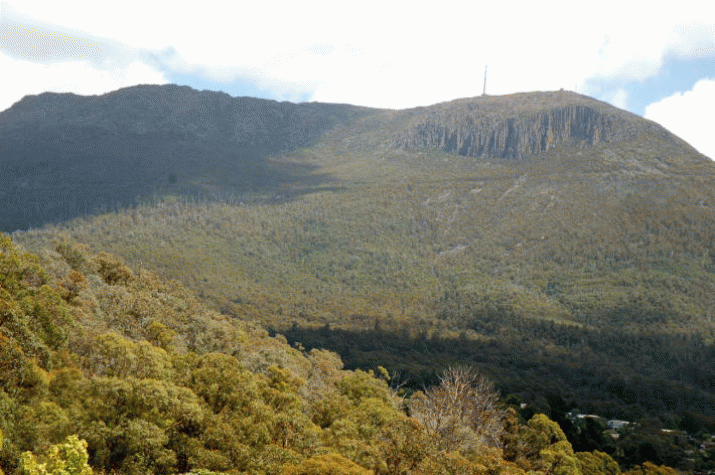
“This marks the beginning of a unique and splendid type of vegetation. Presumably the snow in winter and windborne sand and dust have gradually built up a primary layer of soil which, simply by virtue of the vegetation itself and its decomposed litterfall, has in many places becomes thick enough to support a forest (that is in terms of its species) which however can grow only to a height of 12 to 14 feet. The soil here is always moist, but, where the rocks are not covered with soil, you find the same formations as described above. This is the more remarkable as it is the only place in New Holland where traces of a mighty revolution in nature are clearly to be seen. The rock is basalt [dolerite] and in many places where the mountain drops down perpendicularly to Hobart Town, it occurs in regular pentagonal prisms. … It is about two more miles partly along a bad track. The panorama is sublime. The islands and peninsulas and the surrounding sea lie spread out like a map showing neither elevations nor depressions and the ships dwindle to tiny boats,” and further, “this mountain is the constant background to the beautiful scene presented by Hobart Town. Its ever-changing colours and the lovely relationship between the rock formations and the woods, combined with its distinctive shape make it one of the most beautiful mountains I have ever seen.” [Dymphna Clark. New Holland Journal. MUP. 1994]. [“mighty revolution”…. The world was just on the cusp of being given the important findings of the now famous geologist Charles Lyell, Principles of Geology, issued between 1830-1833 and Elements of Geology, 1838.]
Prior to the Exhibition Gardens area being developed at the Springs area, it was necessary to walk if one wanted to get to the top of the mountain. Certainly there is statistical evidence that people did walk to the top. A report to parliament May 1905 noted that,
“9500 people visited The Springs, November last to April; 8,000 availed themselves of vehicles to reach The Springs, 7000 went to the Pinnacle along the new track. If anything I believe the above figures are underestimated [ Journals and Papers of Parliament. .” Vol. LIII Paper 18. Hobart Water Supply. Appendix 3. A. Werthmeimer].
The Springs site at the beginning of the 1930s served as a “honeypot”, a focal end point from which other decisions had to be made. Was this the end of the recreational experience, was it the start of a walk to the top of the mountain, or elsewhere, was it a place for a picnic or a place to stay longer? Honeypot recreational sites are multifunctional and this was one of them. From the vantage point of the Exhibition Garden site one could gaze upwards at the sublimity of the mountain and the Organ Pipes, feel its awe, power and majesty, yet at the same time one could overlook humanity, Hobart and the Derwent and feel as though one was on top of the world. [Christopher Alexander for example notes in a A Pattern Language. Oxford University Press, 1977. Pattern 62.] that “the instinct to climb up to some high place from which you can look down and survey your world seems to be a fundamental human instinct.”]
Any kind of apparent dismissal of the early nineteenth century text writers must not be quickly brushed aside as “warm and fuzzy”. The whole of the Sublime, Picturesque and Beautiful “Ideal” landscape movement of the eighteenth and nineteenth century was integrally linked to it, while in the twentieth century the “wilderness” concept is not unrelated. Wildness (evoking terror) as distinct from wilderness was very much an element of the Sublime and Mount Wellington fitted to that perception exceedingly well; its weather, topography, vegetation, (e.g. The Vale of Giants) events (Fires and 1872 landslip), all most relevant.
For Alan Wardlaw [MLC 1920-1938], Tasmania could be “the most beautiful country in the world. What an asset this would be from a tourist point of view.” It was advertised as “the Garden State.” “Tasmania is a land of beauty and has been well named ‘The Garden of the South’. ”[Tasmanian Tourist Association: Beautiful Tasmania .]
The vision of the Exhibition Gardens was part of that vision to “beautify” Tasmania.
Mr J. Moore-Robinson in 1937 included the Exhibition Gardens in his Historical Brevities of Tasmania. Moore Robinson writes, “Following the Antique Exhibition in Hobart in 1931 a few interested gentlemen including the late Mr. Alan Walker, the Hon. L.M. Shoobridge M.L.C. Mr. A. V. Giblin, and Mr. Courtney-Pratt put into execution the idea of exhibition gardens for the preservation of Tasmanian flora. With the assistance of the City Council a site was selected just below the Springs Hotel on Mount Wellington and the garden laid out. It is largely maintained in its present condition by the public-spirited action of Mr. Shoobridge, who devotes considerable time to its care, and it is well worth a visit.” Mr Shoobridge it will be noted in 1931 was then aged 80 years. One difficulty for the Garden was that its chief proponents had mostly died by 1940. As with the Pioneer Memorial Avenue, Tasmania owes much to this gentleman for such endeavours, so late in his life. Biographies of Alan Wardlaw and Louis Manton Shoobridge are found in the Australian Dictionary of Biography, available online.
The garden design – still intact – was one of alpine plants, rusticity, winding paths, edged with complementary stone borders. Essentially it was a natural garden. William Robinson (1838-1935), Irish born, but with most of his life spent in England published his book The Wild Garden in 1870 commencing a very different garden style. William Morris, (1834-1896), one of the most influential members of the Arts and Crafts Movement, inspired by the writings of John Ruskin (1819–1900), must be factored in as well. It is more than likely that both gentlemen (Walker and Shoobridge) knew Edna Walling, the very influential garden designer as both had residences in Fern Tree. Walling knew other people in Fern Tree and a number of rustic gardens in Fern Tree are very indicative of her work at Mooroolbark (Bickleigh Vale) in Victoria. It is not difficult to see where the garden “vision” came from, but nevertheless for its time and execution it was extremely unusual.
It is still possible to stand along a winding track of the Exhibition Gardens and “read” the historical landscape as Von Hügel (179 years previously) might have done. In today’s world of “must-develop” that ability is becoming quite rare.