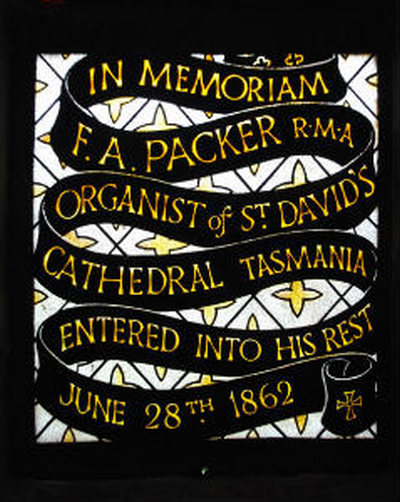
Frederick Augustus Gow Packer was a brilliant Tasmanian composer of secular and religious music. At the time he was widely recognized as one of the most important organist, pianist and composers. He was known far and wide outside the colony of Tasmania.
Over the years he has been virtually forgotten, but he deserves to be re-discovered.
Packer was born in 1839 in Reading, England. He was the eldest son of twelve children of Frederick Alexander (born 1809) and Augusta Gow. Both parents were extraordinarily talented musically. His father was organist of Reading Abbey and an associate of the Royal Academy of Music (London). Mother Augusta also was an associate of the Academy while her father, Nathaniel was a composer. Her grandfather, Neil Gow was also a recognized musician from Scotland. His parents became beware of his gifts early and encouraged his talent. Young Frederick sang and played the organ with the choirs of St George’s Chapel, Windsor and Chapel Royal, St James.
The family chose to migrate to what was still Van Diemen ’s Land (VDL) arriving on the vessel Sylth, 10th July 1852. (Tasmanian Colonist 12 July 1852 P.2 C.4) The colony, since 1803, had indeed progressed; the days of bushranging, confrontation with aborigines and convict transportation were over with the latter coming to an end that year (1852). Now there were native Tasmanians, children of the early settlers, besides many free settlers arriving. The raw, harsh days were behind them and the colony was attracting many enterprising people mainly from the Mother Country.
Frederick senior and wife Augusta arrived with eight of their children and afterwards booked into the Waterloo Hotel, Murray Street. It must have been a quite squeeze. Soon they moved in Durlans House, New Town, just outside of Hobart. (Hobart Town Courier 13th July 1854).
Hobart Town, however, was already home to another Packer family member, that of Charles Sandy Packer. His parents were Charles and Amelia Sandy who had married in 1808 in Middlesex. Charles was brother to Frederick senior, hence uncle to young Frederick. He was born 24th October 1809 Reading, England. Unlike his brother, poor Charles did not come to VDL voluntarily. He possessed obvious musical talent, once being recognized by Mendelssohn, Thalberg and Hummel. He was convicted of forgery and sent to the notorious penal settlement on Norfolk Island, then on to Hobart, where he was able to practice his music.
He was conditionally pardoned and later decided to move to Sydney where he became a composer and recitalist. Before doing so, he married Mary Frances Moore 21 August 1852 at St. George’s Church, Battery Point. He was aged 30 years. Unfortunately for Charles, he got in trouble with the authorities again when in 1863 he got convicted of bigamy and was gaoled for four years. After release his life declined and he died in 1883 and his funeral was attended by 6,000 people, many of the musical world (Argus Melbourne 16th July 1883) and is buried at Waverly Cemetery. A sad demise for someone so talented. Judge Montague in 1848 said of him a “Gentleman of extraordinary musical genius”. (Miss Wayn research, Archives Department, Hobart). He also had once been a member of the Royal Academy of Music.
Packer senior died at his residence 2 July 1862, 19 Davey Street. (Mercury 3 July 1862). His mother was to live until 1892 dying at the “Military Barracks” i.e. Anglesea. There is a memorial window to him in St Kea, Reading England as he had rebuilt the organ there.
When Frederick junior was 17 years of age, the colony underwent great social change. Convict transportation had ceased and to improve the image of the colony, there was also a name change, from Van Diemen’s Land to Tasmania, named after the island’s first sighting by Dutchman, Abel Janszoon Tasman in November 1642. The colony was certainly growing up with the adoption of a bicameral system of government in 1856 bringing Responsible Government.
From thereon until Federation 1 January 1901, Tasmania, despite the occasional economic setbacks, enjoyed steady progress and until Federation was really a small independent country. British soldiery were stationed in the colony until 1870, but Tasmania issued its own stamps, legislated its own laws, including immigration and defence (later to have a War Minister), adopt its own custom requirements and financed its own development. Small fruits, apples, primary industry besides a small manufacturing base had it enjoy one of the highest living standards in the world.
With the coming boom of the mining industry from1870s onwards, the colony, particularly in the north, saw great prosperity. During this time, there was the building of the railway and telegraph (which Frederick junior was to be involved), parliamentary democracy (again with which Frederick Junior was to be involved), adoption of its own flag and the first Australian colony to pass a Constitutional Act. It was able to make its own political and social future without interference from a central government. Frederick Augusta’s music was to reflect this independence, culminating with his composition of the Tasmanian National Anthem which he not only wrote the music but the words. There was an over all growing pride in being Tasmanian, something which has since not been as prevalent.
Music was not, however, sufficient to sustain him financially so he had to establish a career. He eventually become Magistrate, Head of the Telegraph Department (1859-1878) of Hobart and was spend sixteen years as Clerk of the House of Assembly (1878-1994). On the 1st March 1869 he married Marianne Chamberlaine (born 1851-1886) at St. David’s Cathedral and they had three children all born in Hobart; Mona Marion was born in 1869, Gerald Cobbett (1871) and Richard Blundell (1875). Both boys attended Hutchins School.
Like his father, Frederick junior became organist at St David’s Cathedral and a teacher of music. His efforts procured the marvellous organ at the Hobart Town Hall and be became the honorary city organist. He began composing his music which was published by J. Walch and Sons and in 1868 at the visit of the Duke of Edinburgh he conducted the Royal concert. His “Land of Beauty” was performed in 1894 at the Hobart International Exhibition with a choir of 400 and an orchestra of 40. He was also to write a comedy opera, “Sweet Simplicity” which enjoyed successful performances in Hobart and Launceston.
Before all this glory, he had been appointed to the Telegraph Department in Hobart, aged 20 in 1859. Previously he had been learning his skills in an unpaid capacity. (Letter, J. Reynolds Ball 15th November 1858). Packer was quickly promoted as Head of the Department, but really, there was not a lot of telegraph involved. Then there was only a single telegraph line spanning 170 miles, from Low Head in the north to the station at Mount Nelson in the south. Nonetheless by the time he had left the department in 1878 there were over 900 miles of line linking a network of 59 stations. Records of his time as Head of the Department indicated that he was a hard worker and a stern disciplinarian. He was also fair, instructing his staff how in the correct way fulfil their duties. He would tolerate no misbehaving and if a worker was caught playing tunes on the batter jars for the amusement of Hobart cab-drivers, it meant instant dismissal. Yet, he worked for better pay and conditions for his staff, stating “The duties of a Telegraphist require skill, constant care and attention and involve peculiar responsibilities and trust.” He was able to obtain, because of the increased telegraph traffic, a second line between Launceston and Hobart.
In 1878 he had a change of career as Clerk Assistant at the House of Assembly between 1878-1882 and afterwards as Clerk of the House until 1894. In 1890 he wrote a booklet outlying the Tasmanian Parliament – “Rules and Practice”. (Held at the University of Tasmania). It was during this year he married a second time to Clarice Octavia Allison on the 22nd November.
Packer composed many, many songs and musical items. A great number were published as song sheets and they can be found at the Archives Department, Hobart. Some of his works were produced for science congresses and obtained eminence beyond Tasmania. About 1892 he produced the Tasmanian National Anthem, published by J. Walch and Sons. I believe it was played for the first time publicly for a very long period by the Clarence City Bank at the annual Boer War Commemorative Day, in Hobart, June 2013.
Packer was also a music teacher for ‘Tasmania’s Nightingale’ – Amy Sherwin.
In 1895 he decided to move to Sydney, but before leaving Tasmania, he was given a “grand complementary concert” which was attended by all leading citizens and their Excellencies the Governor, Viscount Gormanston and Lady Gormanston. The move was not kind to him and he died after a long illness in the Parramatta Asylum 1 August 1902. It was called at the time the Parramatta Lunatic Asylum and was not a pleasant place. Treatment would be described today as somewhat brutal. One patient a report stated who was being treated for dementia had heavy weights of lead weighting 20 pounds attached to her skull. A report in 1877 (true, before Packer was admitted) stated, “The painful truth is that no patient ever has yet discharged from the Parramatta Lunatic Asylum in a perfectly sane condition and unless great reform take place in the medical treatment, general supervision and general arrangement of the building I am perfectly confident that no patient ever will.”(Factory to Asylum – the early years at the Parramatta Psychiatric Centre – Graham A. Edwards 1972). Hopefully things did change by the time our Frederick was admitted.
The Mercury newspaper (Sat 2nd August 1902) partly reads, “It will be heard with great regret that Frederick Augustus Packer, formerly Clerk to the House of Assembly, Tasmania, died 1inst at Sydney where he had resided for some years past. Mr Packer was the fourth generation of a race of musicians, on the mother’s side. His great grandfather was Mr Neil Gow, a Scotch musician of some celebrity in his day and his grandfather was Mr. Nathaniel Gow, the composer of the favourite Scotch song, ‘Caller Herrin’ ….Mr F.A. Packer, who has just died was well-known as the composer of a number of admired songs, the best-known of which is ‘I am listen-ing’. He will long be remembered in Hobart musical circles as an organist of much capability. He had been in bad health for a long time past and his death was hardly unexpected.”
Frederick Augustus Gow Packer was great uncle to Sir Frank Packer of media fame.
His second wife, Clarice (Bn Sorell 1860) survived him until 1930 when he died in California USA. She married again becoming Mrs Searle. They had one son, Frederick Ryland born in Hobart 1892.
In 1936 a concert at the Hobart Town Hall took place which included a number of songs composed by Packer. They were, “Tho Standard of England”; “Is my Love on the Sea”; and “For old Love’s sake”.
The Mercury newspaper reported (9 Oct 1936), “To many the name of Mr. Packer might be unknown” so it would appear that he was fading into the past even though he only died 34 years previously. The reports wrongly adds that he was the son of “Charles Packer”.
Some of his religious compositions were:
• Nearer to Thee
• Praise the Lord, whose Mighty works.
• God my Salvation, hear.
• Brief Life is here our portion
• Jesus calls up o’er the tumult.