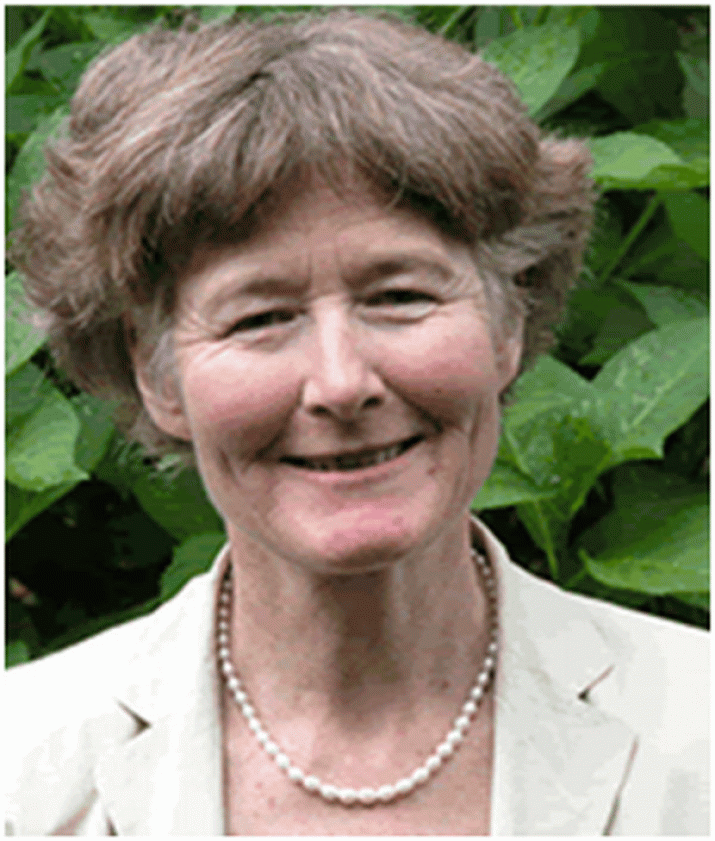

Helen Gee and Bob Graham

Helen Gee and Thomas Graham

Helen Bob and Margorie

Helen fronts the media
An article about the late Helen Gee
On Sunday 18 August, about 60 people gathered in the rain at Hobart’s Botanical Gardens to pay tribute to the conservation achievements of the late Helen Gee. In a pretty corner of the gardens, a small stand of rare Wollemi pine trees had been established to commemorate Helen’s life and honour her enormous contribution to the environment movement.
It doesn’t need me to say it but it’s worth repeating: Helen Gee was one of the most important individuals in the Tasmanian conservation movement.
Helen, who died in December 2012, was an adventurer, a writer, an editor and a poet. Crucially, she was also an activist. She was perpetually engaged in the political processes determining the future of the wilderness areas she loved. Had she been able to attend her own memorial ceremony, she would probably have gone to the concurrent Tarkine protest instead.
While Peter Dombrovskis’s photos and Bob Brown’s words shaped the way we feel about Tasmania’s wilderness, Helen’s works heavily influenced the way we think about it. I don’t mean ‘thinking’ in a dispassionate, dry and detached way; I mean ‘thinking’ that embodies lively curiosity and an intense fascination with life.
This is exemplified by the ‘South West Book’, published in 1978 and edited by Janet Fenton and Helen Gee. The subject matter of this landmark publication runs broad and deep. There are contributions from geologists, biologists, speleologists, archaeologists, geomorphologists, recreationists, foresters, skiers and a pilot. Unafraid to confront the conflicts over land use in the South-West, the book presents assessments of forest resource side by side with explorations of the value of wilderness. Graphs of power-demand projections coexist with drawings of extinct mega-marsupials. Helen herself contributed articles dealing with Tasmania’s wild rivers, the tourism potential of the South-West, and Tasmania’s evolving environmental consciousness. The resultant encyclopedia of South-West Tasmania has been an essential tool for conservation campaigners for over 30 years, retaining its relevance today.
Perhaps the book’s most compelling achievement was to make us think of the South-West as a single entity. Yes, the immensely special features, such as Lake Pedder, the Franklin and Gordon rivers and the Arthur ranges, received their due. But this wilderness was greater than the sum of its parts. In this vein, the concluding chapter of ‘The South-West Book’, by geomorphologist Kevin Kiernan, canvassed the notion of World Heritage listing for Tasmania’s wilderness. This is a vision that has inspired conservationists to this day.
What a shame it is that Helen did not live to see the 172,000-hectare extension to the Tasmanian Wilderness approved by the World Heritage Committee in Phnom Penh in June. The World Heritage Area now embraces the Mt Field National Park, the Mole Creek karst, most of the Great Western Tiers, the rainforested canyon of the Dove River, and the forests of the Weld, middle Huon, upper Florentine and Styx valleys – the tallest flowering plants on Earth. Helen herself played a major role in campaigning for these places, fronting direct-action protests in the Huon at least twice in the grim 1990s. Yet the work of securing this World Heritage wilderness continues. Large tracts of wilderness south of Macquarie Harbour, in the Tarkine, as well as outstanding features such as Reynolds Falls, the Tyndall Range and the Vale of Belvoir are yet to be fully protected. We can only hope that new generations of activists will take up Helen’s vision for an expanded World Heritage Area of 2.2 million hectares, fully protected from mining, logging and inappropriate tourism developments.
Helen’s visionary work in fostering the concept of wilderness continued, in both word and deed. The Wilderness Society journal that she edited in the late 1970s and early 1980s featured probing articles by the likes of Paul Smith into the spiritual values of wilderness. Yes, protecting large tracts of natural country was important for biodiversity conservation. But wilderness was also important purely for its own sake. Helen’s deep belief in these ideals led her to become a driving force of the push to restore the original Lake Pedder, drowned by part of a hydro scheme in1973. This work stimulated a national parliamentary committee of inquiry whose final report in 1995, disappointingly, failed to recommend restoration of this former jewel of the South-West. This campaign was never a populist one, and drew all sorts of facile criticisms that were readily propagated by a hostile media. Yet the vision remains and hopefully one day Tasmania will be mature enough to undertake this great endeavour.
Yet for all Helen’s ideals, she could never be boxed as an environmental ideologue. Perhaps because she and her husband Bob were farmers, her views on management always had a practical, feet-on-the-ground edge. She was a supporter of controlled burning of buttongrass plains for the sake of maintaining biodiversity and to provide protective buffer zones for fire-sensitive rainforests and alpine vegetation. She put such views to the World Heritage Area Consultative Committee of which she was a member in the late 1980s and early 1990s. She was never a total opponent of all native-forest logging and had doubts about the desirability of establishing large-scale plantations, even when other conservationists were promoting such an expansion.
Helen and Bob were also instrumental in turning our attention eastward, towards hitherto neglected parts of the state’s environment. After the 1983 Franklin victory, when the Wilderness Society was becoming preoccupied with the forests of the Lemonthyme and Farmhouse Creek, we were suddenly confronted with a proposal to create a Douglas-Apsley National Park. This country was different from the tall eucalypts and rainforests of the west. These ecologically intact catchments of Tasmania’s east coast contained rocky spurs of open dry-sclerophyll forest, moist gullies, rivers whose flow varied wildly, and spectacular waterfalls and pinnacles.
Once again, Helen’s role as an educator came to the fore – except this time, our education came as much through the feet as via the mind. Helen, Bob and friends such as Jeff Weston surveyed and constructed the Leeaberra walking track, running from north to south through the proposed park. Other tracks to waterholes, waterfalls and lookouts were established. Maps and brochures were produced. Open days and walks were organized. These initiatives opened up these forests – then threatened by logging – to bushwalkers, picnickers and tourists.
The declaration of the 15,810-ha Douglas-Apsley National Park (as part of the Labor-Green Accord) in December 1989 was one of the great unsung victories in Tasmanian conservation history. It’s a landscape of great biological and scenic value. When I visited the park in 2011 not long after returning from a study tour of World Heritage areas in North America, Europe and Japan, I was bowled over by the area’s integrity and beauty. The Douglas-Apsley certainly stacks up well against more celebrated forests in the northern hemisphere.
Helen also pioneered campaigns for other East Coast areas. With Sally Meredith in 1990 and 1991, she battled against the odds to make the Wielangta forest an issue. The declaration of new reserves in Wielangta in 1999 arose from the Regional Forest Agreement, but would this have occurred without the public campaign run by Sally and Helen? And who can forget the look of unadulterated joy on Helen’s face as she stood behind Senator Bob Brown on the steps of Hobart’s Federal Court when the initial positive judgment about Wielangta was handed down in 2006? Forestry Tasmania’s management of biodiversity had been tried and found wanting. Although this decision was later overturned on legalistic grounds, the damning evidence against Forestry Tasmania was not.
Meanwhile, Helen’s work in publishing continued unabated. If ‘The South-West Book’ is a portrait of a wilderness, then ‘For the Forests’ is the profile of a movement. This detailed compilation of personal stories of individuals involved in the forests battle over many years was published by the Wilderness Society in 2001. It contains vivid contributions from tree-sitters, scientists, wood-turners, members of Parliament, artists, river-rafters, small sawmillers, lobbyists, photographers, tourism operators and an anonymous logtruck driver. It painted a broad canvas of concerns about the management of forests stretching from the Tasman Peninsula to the Tarkine. Issues raised included clearfelling, loss of wilderness, destruction of specialty timbers, 1080 poisoning, plantations, water quality, biodiversity and corruption. Nobody but Helen, who enjoyed the respect of all components of the forest movement, could have brought this labour of love to such a positive outcome.
Yet Helen did not shy away from difficult issues within the movement. There were crucial times when she stood up for what was right, even if it meant disagreeing with some of her colleagues. She stood for ‘no dams’ during the furious but necessary internal debate about whether to support the Lowe government’s compromise Gordon-above-Olga scheme in 1980 and 1981. In 2004, when WWF told the Howard Government that it did not have to protect tall-eucalypt forests in the Florentine, Weld and Styx valleys, Helen spoke out against such treachery. As someone who was in the public spotlight at awkward times like this, I was always very reassured to have the support of Helen Gee.
Given her crucial role in the tense and divisive forests battle, it is unsurprising that Helen became one of the targets of Gunns. Then the world’s biggest exporter of hardwood chips – and the most powerful corporation in Tasmania – Gunns launched a lawsuit against 20 organisations and individuals, seeking damages well in excess of $6 million. Helen was defendant number 12. Her alleged offences were to have damaged the company’s commercial operations by providing accommodation for protesters against the Triabunna woodchip mill, and for having issued a media release. Gunns’s action, widely condemned for its impacts on free speech, became infamous and rebounded on the company. Virtually all of the charges brought by Gunns were eventually dropped and compensation was paid to some defendants. However, at the time, the shock of the company’s ruthlessness reverberated through Tasmania’s small population. Many forestry critics went back into their shells – at least for a time.
If Helen was rattled, she certainly didn’t show it. I was defendant number 2 and remember one occasion in early 2005 when I was feeling rather oppressed and directionless. With my head buried in a newspaper, I sat in an obscure café, hiding away from work and all who knew me. Suddenly Helen was there. She was organizing a rally about the forests. She was not worried about the Gunns case but was concerned that the Tasmanian House of Assembly was withholding permission for her gathering to be held on Parliament’s front steps – the traditional rallying point for public protest. A deposit of $10,000 for ‘public liability’ was being demanded from her tiny and impoverished South East Forests Protection Group. I immediately cheered up and told Helen that this could be the best thing to happen to her proposed rally. Together we cooked up a media release about democracy being undermined by the very institution that should be upholding it. The story ran on the front page of the next day’s Mercury; Parliament House relented; the rally went ahead; and the forests – particularly those at Recherche Bay (another campaign where Helen played a vital role) – were back on the agenda.
It was not one of the greatest Tasmanian forest rallies ever seen, and nor was it a key turning point in any particular campaign. But it was one of those little bits of defiant humour that keeps an activist’s body and soul together during tough times. Helen and I had had a good laugh at the politicians’ expense.
Yet the constant stress and myriad disappointments of the campaign must have taken their toll. It was certainly hard on Helen and her young family growing up in the Triabunna area, where hostility against ‘greenies’ was rife. When Helen was diagnosed with a brain tumour in early 2010, most of us in the close-knit conservation movement were shocked. She had led such an adventurous, healthy outdoor life. Why Helen? It seemed so unfair.
A card I received from Helen during that time described the wonderful bushwalks she was enjoying on Mt Wellington between bursts of treatment. She wrote of the glorious weather, and the features of the mountain that she was discovering anew. It projected such a positive, reassuring spirit, it was as if I were the one with the serious illness and she the one offering consolation.
Helen has been deservedly lauded for her towering achievements in the field of conservation. But she will also be remembered for her personal qualities. The joy she experienced in the outdoors, whether walking in the mountains, rafting wild rivers, or swimming in the rockpools of the west coast. The loving attention to detail she brought to all her projects. Her sense of humour that was both gentle and wicked. The sheer delight she took in reading, poetry, art, music and the company of friends.
She was a woman who brought a very special grace to everything she took on.