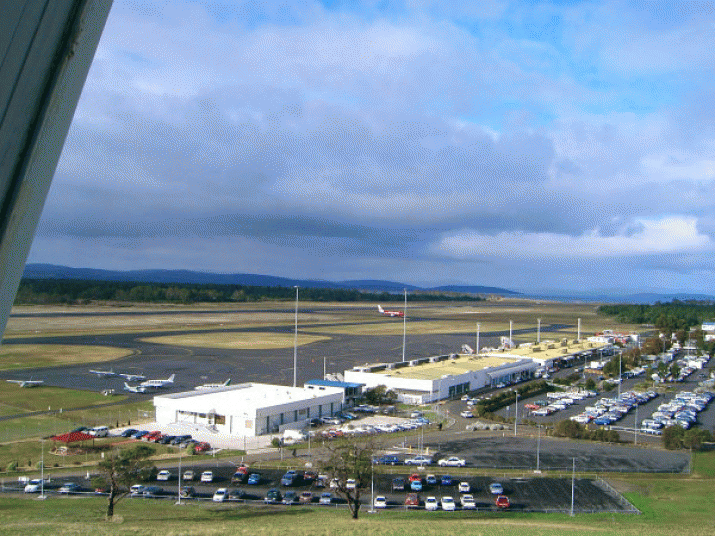
The election ritual certainly reinforces a belief in cargo cultism. On his latest flying visit to Hobart Tony Abbott promised $38 million to help upgrade the Hobart Airport, sold as a much needed upgrade of a public facility, but in reality a bail-out of a badly managed private consortium.
The airport is owned and operated by a Macquarie Bank managed syndicate which acquired it from the State Government in 2008. Any upgrade should have been easy to organise without government assistance were it not for the highly exploitative terms imposed by Macquarie which has seen most of the earnings diverted to financiers and paper shufflers leaving the business without sufficient funds for capital improvements.
Mr Abbott conveniently ignored the larger and more pressing problem of Bass Strait shipping costs and Port of Melbourne charges in his desire to pick up votes in the Hobart based electorate of Denison and Franklin.
Macquarie as a manager of assets is not fussed if the purchase price is too high. In fact it welcomes higher prices as it means higher management fees. The State Government as seller of the airport in 2008 expected to receive between $85 million and $100 million. Adele Ferguson in The Australian on 5th July 2007 suggested a price between $117 million and $140 million was possible. Macquarie paid an unbelievable $352 million. Syndicate partners contributed $200 million in cash and borrowed another $175 million.
Almost all borrowings were hedged via an interest swap agreement. In other words rates were fixed at the prevailing 2008 levels for 15 years. Quite astonishing.
Revenue in 2012 was $31 million and expenses $11 million leaving an EBITDA of $20 million. EBITDA is earnings before tax, interest, depreciation and amortisation and in this case before management fees to Macquarie. In this instance it is essentially the amount of cash generated by the business. Depreciation of $4 million and interest costs of $13 million reduced the profit figure to $3 million. Macquarie then removed 75% of the remaining profits with a management fee of $2.2 million reducing profit to under $1 million. The management fee is based on gross funds under management, a paper shuffling fee rather than a performance fee based on profits.
But there was worse to come.
And to learn what that is, read the rest on John Lawrence’s website, Tasfintalk, here
• Meanwhile, Examiner: Airport’s pot of gold
Sydney Airport has paid no tax in the 10 years since it was privatised by the government.
While other international gateways such as Melbourne and Auckland are also held in private hands and regularly pay corporate tax, the last time Sydney Airport paid tax was before its sale to Macquarie Bank in 2002.
Not only has the company that controls the airport continued to structure its affairs so that it has no tax liability, it has won a tax benefit also.
An examination of Sydney Airport Corporation’s financial accounts since its first full year of privatisation in 2003 shows the airport booked almost $8 billion in revenues during that time and gained tax benefits of almost $400 million. Although its report for June 2006 shows an entry of $425,000 for corporate tax, the picture is clouded by the complexity of the financial statements which includes a tax gain of $137 million in the interim accounts for that year.
In light of the potential sale of Australia Post, Medibank Private and assorted state-owned electricity assets after the election, Sydney Airport’s failure to contribute to the national coffers lends another weapon to the armoury of those who oppose privatisation.
Further, it reflects the profound dilemma aggravating governments around the world; how to compel recalcitrant corporations to pay their fair share. Google Australia for instance is yet to contribute any meaningful corporate tax in this country, despite earning billions.
Google routes its revenues through low-tax jurisdictions such as Ireland. It paid a miserly $74,000 in 2011 on sales estimated in the order of $2 billion.
In its profit results handed down on Thursday, however, Sydney Airport Corporation makes Google look like a half-decent corporate citizen.
Earlier this week, a request to interview Sydney Airport’s chief executive Kerrie Mather was rejected. Ms Mather was not available to answer questions via email either. A spokeswoman for Ms Mather did not deny the proposition that the airport had paid zero tax for the decade.
If it chose, Sydney Airport could pay down its enormous $8.5 billion debt and deliver a bottom line profit. However, it would then be required to pay tax on that profit. Interest is tax deductible. As the airport is a monopoly asset and an essential service with stable revenues – unlike most other companies – it can afford to carry extremely high debt. In the event of a default, the government would be forced to step in anyway and bail out the airport, so the corporate risk poses little danger to air services at Mascot, only to taxpayers.
While Sydney Airport has been no ringing endorsement for the benefits of privatisation it has been a monumental success for bankers and investment bankers.
The Macquarie consortium paid $5.6 billion for the asset in June 2002. The deal was a raging success, returning $2 billion of the original equity put up by the partners in just four years. It has delivered more than $1 billion in fees.
• John Lawrence:
Hobart Airport is but one example of the Macquarie infrastructure model. Sydney Airport however is the piece de resistance.
Sydney Airport’s spare cash, $700 million was the latest annual figure (this compares to Hobart’s $20 million) was similarly diverted to financiers and managers. Were it not privatised in 2002, by now it would have tipped $1 billion into Commonwealth coffers. Michael West in The Age has posted two excellent articles on how the Macquarie privatisation model has worked to shift money to the rent seekers.
The benefits of privatisation were ostensibly to reduce public debt. Instead we have even larger amount of private debt and returns to governments diverted to rent seekers. The practice also highlights the distortion resulting from the preferential taxation treatment given to debt financing vs equity financing. It is difficult to see why, in the case of acquisition of existing assets, this is desirable public policy.
Read the articles here:
http://www.theage.com.au/business/sydney-airport-and-the-magical-mystery-tour-20130823-2sha2.html
http://www.theage.com.au/business/airports-pot-of-gold-20130822-2segw.html