German forest scientist, Professor Andreas Rothe, has injected some much needed rationality and clarity of vision into discussions regarding the future of Tasmanian forestry practices. (The Mercury 20/7 and, TT here)
Professor Rothe points to the folly of insisting on complete cessation of native forest harvesting and thus having a forest industry based exclusively on plantations.
Plantations are essentially monocultures. Plantations have many well documented downsides. Plantations are not able to supply the high quality timber which can be responsibly sourced from, non high conservation value, native forests.
It is possible to manage native forests for timber production in an ecologically sustainable way.
Reducing waste is a key requirement of any reform of the forest industry in Tasmania.
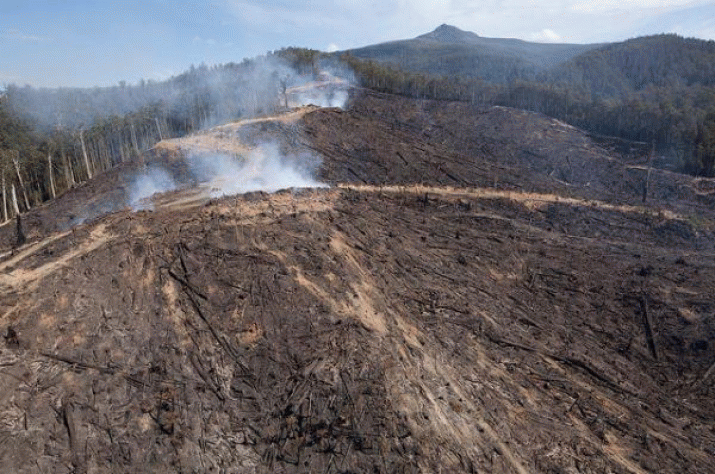
Clearfelling and broadacre burning is inherently wasteful and inappropriate at a time in history when global climate change and natural resource depletion should be amongst our top concerns.
It makes sense to use forest derived, as well as other organic waste, to generate energy in small dispersed power stations so long as the feedstock is obtained from operations which are conducted in an environmentally and socially responsible manner.
The false dichotomy of clearfell or reserve must be abandoned.
Restorative techniques to increase biodiversity in existing plantations are available and must be promoted.
It is possible to have a profitable and ecologically sustainable native forest industry whilst rejoicing our great fortune in having, and protecting, high conservation value forests.
• Bryan Green: Campaign highlights benefits of forest agreement “It’s only the Liberal party and a few environmental fringe groups who are out of step with what most people want.
• Ta Ann’s $10 million loss, here … all predicted early last year by TT’s John Lawrence, A dog: The financial truth about Ta Ann Tasmania, here
• Vica Bayley: Nothing in the forest agreement prevents protest …
Those who believed that the Tasmanian Forest Agreement and legislation threatened free speech may have been scratching their heads last week as the debate raged over protests in the forests and at Ta Ann’s mills.
Far from stifling speech, every perspective on the protests, forest protection, industry, jobs and the forest agreement was heard from a line-up of commentators and participants in a public debate central to the future of Tasmania.
While many voices were critical of the protests, including my own, criticism should not be interpreted as an attempt to control.
Rather, it’s our own expression of free speech, our obligation to put an alternative perspective and our right to ask the question of how these protests fit into a broader plan to protect special parts of Tassie in new national parks and reserves.
Nothing in the forest agreement prevents protest, quashes dissent or prosecutes people.The protests were held, the debate was had and the arrestees will face the courts under the exact same laws as before.
What the forest agreement does do is offer an alternative to protest, conflict and controversy as a way of finally delivering outcomes for the environment, whilst supporting workers and the community.
Protest is an important part of a functioning democracy and peaceful action is a right that I and many others will defend and retain. It has been a defining part of theTasmanian environmental debate and has been used many timesto oppose destructive activitiesand promoteprotection and newreserves. The Franklin, Tarkine road, Farmhouse Creek, Wesley Vale and the Styx, Weld and Upper Florentine are all examples were people have stood up in the face of unwavering hostility from governments, industry and companies to articulate a vision for protection.
But those examples are from a different era, devoid of the opportunities of today.
The forest agreement, while imperfect from many perspectives, is a genuine collaboration that transformed governments, industry and companies who were historically obstructive into supporters of the vision for creating the security of new conservation reserves.
This unlikely collaboration has already helped translate decades of protest, campaign and advocacy into the delivery of World Heritage protection for a further 120,000 hectares of some of Tasmania’s majestic and iconic forests: the Far South, Huon, Styx, the Weld, the Upper Florentine, Upper Derwent and Great Western Tiers.
And the forest agreement can deliver another 400,000 hectares of important forests in areas like the Blue Tier, Tarkine, Reedy Marsh, Tasman Peninsula, Wielangta and Bruny Island … but only if we give it a chance to succeed.The forest agreement offers these same areas legal protection from logging and a pathway to formalise them as new reserves.
These forests deserve protection, not because of the forest agreement, but because of their critical natural and cultural importance. But, for years we have asked, rallied, protested and built a campaign for their protection but with limited, incremental success in achieving the reserves. It is almost a decade since Parliament passed the last incremental additions to reserves and since then the damage has continued.
Finally the collaboration and consensus of the forest agreement has cut through the deadlock of polarised politics, long-held personal views and ideologies.
Yes, the Parliament, including the Upper House, can exercise a power it already had and veto the creation of new forest reserves, but at great risk. The forest agreement offers a mutually dependent solution: one in which a viable forest industry and the jobs that come with it are dependent on the permanent reservation of the agreed forest areas.
As such, it appears the only tangible way of achieving real reserve gains that offer the opportunity to move on.
No-one is going to give up the right to protest. Environmentalists hold onto it in the event that durable reservation of forests is not delivered. Workers hold onto the right to strike and picket if wages and conditions are not met. And communities also retain it, as seen on the streets of Smithton.
However, just because you can protest does not mean that you should. In the face of a fresh paradigm in Tasmania, those who protest should articulate how it fits into a plan to deliver on their goals. For environmentalists, how, under today’s circumstances, does it progress Tasmania towards the long-overdue passage of new national parks and reserves through the Upper House?
It’s a question asked in the spirit of free speech.
• Kim Booth: Committee to shine light on forestry exit grants