DHHS toxicology reports flawed – but how flawed? (Part 2)
Part 2 in the Rosebery series on DHHS toxicology reports. Part 1, here
In April 2010 the Toxic Heavy Metals Taskforce Tasmania conducted a comprehensive review on the reports written by toxicologists Professor Braitberg and Professor Daly on 10 patients from Rosebery diagnosed with heavy metal poisoning by Dr Andreas Ernst. The Taskforce, in collaboration with 8 of the ten patients did a comparison between these reports and the known and available information on 8 patients.
As Part 2 in this series we show some of the flaws in Professor Braitberg and professor Daly’s reports on Patient B based on a comprehensive knowledge at that time of Patient B’s complete medical files and health status..
As was the case with Patient A it is our view that the DHHS must have withheld a considerable volume of medical files for Patient B as Professor Braitberg and Professor Daly were unable to produce a comprehensive medical assessment for each patient.
Below is the Taskforce critique of Professor Braitberg and Professor Daly’s flawed report on Patient B’s health status:
PATIENT B
Professor Daly’s Report:
Page 15 – Incorrectly analysed patient B’s biological data for arsenic and cadmium. “The cadmium elimination was high (1257nmol/L), but this is likely to be secondary to collection artifact.” This figure of 1257 nmol/L is not patient B’s result but is that of another patient. Patient B’s result is 232 nmol/L. The normal reference range in urine for cadmium should be 0-30 nmol/d.
Incorrectly states “A 24-hour urine collection was repeated in January 2009. The urinary arsenic elimination was 0.096 mcmol/mmolCr, which was slightly elevated (reference range 0-0.060 mcmol/mmol Cr). Speciation of urinary arsenic on the same day demonstrated that 98% of the eliminated arsenic was in the form of arsenobetaine, a non- toxic organic arsenic, a non-toxic organic arsenic compound found in seafood and shellfish”. The documents from North West Pathology and Queensland Health Clinical and Statewide Services show that the speciation was not done on the same day. In addition, the speciation results from Queensland Health Clinical and Statewide Services are not consistent with results of tests conducted on urinary samples taken from people who have eaten seafood and shellfish. Further, the reports omitted to mention that arsenobetaine can also be excreted after exposure to inorganic arsenic and arsine gas.
Page 16 – Incorrectly lists medications prescribed by Drs Henshaw and Johnson and being taken by patient B – as only one out of the seven have been taken by patient B for over 18 months.
Page 17 – Refers to a report by Dr Robert Parkes from a consultation with patient B on 20th November 2008. In the Final Report released in April 2009 it states on Page 49, in reference to Dr Parkes report from patient B’s one consultation “however, to date the physician has not released the report to anyone.”. The information provided from Dr Parkes was incomplete, deficient and some additional medical conditions diagnosed by Dr Parkes and previously unknown to that specific patient have never been released to her GP for follow up testing. This information should have been pursued for the purposes of any investigation for a heavy metal diagnosis.
Page 18 – Incorrectly states that for patient B “there is no evidence of anaemia” conflicting with Prof Braitberg on Page 43 where he states “Iron deficiency anaemia – cause needs to be pursued…….Copper is necessary for iron uptake and a copper deficiency can result in iron deficiency. In this case there is iron deficiency in the setting of an excess of copper and normal zinc”.
Professor Braitberg’s Report:
Page 24 – In relation to patient B “Dr Johnson, from the Rosebery Medical Centre lists her medication, as of 29-11-09 as:………,…….,…..,” but patient B has only been taking one out of the seven medications prescribed by Drs Henshaw and Johnson in the past eighteen months.
Also refers to a report by Dr Robert Parkes from a consultation with patient B on 20th November 2008. In the Final Report released in April 2009 it states on Page 49, in reference to Dr Parkes report from patient B’s one consultation “however, to date the physician has not released the report to anyone.”. The information provided from Dr Parkes was incomplete, deficient and some additional medical conditions diagnosed by Dr Parkes and previously unknown to Patient B and never been released to her GP for follow up diagnostic testing and treatment. This information should have been pursued for the purposes of any investigation to ascertain the potential contribution of heavy metal toxicity.
The statement that patient B’s symptoms did not include “anorexia and skin rashes” was also incorrect.
Page 26 – There is no 24 hour urinary cadmium result in the table of urinary test results.
In January 2010 patient B had a Nuclear Medicine Whole Body Scan, Whole Body Bone Density Test, heavy metal and complete work up blood testing, chest, lung and spinal x- rays. The results of these tests were not provided to Profs Daly and Braitberg for assessment.
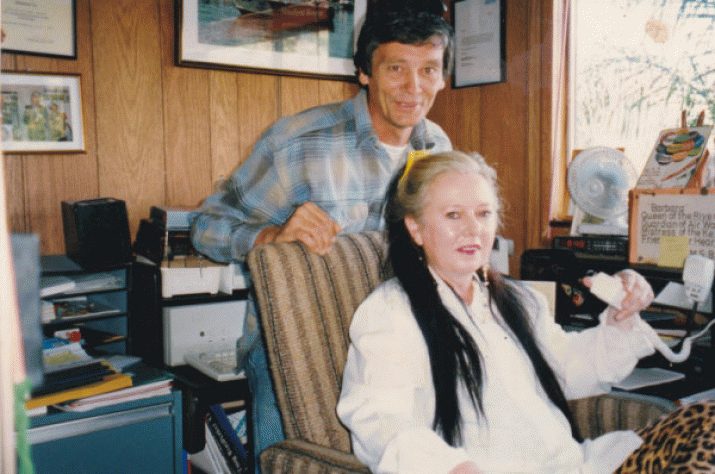
• Pic: The photo was taken at Bar Point Rescue Base in 1996 in radio room. The context is that Roscoe has told Tasmania that I was sick before I moved to Rosebery. So I am supplying pictorial evidence to prove otherwise …
*Roscoe: Roscoe Taylor is Director of Public Health in Tasmania.
• Dr David Obendorf, in Comments: [/b] The surname-less “david” at [comment #5] maybe a public servant or a medical professional, however, I feel that david may not have bothered to understand the toxic history of the Rosebery mining town and its legacy of multiple heavy metal exposure risks. If the DHHS and the EPA had bothered to conduct a thorough environmental and epidemiological survey of the pathways of exposure for the affected residents, Kay Seltitzas and other suffering individuals would not continue to bang the drum and blow the whistle on this bureaucratic obfuscation and self-serving inertia. This is another mendacious performance from a Public Health watchdog and the matter needs to be taken seriously. In addition, the failure of the [b]Tasmanian Greens[/b] MPs (in Government) to support affected Rosebery residents is a disappointment too — David Obendorf, veterinary pathologist