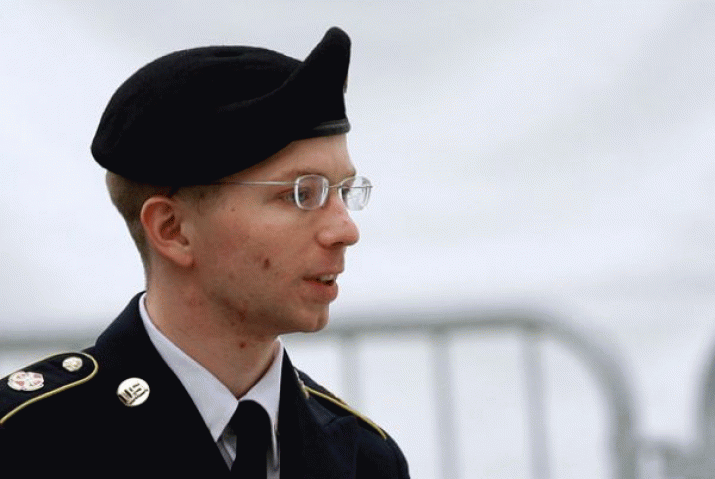
Today begins the court-martial of Private First Class Bradley Manning, Wikileaks’ source inside the US military. Because Manning was arrested over three years ago, the global news media have already written much about the young soldier from Crescent, Oklahoma. And though news accounts have frequently gotten the facts right (he’s 25, was deployed to FOB Hammer in the Mada’in Qada desert of Iraq, is 5 foot 2), most reports have written about the big issues that collide in this case without the slightest sense of context and perspective, leading to all kinds of basic errors and distortions—for instance that the leaks were “top secret”; that Wikileaks is on a “utopian” quest for “total transparency,” that Manning did what he did not for political but for psychological (or sexual!) reasons. As Pfc. Manning’s court-martial proceeds over the next three to four months in Ft. Meade, you can bet that media reports will continue to put across the same funhouse distortions. So to kick off my blog coverage of the court-martial for The Nation, here’s a quick debunking trip through the thickets of folklore that have sprung up around this case.
First, it is routinely asserted or implied that Manning declassified the field reports and diplomatic cables because he is a nut job, or because he is gay, or because he is a gay nut job. In fact, Manning’s motive was expressly political: “I want people to see the truth…regardless of who they are…because without information, you cannot make informed decisions as a public.” People can disagree about the consequences of Manning’s leak, but his motive for declassifying the documents is plainly stated, and it has nothing to do with his mental health or sexuality. As former infantry soldier Ethan McCord (seen through the helicopter gunsight camera in the leaked “Collateral Murder” video rescuing wounded children from a shot-up van) wrote, to fixate on Manning’s sexuality “erases Manning’s political agency.”
Another common smear, Myth #2, is that Bradley Manning and Wikileaks are “utopian,” probably the worst curse word in educated English, carrying as it does connotations of extremism and intolerance wrapped in naïveté, or “idealists,” almost as bad. But is there anything “utopian” about declassifying less than 1 percent of what Washington classifies in a given year (92 million documents at last count)? Manning’s leak, though the largest security breach in US history, has not put us on the precipice towards “total transparency,” a mystical condition which neither Manning nor Wikileaks have ever called for or even mentioned. The young soldier’s act is best seen as a very practical, defensive move against dystopian levels of government secrecy—again, the classified material that Manning leaked is less than 1 percent of the 92 million documents that Washington annually declares a state secret. (According to the feds’ own Information Security Oversight Office, the annual cost of all this classification is about $11 billion.)
A corollary (Myth #3) is that Wikileaks is “anti-American,” perhaps because it palpably disapproves of the US invasion of Iraq—but then this opinion now shared by a supermajority of us Americans. Wikileaks’ mission statement quotes Jefferson and Supreme Court Decisions—an odd kind of anti-Americanism—and its ideology of tech’ed-up classical liberalism comes straight out of Silicon Valley. Digging through Manning’s and Wikileaks’ public (and private) statements reveals no bias against the USA.
Read more: http://www.thenation.com/blog/174622/seven-myths-about-bradley-manning#ixzz2VJ4Tw2il
• Reuters: Reports on surveillance of Americans fuel debate over privacy, security