Friday:
Cradle Mountain Water’s announcement today about high levels of lead found in drinking water in Rosebery is no surprise to the Tasmanian Public and Environmental Health Network.
Spokesperson Isla MacGregor said “Rosebery is now the seventh town in Tasmania with drinking water supplies contaminated with toxic heavy metals. Five of the seven towns have been impacted on by local mines, Whitemark’s and Ringarooma’s water was sourced from areas near where mining has occurred.”
The seven towns with drinking water supplies contaminated with lead are Whitemark, Pioneer, Ringarooma, Avoca, Royal George, Rosebery and Gormanston. Royal George’s water is also contaminated with arsenic and cadmium and Avoca with cadmium also.
These poisoned water results from Rosebery cast serious doubts over the rigour and integrity of the EPA’s 2008-2009 investigation in Rosebery, an investigation which was highly criticised by the Toxic Heavy Metals Taskforce Tasmania.
The Department of Health has allowed public health to be put at risk, by failing to act upon high levels of toxic metals in seven towns’ drinking water supplies. Tasmania must now be viewed as a Third World state with over one third of Tasmanian towns failing to provide raw drinking water that meets Australian Drinking Water Guidelines.
The ABC Radio National Background Briefing program Don’t Drink the Water which went to air in April this year, highlighted the alarming levels of Lead, Cadmium and Arsenic found in drinking water in five towns that the Department of Health and Human Services and Ben Lomond Water Authority did not take timely action on and prevent further harm to the public.

Don’t Drink the Water exposed information that showed the Tasmanian Department of Health for failing to:
• provide safe drinking water to the population who have been put at risks equivalent to those in Third World countries
• comply with national Drinking Water Guidelines
• comply with the deficient Tasmanian Drinking Water Guidelines as adequate risk assessments of raw drinking water sources and water testing was not complied with.
• provide sufficient and up-to-date information to the population of known and unknown risks from chronic and acute exposure to mixtures of heavy metals.
• take timely population sampling and immediate and ongoing protective health measures for those at risk especially to children exposed to metal levels that pose an ‘imminent and substantial danger’ (US Centers for Disease Control).
“Ben Lomond Water has to date still not ascertained where the lead in the water at Ringarooma is coming from. This is not good enough.”
The World Health Organisation (WHO) and the US Centers for Disease Control (USCDC) have said that there is no safe level of lead, and that drinking water should never have more than 10ppb of Lead.
“We want to see full public disclosure by Tasmanian water authorities of all their data, their proposed future monitoring programs and what action they intend to take to provide reticulated safe drinking water.”
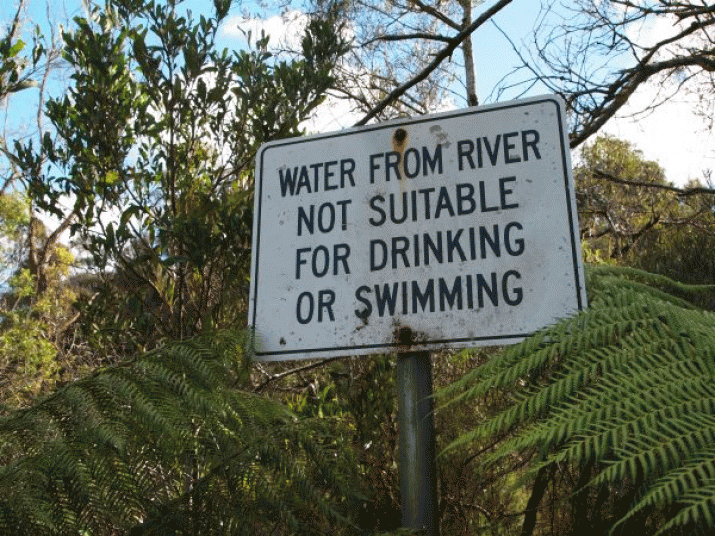
“No mining town in Tasmania treats their drinking water supplies to remove metals. The Rosebery drinking water supply is taken from the Stitt River which is publicly signed on the Murchison Highway as being unfit for drinking.”
“MMG must act to improve this water problem for Rosebery workers and residents. Water supply intakes could easily be relocated to uncontaminated waterways or effective treatment plants installed.”
Prof Mark Edwards*, a leading expert in Lead Contamination in Drinking Water in the US said that drinking water with Lead levels of 40 ppb are an ‘imminent and substantial danger to children’.
The Health Minister, Michelle O’Byrne and the Director of Health Dr Roscoe Taylor have failed in their duty of care to protect the health of Tasmanians especially those living in regional areas.
“TPEHN reiterate their previous call for Premier Lara Giddings to stand down the Minister of Health and Director of Health and Greens Minster for Consumer Protection Nick McKim and to appoint people who really do understand their duty of care and will act accordingly.”
“TPEHN want an independent inquiry established into the state of Tasmania’s unsafe drinking water supplies as a matter of urgency. Clean drinking water needs to be considered a fundamental human right. “. said Isla MacGregor.
ABC:
Safe drinking water is being arranged for a community on Tasmania’s West Coast after lead was found in the local supply.
Routine testing in Primrose Estate at Rosebery has revealed high levels of the metal.
Cradle Mountain Water says residents of about 260 properties in the Primrose Estate and Dalmeny areas should not drink their tap-water, even if they boil it first.
The authority’s Chief Executive Andrew Kneebone says the ban could be in place for several days, while the source of the contamination is identified.
He says the contamination has probably come from piping or fittings, but an investigation is still underway.
“Boiling doesn’t make this water safe to drink, it’s absolutely the lead contamination,” he said.
Mr Kneebone says safe water will be distributed from a station on Dalmeny Street from tomorrow morning.
“To make sure that people aren’t left without drinking water, we’ve set up a supply site from a safe supply that we know doesn’t have this issue.”
Residents affected by the contamination are being letter-boxed this afternoon.
EARLER, on Tasmanian Times
AND, it’s not as if there weren’t a few canaries in the mine …
• Dr Roscoe Taylor must act on Rosebery water filter results
*Pic: The Stitt River – the intake for the Rosebery water supply is upstream of this sign. The intake for the town’s water supply is directly below the main drainage zone for the AMD (acid mine drainage) from the open cut at the mine and the same area that the poisoned Rosebery residents lived – only one person of those who were poisoned in Rosebery remains in the town. Groundwater from this drainage area flows directly into the Stitt River at the town’s water supply intake.
*First published, Friday, May 17
Saturday:
TASMANIAN PUBLIC AND ENVIRONMENTAL HEALTH NETWORK
MEDIA RELEASE
18th MAY 2013
ROSEBERY WATER WARNING IGNORED
WATER FILTER RESULTS SHOW LEAD FROM OTHER AREA
The Tasmanian Public and Environmental Health Network are calling on the Premier Lara Giddings to urgently conduct a proper investigation into the raw drinking water supply in Rosebery.
Last year on 5th April 2012 the Toxics Heavy Metals Taskforce Tasmania sent results from Sydney Analytical Laboratory to Director of Health Dr Roscoe Taylor for tests on a kitchen bench top water filter system from a home in Rosebery. The Taskforce asked Dr Taylor to immediately conduct the necessary investigations into the presence of metals in the Rosebery drinking water supply.
The water filter was taken from a home not in the Dalmeny and Primrose areas where the recent lead levels have been found in drinking water. The Portable Counter Top System water filter usually functional for one year became totally clogged after only eight months in use.
Isla MacGregor said “Dr Roscoe Taylor took no action on the Taskforce’s request to do follow up investigations on these water filter results from Sydney Analytical Laboratories”.
“The results from NATA accredited Sydney Analytical Laboratories showed some high levels of metals in the water filter including lead, copper, zinc and manganese.”
Cradle Mountain Water’s own website states:
Rosebery Water Treatment Plant Upgrade
Background
Currently Rosebery water supply doesn’t meet Australian Drinking Water Guidelines. There is no treatment plant in Rosebery and is subject to high levels of tannin causing the water to appear dirty. The water is pumped directly from the Stitt River or gravity fed from Mountain Creek subject to adequate flows. Two dosage stations provide disinfection to remove bacteria. Cradle Mountain Water is proceeding with a project to supply Rosebery residents with water that meets Australian Drinking Water Guidelines.
“The Stitt River is known to be impacted by groundwater from Acid Mine Drainage (AMD) which is contaminated with toxic metals in addition to leachate from the water treatment ponds which were formerly tailings dams.”
“Last year the Toxic Heavy Metals Taskforce Tasmania also sent the laboratory results to Cradle Mountain Water and requested that they provide all households in Rosebery with a Domestic Reverse Osmosis water filtration system as these are the only filtration systems that can remove both soluble and insoluble metals from the drinking water in Rosebery.”
“Again no reply was received from Cradle Mountain Water. It is inexcusable that Cradle Mountain Water has taken so long to determine that lead is in the drinking water supplies in Rosebery.”
“It is totally unacceptable that Dr Roscoe Taylor has failed to protect public health and ensure the provision of safe drinking water in Rosebery and the other 6 towns in Tasmania now known to be contaminated with lead, arsenic or cadmium. The Premier Lara Giddings should stand Dr Roscoe Taylor down from his position as Chief Public Health Officer of Tasmania.” said Isla MacGregor
Download: Sydney Analytical Laboratory Rosebery Water filter heavy metals test results:
Sydney_An._Lab__._Rosebery_Water_filter_heavy_metals_test_results___.doc

Acid Mine Drainage seepage on Murchison Street adjoining house that had over 4,590 mg/kg lead in front yard, says Isla MacGregor


The Stitt River flows into the Pieman River on the southern edge of the Tarkine – another river fast becoming another Queen and King River as a result of acid mine drainage from the Mt Lyell mine, says Isla MacGregor

Queen River Queenstown – the effects of Acid Mine Drainage from Mt Lyell mine will quite possibly last for thousands of years, says Isla MacGregor

MMG’s Avebury mine operations south west of Zeehan were suspended in 2011 because arsenic levels in the ore exceeded international shipping guidelines. MMG CEO Andrew Michelmore said “When we produce a 20-plus per cent nickel concentrate, we end up with over 2000 parts per million arsenic and the permit for shipping is 2000 parts per million,” he said. The Avebury operations are closer than 100m to a waterway as this photo shows.

Behind Gormanston – lead in drinking water here also – other metals not mentioned.

For Sale at Gormanston – property overlooking the Linda Valley to Lake Burbury. Property formerly owned by the Oates family whose children were poisoned with lead. The DHHS relocated the family out of the west coast. West Coast Council have refused to provide Information Notes about reducing health risks from exposure to heavy metals with Cert 337 in conveyancing for contaminated properties on the west coast. This property has been for sale for several years. Many properties that West Coast Council have resumed for non payment of rates have been put up for sale. Beware that unsuspecting mainland buyer! What happened in Rosebery over again, says Isla MacGregor

Zeehan smelter waste – ongoing legacy for our wildlife