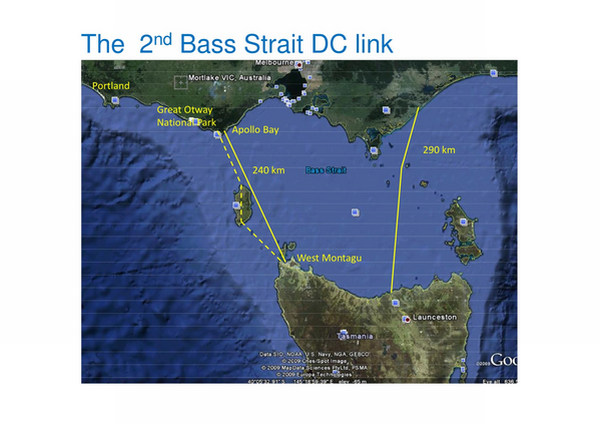
Tasmanian Times scooped today’s announcement of the mega King Island wind prospect by some two years when it published an as yet unpublished map of a proposed route for Basslink Mark 2 that would either pass close by King Island or, alternatively, would use the island as a hopping point on it’s intended link to Victoria and incorporating King Island’s significant wind power potential in the bargain. Basslink No. 2, here
Supplying power to the Bass Strait islands has been hugely problematic for decades. In 2010 I visited Flinders Island to advise the local government there on energy saving options and it was a real eye opener to see the generator system that at the time was gobbling through 2 million litres of diesel annually … and that was with an adjunct wind generator helping out.
To the west, wind power enthusiasts and university and Hydro personnel had been experimenting with a number of unique technologies on King Island and one thing they all would have witnessed was the consistency of wind that at times almost blew their faces off.
This is where opportune price comes in because until recently wind power was significantly more expensive than most grid power, but when you are competing with diesel prices, wind is dirt cheap. More recently wind power prices have dropped, we have a carbon market and a mandated renewable energy target and so King Island’s wind potential has come into its own as a much larger viable prospect.
Tasmanian Times scooped today’s announcement of the mega King Island wind prospect by some two years when it published an as yet unpublished map of a proposed route for Basslink Mark 2 that would either pass close by King Island or, alternatively, would use the island as a hopping point on its intended link to Victoria and incorporating King Island’s significant wind power potential in the bargain.
Like nearly everyone, I am not privy to Hydro Tasmania’s detailed planning on this but am aware that Hydro and Transend between them have been quite miffed at the way the privately owned Basslink cable has lumped Tasmania with an annual outlay of some $90 million annually and so there has been a background understanding that any second Basslink cable system would be financed and owned ‘internally’. As to whether there is a venture partner that would be engaged to develop the proposed wind farm, I expect the answer to that is yes and it could be Samsung corporation.
Some may question why the proposed King Island wind venture would be linked by cable to Victoria rather than to Tasmania. Well that’s simply comes down to three factors:
1. King Island is closer to the mainland than to Tasmania.
2. More importantly, a power supply of that size would be too big to link to the Tasmanian system without causing instability problems.
3. Then there’s the issue that the Victorian Ballieu government has successfully stymied wind power developments in Victoria by imposing layers of planning restrictions on them, so Hydro Tasmania has an opportunity to use that for its own commercial advantage.
Some concerned people will question why the Wind venture would not be linked both ways – to both Victoria and Tasmania – at the outset, thus giving greater flexibility to the market and also an additional route for export of Tasmanian power to Victoria. That’s a legitimate question, and I think it comes down to limiting the capital cost in the first instance and taking advantage of the most opportune market, and it’s patently clear that a link to the Victorian grid would do that .
In the event that a major power consumer did happen to close up in Tasmania it is deemed that there needs to be provision in place for another wire across the Strait to the mainland (Hydro Tas has been making contingency plans for such an eventuality) and this venture goes part of the way to enabling that to happen at fairly short notice by bridging the gap, wherupon Tasmania would become a major power exporter.
An eventual Basslink Mark 2 has always been on the cards, but with Basslink Mark 1 having been such a mixed blessing for Tasmanian power utilities the state decision makers have not wanted to create another financial millstone around Tasmanian power consumers necks. In that context the King Island venture would have to stand on its own two feet economically and those who have designed this proposal would have had to crunch the numbers pretty carefully.
Well, I’ll stop right there on that front because there is every reason for the public to be very cynical about such matters.
On the climate front, coal fired power generation is on a decline in Australia as wind power goes head-to-head with the development of gas fired generators for market share. Both have been growing at a furious rate, but in that head-to-head battle gas has been outstripping wind power quite handsomely to date owing to low set-up cost. Like hydro-electricity, nearly all of the costs of wind power developments are up front at the building stage, so it all comes down to finding a capital venture partner that is in for the long haul. I somehow doubt that Hydro Tas has the liquidity to do it on its own, like it used to in its dam building days.
There are some good questions that need to be asked about all this, so that the public feels confident rather than nervous about another white elephant being developed. On the bright side isn’t a 600 MW renewable energy wind farm a so much better development goal than was a pulpmill in the Tamar!
• Earlier today on Tasmanian Times: Wind farm project for King Island
• What the Premier and her Deputy say …
Lara Giddings
Premier
Bryan Green
Deputy Premier
Wednesday 28th Nov 2012
Plans for biggest wind farm in Southern Hemisphere unveiled
Plans have been unveiled to build the biggest wind farm in the southern hemisphere on King Island with a $2 billion project estimated to create up to 500 construction jobs.
The Premier, Lara Giddings, today announced investigations were underway to build a 200-turbine wind farm and sell the power into the Victorian electricity grid via an underwater cable across Bass Strait.
Importantly, it would also be the first step towards securing a second Basslink cable between Victoria and the Tasmanian mainland.
Ms Giddings said the Government supported the TasWind concept developed by Hydro Tasmania and looked forward to the project proceeding to the full feasibility stage.
“We are looking at the biggest single infrastructure project in Tasmania’s history,” Ms Giddings said. “The project would also provide hundreds of millions of dollars a year in extra revenue to the State.
“It is still in the early stages but this is exactly the kind of forward thinking that will deliver the new jobs and opportunities we are striving for.
“This is an extremely exciting proposal that would not only transform King Island but provide enormous benefits to our economy.
“The project is likely to require significant upgrading of King Island’s road and port infrastructure which will create more jobs and be the catalyst for growth of existing and new industries.
“It would also be a key step towards the State Government’s long term strategic goal to build a second Basslink electricity cable, linking King Island to both Victoria and the Tasmanian mainland.”
Mr Green said the wind farm could generate enough energy to power 240,000 homes and provide an estimated $220 million a year in revenue to the State.
“Hydro Tasmania has the runs on the board with the development of wind farms in the far North West and the $400 million Musselroe project currently under construction in the North-East,” Mr Green said.
“The work Hydro has done so far indicates TasWind is broadly feasible from a technical, economic and environmental perspective.”
He said the project is a great opportunity to further develop Tasmania’s world-class wind resource and entrench our standing as the nation’s renewable energy powerhouse. “The next important step is to seek the views of the King Island community because its support is crucial to the project proceeding.
“A project of this size will have considerable benefits for the island in terms of jobs and infrastructure development and we want to ensure the community is fully informed.
Community forums will begin next month and run till February.
Mr Green said a decision on whether to proceed to the full feasibility stage would be made by April next year.
• What Cassy O’Connor says …
Cassy O’Connor
Minister for Climate Change
Wednesday 28th Nov 2012
King Island Announcement Welcomed
The Minister for Climate Change, Cassy O’Connor welcomed the announcement today of the proposal for a $2 billion wind farm investment for King Island as a project with exciting potential.
“This project would have a fantastic climate change outcome, through significant reduction of greenhouse emissions by investing in renewable energy,” she said.
“If approved, the proposal, involving construction of a 600 megawatt wind farm consisting of around 200 turbines will be transmitted into the National Electricity Market via a high-voltage direct current underwater cable across Bass Strait, with a landing point in Victoria, which will directly offset coal-power electricity supplies that are the current modus operandi on the mainland.”
The Chair of the Tasmanian Climate Action Council, Professor Lesley Hughes, said the development is “an extremely exciting and timely development and shows that Tasmania can lead the way in renewable energy.”
“A report released by the Climate Commission just this week concludes Australia has huge potential for renewable energy, but that this is so far under-utilised,” she said.
“The Tasmanian Government’s announcement of the TasWind project today is a huge step in the right direction.”
Professor Hughes is also a member of Australia’s Climate Commission. The report can be found at http://climatecommission.gov.au/report/the-critical-decade-generating-renewable-australia/
• Peter Whish-Wilson: Wind Farm Points the Way to Jobs for the Future
The Australian Greens have cautiously welcomed Hydro Tasmania’s announcement it plans to build a 200 turbine wind farm on King Island off the North West Coast of Tasmania.
Greens Leader Christine Milne said, “Tasmania has such a bright future if we embrace the clean, smart, jobs-rich industries like renewable energy that the Greens have been working to support.
“It’s remarkable to recall that, when I attended the opening of Tasmania’s first wind farm, on King Island back in the 1990s, the then Opposition Leader Jim Bacon refused to attend.
“This project shows that the Clean Energy package, delivered and driven by the Greens, is how we can create great jobs for Tasmanians while caring for our environment.”
Senator Peter Whish-Wilson stated the development was an example of the positive structural economic change that the Greens have driven in Tasmania and Australia.
“The leadership and vision of the Greens in parliament has delivered a price on carbon pollution, which is the incentive driving these types of positive job creation investments in clean energy.
“It is also what is delivering Hydro Tasmania hundreds of millions of dollars in profit windfalls for all Tasmanians, paying for hospitals and schools.
“I’m waiting to see all of the detail around this proposal, and the local communities’ feedback on it, but generally speaking it’s the type of investment Tasmania needs.
“In particular I would like to see an analysis of the merits of “closing the loop”, by connecting the project to the Tasmanian grid, as well as to the Victorian electricity grid.
“King Island has really suffered from the tyranny of distance of late with the closure of its local abattoir in September due to rising transport costs.
“Now the Island stands to benefit from that same location, due its unique natural advantage in Australia’s clean energy future.”
THE world is on the cusp of a “tipping point” into dangerous climate change, according to new data gathered by scientists measuring methane leaking from the Arctic permafrost and a report presented to the United Nations on Tuesday.
“The permafrost carbon feedback is irreversible on human time scales,” says the report, Policy Implications of Warming Permafrost. “Overall, these observations indicate that large-scale thawing of permafrost may already have started.”
While countries the size of Australia tally up their greenhouse emissions in hundreds of millions of tonnes, the Arctic’s stores are measured in tens of billions.
Read more: http://www.theage.com.au/environment/climate-change/where-even-the-earth-is-melting-20121127-2a5tp.html#ixzz2DSbZDCrJ