Graphic: Tamar Devil
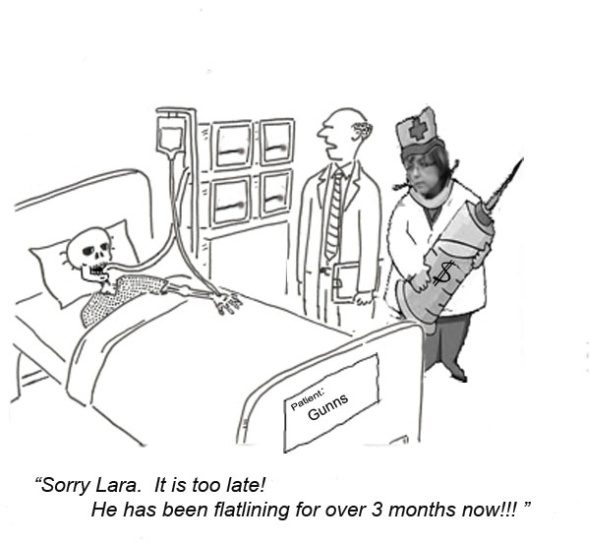
The AFR this morning reported in its ‘Street Talk’ section on speculation that hedge fund vultures are circling Gunns with a view to purchasing Gunns’ debt from the banking syndicate led by ANZ should the banks decide to offload the distressed debt, rather than wait for Gunns to default and have to sort out the mess that will ensue.
This will mean that Gunns will still owe $500 million+ but they will owe it to the hedgies rather than the banks.
If and when loans are repaid, the hedge funds will make a profit, how much depending on the size of the discount the banks are willing to wear to rid themselves of their ongoing nightmare and the imbroglio that will follow should Gunns fail to repay loans by Christmas.
If the loans aren’t repaid then the hedge funds will be in a position to dictate subsequent restructure/liquidation moves.
• Last week on Tasmanian Times: Flatlining Gunns now faces $64m tax bill
• See the flatline: Gunns Ltd Share Price here
• The finance expert view: John Lawrence here
• SALE OF PORTLAND WOODCHIP EXPORT FACILITY
Please refer to link below for the full announcement:
http://www.gunns.com.au/Content/uploads/documents/ASX%20RELEASE%20-%202012%2007%2016%20-%20Sale%20of%20Portland%20Woodchip%20Export%20Facility.pdf
First published: 2012-07-16 04:55 AM
• Mike King, The Motley Fool, 9 News Finance: Woodchips for shares?
Gunns Limited’s (ASX: GNS) share price is down 79%, but has been in a trading halt in March 2012, and there are doubts whether it will ever trade again. The forestry and timber company has also felt the effects of too much debt. (Now you know why I avoid companies with loads of debt). Like BlueScope, Gunns has also had to compete with cheap imports, which slashed the company’s margins. Add in the high Australian dollar, plans to build an expensive pulp mill in Tasmania, opposed by many and the current business appears unsustainable.
Four train-wreck stocks you’re glad you didn’t own

• Gunns sells off its interest in Portland port: What Robert Eastment (above) says …
By Libby Price (ABC Country Hour Victoria)
Tuesday, 17/07/2012
Tasmanian timber company Gunns continues to rationalise its business, with the sale of its woodchip export operations at the Port of Portland in Victoria for almost $62 million.
The facility been bought by Australian Bluegum Plantations, which owns several former managed investment scheme plantations in the Green Triangle Region of south-west Victoria.
Pulp and paper industry analyst Robert Eastment says Gunns is selling assets so it can fund a $400 million pulp mill in northern Tasmania.
“Gunns have said for quite a few months now that they are unequivocally out of woodchips, full stop, regardless of whether it’s native forests or whether it’s plantations,” he said.
“They built that port, they don’t need it any more, they’re out of it, it’s just one more stepping stone towards divestment.”
TRANSCRIPT
Introduction: Australia’s floundering timber industry continues to undergo major restructuring. With the latest being the sale of Tasmanian timber company – Gunns – of its woodchip facility at the port of Portland in Victoria for almost $62 million. The facility has been bought by Australian Bluegum Plantations that company owns several of the former Managed Investment Scheme plantation estates in that Green Triangle region of south-west Victoria and south-east South Australia. Robert Eastment is a Pulp & Paper Industry Analyst with the company Industry Edge.
Robert Eastment: It is very significant to the area of plantations that have been developed in behind the port… in the Green Triangle area. There was a lot of MIS companies mainly Timbercorp, Great Southern and others and without that port at Portland all those trees essentially have got nowhere go; no, no destination. So it’s extremely relevant for the plantations in that area.
Interviewer (Libby Price): We’ll talk about Great Southern and Timbercorp in a moment. First though let’s look at Gunns. This really is the latest in divestment of assets to find funding to build the controversial pulp mill in Tasmania?
Eastment: Ah…(pause) Yes, it is. Gunns have said for quite a few months now are unequivocally out of woodchips. Full stop.Regardless whether its native forests, or whether its plantations.Ahh… Gunns took on what we would refer to as the ’responsible entity’; and they were sort of the forest managers of the Great southern estates in that region, of the Green triangle. And they built that port to, to simple shift that wood; that they were going to cut on the Great Southern Green triangle plantations. Look, they don’t need it anymore, they’re out of it, ahhm… It’s just one more stepping stone towards divestment.
Interviewer: So, it was an obvious move, what about the buyer?How stable is the buyer?
Eastment: Ahhm…(pause)… very. It’s good. The…Australian BluegumPlantations, that is essentially a company that was brought in to buy out the Timbercorp estate. And unlike Great Southern which separated the land and the trees and a whole lot of issues. With Timbercorp, what they did is they sold everything – holus bolus – so the buyers, Australian Bluegum Plantations, they ahm… yeah, they actually own everything. And for them having the port, it certainly makes sense and ahh…(pause). Look honestly there was no surprise to the market; everybody thought they would be, definitely, the main bidder.
Interviewer: And a good price?
Eastment: Ahhh…(pause)… Look (laughs), it depends who the buyer and seller is, doesn’t it? If you… Gunns built that port for about $25 million… ahhm, and they’re selling it for about 6o [million]. So I guess you might say, ‘Well they’ve made a lot of money’. But they had to go through a lot of grief in the process; a lot of work, a lot of planning, everything else. It is an operating port; it’s the only one in that region that’s going to come up for sale. So, $60 million, I would say it was a fair price for both sides.
Interviewer: Generally are we likely to see any more rationalisation in the industry?
(Pause)
Eastment: I think there’s still a bit to go. Yes… I think there’s a little bit; there’s still some companies to ahh… to, I say to, to become ‘come clean’. We know there are FEA estates that are essentially in Tasmania, and in northern NSW, that are still in a mix of receivership and administration and stuff. And ahh… we know that the ITC…, or ITC-Elders estate is up for sale as well. So, I think there some… more to go, I suppose; some more cleaning out, more changes… that will occur.
Interviewer: So, you’ve already mention Great Southern and Timbercorp, ahhm… where are they both at? Are we ever going to see them again, or are they gone?
(Pause)
Eastment: No, they’ve… those entities as we knew them have ahh…gone now. They’ve gone. I think what we will see, going into the future is that the residual plantations – if I can put it that way – will continue to be harvested, I suppose. Ahhm… the ones which are viable…ahhm are likely to be replanted, I suppose. But, the ones which are further away from ports; the ones which were essentially put on land which was never really going to work anyway. Those ones might be burnt; or they might be harvested; they might be used for carbon, or pellets, or they might possibly for woodchips. But they will never go back into ahhm… ahh..into (pause) plantations, I wouldn’t imagine, for a second or third rotation. So…
Interviewer: So do you think a lot of that land will be sold again, as farming land again?
Eastment: Well, that’s a very interesting point … because you see the farmers would have sold that land thinking ‘Yippee, we’re out of here now’, because there was… quite a bit was marginal land or there was difficulties with it. So the farmers have basically gone up to the Gold Coast… sitting up here, thinking it’s the best thing that has happened to them. So, who’s going o buy that land back? It won’t be the farmers who originally sold it. Also when the plantation companies bought that land… ahhm..you know, a lot of it would have been reasonable, arable land, I suppose – of some form. Now, once they harvested that, it’s going o be full of stumps. So you won’t be able to turn it back into the productive… or even the marginal farming land that it was, for a few years. Until you’ve got rid of those stumps and such like. So it’s not just a question of say, ‘Oh well, we’ve got into farming into plantations, let’s just put it back into farming’. We know, from history, you know, from the old land clearers – the settlers – you know, it takes quite a bit of land and effort to, to, to re…change the land back from forestry back to an arable or pastoral process.
Interviewer: So it might just sit there for a long time?
Eastment: Well you’ve got to find some who gunna buy it too. Now also when those plantations were bought out – from the farmers – they were able to buy it in fairly big swags of land. But of course now when you harvest them, putting them back; the areas that will be harvested would probably be smaller. So there will be… bemore patchy… more, more sort like a quilt type approach. A bit here a bit there… mosaic is probably a better word. So the companies will probably have to build up large parcels of land and hold them for a few years before they can put them on the market. So it’s not… it won’t be a straight forward run for the companies… no.
Interviewer: Now, we’ve been looking at the blue gum and pine plantations. What about the almond plantations… what’s happened there?
Eastment: Look, I’m not an expert on almonds at all. Ahhh… or sort of walnuts, or any of those other {MIS] ones. I think they’re all… ahhm… How can I put it nicely? Ahh..the market got a bit enthusiastic I think in the early days. And it probably hasn’t turned out how companies… how everyone expected.
Interviewer: It’s a salutary lesson though,as to what happens in a market once you get substantial tax exemptions?
Eastment: Ahhh…. Look, I think you can date them back to about the late 1700s, I think (chuckles). One never learns, do they? They come around again in the 1800s and you think, you know ‘that’ll never happen again’ and it does. And as sure as I and your listeners are sitting here today, it’s going to happen again in a few years on something else. So, it is a lesson, but ahh… at least one only has to shake one’s head and think… think:’Wow, how did that happen?’.
Interviewer: But what about the people who invested? I guess a lot of them are wondering where their money is?
Eastment: Well look… many of them will get some money back. It probably won’t be as much as they were anticipating. Ahhm… honestly a lot of those issues are before the courts, I think… in various types. Ahhhmm… also..yeah, I, I certainly feel very sorry for them because a lot of them were sort of steam-rolled into them, I think. But… having said that, a lot of them will get some money back, in time. But it’s just not what they… not, not what… the level of expectations that they were originally hoping for.
Interviewer: And carbon trading doesn’t help?
Eastment: (pause) Arrrh… I think it’s too early days yet! I think carbon trading is ahhm…(pause) you know, while Australia has certainly signed up to a number of international treaties. We must remember too that it’s a federal government that signed the international treaties; not the individual companies or anything like that so… I’ve seen a couple of instances where companies have said or inferred that they’ll go off and do some trading somewhere or other… overseas or something. But at the end of the day, of course, it’s a federal government who signed those treaties and therefore they are the ones who have the right to go off and do the trade.
Interviewer: So what’s the future of plantation timber, will it be with the more niche market – the superior timber woods?
Eastment: No…. I don’t think it will be at all. I think there will be a few little sawn-timber plantations. But most of those will be in northern NSW or southern Queensland, possible a few up in the tropics. But I think the area we were talking about; which was down in Victoria and South Australia [the Green Triangle] also in Tasmania of course, and in WA, that’sahh… at the end of the day, that’s all woodchip.
Interviewer: And woodchip, you’d think there would be some sort of market or it, but at low prices?
Eastment: Yes, it is. Ahh.We certainly have some state governments saying, ‘it’s the nd of the world, there’s no market, we’ve got to close it all down’. That is not right. That’s simply wrong, that’s political spin. Ahhm, there are markets out there, we know….with woodchips themselves. Actually it’s tough… look it’s very hard indeed for the harvesters, and the managers and companies. There’s certainly markets there, but as you said correctly, they are at a low price especially into the China, Taiwan, Korea [markets] which will be at a lower price than what Japan are paying.
Interviewer (Libby Price): Pulp and Paper Analyst Robert Eastment. I thought he was very interesting.
Transcript of ABC Country Hour Victoria interview: here